Wholesale Real Estate · ForeclosuresDaily.com
Navigating the Boynton Beach Real Estate Market
Boynton Beach has the kind of real estate mix that attracts both everyday homebuyers and value-focused investors: coastal appeal, established neighborhoods, condo communities, single-family homes, and pockets where older properties may need updates. For anyone exploring wholesale real estate, FSBO opportunities, or a Private house sale, the goal is not simply to find a low price; it is to understand seller motivation, repair risk, after-repair value, and exit strategy before moving forward. This guide breaks down how to approach the Boynton Beach market with practical discipline, especially if you are looking for wholesale property deals or a Cheap house for sale without overpaying for hidden problems.

“Listed and sold 25 properties and personally bought and sold four fix-and-flip properties, all generated from probate leads.”
Carolynn CastilloWatch video →Webinar press release →
What should investors know about the Boynton Beach market?
Investors should know that Boynton Beach is a mature Palm Beach County market with both lifestyle demand and neighborhood-by-neighborhood variation. The city sits in Palm Beach County in southeast Florida, and city materials describe it as a coastal community with Intracoastal access; Census QuickFacts estimated Boynton Beach at 83,095 residents as of July 1, 2024, with an owner-occupied housing unit rate of 64.7% for 2020–2024. That combination matters because a market with many owner-occupants can generate a different deal flow than a heavily renter-driven area: more inherited homes, long-held properties, relocation sales, deferred-maintenance situations, and equity-rich owners who may prefer a simple sale over a traditional listing.
For real estate investing, Boynton Beach should not be treated as one uniform area. Coastal-adjacent homes, active adult communities, townhome pockets, condo buildings, and inland single-family subdivisions can behave very differently. A property that looks like a bargain in one zip code may be overpriced in another if HOA restrictions, insurance costs, flood considerations, renovation limits, or buyer demand reduce the resale upside.
That is why successful investors often begin with submarket research instead of chasing the first “discounted” lead. A strong deal is built on the spread between the acquisition cost, repairs, carrying costs, transaction costs, and the realistic resale or rental value. If the numbers only work under perfect conditions, the opportunity may not be as strong as it looks.
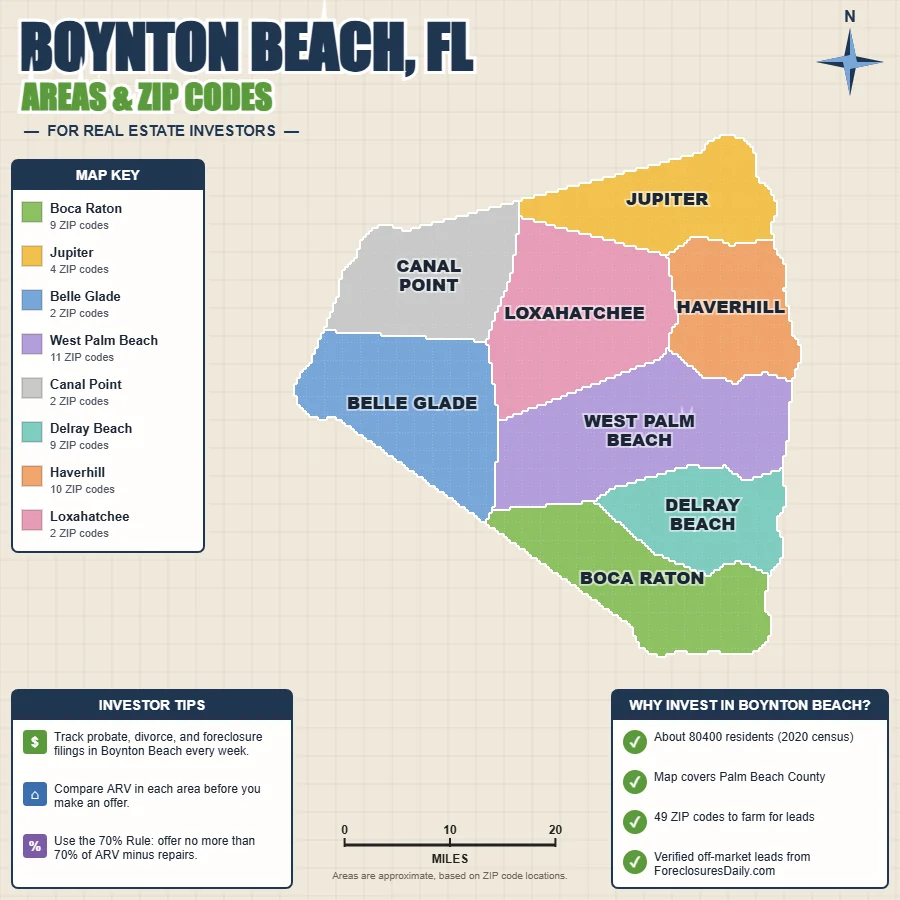
Local market snapshot: Boynton Beach
Boynton Beach is home to about 80400 residents as of the 2020 census. Its ZIP codes cover neighborhoods across the city, and motivated-seller situations such as inherited homes, tired rentals, and pre-foreclosures show up in every one of them.
In a smaller market like Boynton Beach, fewer investors compete for each deal, so a consistent follow-up system can make a big difference.
Wholesale Real Estate Boynton Beach, Florida starts with motivated situations
Wholesale Real Estate Boynton Beach, Florida is usually driven by a simple idea: find a property that can be contracted at a price attractive enough for another buyer, often a rehabber, landlord, or investor, to step in and still have room for profit. In practice, that means wholesalers must understand both the seller’s needs and the end buyer’s required margins. A seller may want speed, privacy, fewer repairs, or certainty; an investor-buyer wants numbers that make sense after every cost is accounted for.
The best wholesale real estate opportunities are often not obvious from public listings. They may come from off-market conversations, referrals, direct mail, public records research, networking, or platforms that help identify distressed or under-marketed properties. Tools such as the ForeclosuresDaily off-market Platform can be part of a broader sourcing strategy, but no platform replaces due diligence. Every lead still needs verification, property condition review, title awareness, and a realistic estimate of demand from cash buyers.
Real estate wholesale also requires professionalism. You are not just “flipping paper”; you are solving a transaction problem. Sellers should understand what they are signing, buyers should understand the assignment or closing structure, and everyone should be clear on timelines. Because rules around wholesaling, disclosures, marketing contracts, and licensing can vary and change, investors should consult qualified local professionals before relying on a specific transaction model.

Full-time real estate investor since 2003, with over 20 years of experience.
Phillip WarrickWatch video →Webinar press release →
The main deal sources in Boynton Beach
Good deals rarely come from one channel alone. A balanced approach gives you more chances to find motivated sellers while reducing dependence on crowded listing sites.
Common sources include:
- FSBO properties: A for-sale-by-owner seller may want to avoid listing delays, agent commissions, open houses, or repeated showings. Some FSBO sellers are flexible, while others price too high because they are emotionally attached or relying on outdated comps.
- Private house sale opportunities: A Private house sale can work well when the owner values discretion. This may involve a landlord exiting a rental, a family handling an inherited home, or an owner who does not want the property widely marketed.
- Inheritance situations: Inheritance can create a genuine need for simplicity. Heirs may live out of state, disagree about what to do, or lack the time and funds to repair and list the home.
- Pre-probate leads: Pre-probate research requires sensitivity and care. Families may be grieving, and the best approach is respectful, helpful, and never aggressive.
- Divorce-related sales: Divorce can create urgency, but it also adds legal and emotional complexity. Both parties must have proper authority and a clear agreement before a sale can proceed.
- Distressed or deferred-maintenance homes: Some owners would rather accept a lower as-is offer than manage contractors, inspections, permits, and buyer-requested repairs.
- Landlord fatigue: Owners with older rentals, difficult tenants, rising expenses, or upcoming capital improvements may be open to a clean exit.
These sources can produce wholesale property deals, but motivation alone does not guarantee a discount. The property still has to be evaluated against real repair costs, local buyer appetite, and a defensible resale price.
Watch Joe Creasy share their experience using ForeclosuresDaily.com.
Joe CreasyWatch video →
Zip codes shape buyer demand and deal strategy
The primary zip codes for wholesale real estate and housing markets in Boynton Beach, Florida include 33435, 33436, 33426, 33437, 33472, and 33473. These zip codes are useful starting points for research because they help investors organize comps, buyer preferences, property types, and pricing expectations. However, zip codes are broad. A canal-front home, a condo with rental restrictions, and an older inland single-family property can all tell very different investment stories even when they share a Boynton Beach address.
For wholesale real estate research in Boynton Beach, break each zip code into smaller, practical categories. Look at the age of homes, HOA presence, lot sizes, proximity to schools, access to major roads, renovation style, and whether buyers in that pocket prefer turnkey homes or value-add projects. A cheap acquisition in a restricted community may be less attractive if rental limits, approval rules, or high monthly dues narrow your pool of potential buyers.
A simple zip-code review should include:
- Recent comparable sales: Focus on sold properties, not just active asking prices. Active listings show ambition; closed sales show what buyers actually paid.
- Property type: Compare single-family homes to single-family homes, condos to condos, and townhomes to townhomes. Mixing them can distort value.
- Condition level: A fully renovated comp should not be used casually to justify the value of a home needing major updates.
- Community restrictions, such as HOA rules, age-restricted communities, rental limits, and approval requirements, can affect exit options.
- Buyer depth: A deal is safer when multiple buyers would reasonably want it, not just one highly specific buyer.
Why do ARV Margins matter so much?
ARV Margins matter because the after-repair value is the number that supports the entire investment plan. If the ARV is inflated, every other calculation becomes misleading: the buyer may overpay, the rehab budget may seem safer than it is, and the expected profit can disappear once real-world costs come in. In a market like Boynton Beach, where property type and location can quickly shift values, conservative ARV analysis is one of the best protections against a bad deal.
ARV stands for after-repair value, or what a property could reasonably sell for after appropriate improvements. The word “reasonably” is important. A strong ARV is not based on the highest sale in the area unless that sale is truly comparable in size, layout, condition, location, community rules, and timing.
When estimating ARV Margins, investors should account for:
- Purchase price and assignment fee, if applicable
- Renovation scope, including materials, labor, permits, and contingency
- Closing costs on purchase and resale
- Holding costs such as taxes, insurance, utilities, HOA dues, and loan interest
- Market time, including delays for inspections, approvals, or contractor schedules
- Selling costs, concessions, and potential price reductions
- Profit required by the end buyer
A wholesale deal that looks attractive before these costs may become thin afterward. This is why experienced buyers often demand a larger discount on properties with unknown roof age, outdated electrical systems, plumbing concerns, water intrusion, mold, structural movement, or complex HOA requirements.
Finding a Cheap house for sale without buying a costly problem
Kaylee HarrisWatch video →
A Cheap house for sale can be a real opportunity, but “cheap” should never be the only reason to pursue it. A low price often reflects a real issue: condition, location, title complications, liens, code violations, insurance challenges, access problems, tenant issues, or limited financing options. The investor’s job is to discover whether the discount is bigger than the problem.
Before making an offer, walk through the property with a repair-first mindset. Look beyond paint and flooring. Roof condition, HVAC age, windows, electrical panels, cast-iron plumbing, drainage, termites, foundation concerns, and unpermitted additions can quickly change the deal. In Florida, insurance considerations can also influence whether an end buyer will feel comfortable with the property.
Use this quick screening checklist:
- Is the seller legally able to sign and close?
- Are there mortgages, liens, judgments, unpaid HOA dues, or code issues?
- Does the property need cosmetic updates, major systems work, or both?
- Are there rental, resale, age, or buyer-approval restrictions?
- Do nearby sold comps support the projected ARV?
- Would at least several cash buyers likely want the deal?
- Is there enough spread after assignment fee, repairs, holding costs, and resale costs?
If too many answers are uncertain, slow down. The best investors do not win by making the most offers; they win by making informed offers and walking away when the numbers are unclear.
Ready to start? Talk to our team about leads in your market →
Distressed Real Estate Leads
Motivated Sellers Who Want to Liquidate Fast
Every lead starts with a life event that gives the owner a reason to sell. Click any lead type to see our products.
Probate Leads
Estates in probate, where executors and heirs often need to sell the property to settle the estate.
Foreclosure Leads
Pre-foreclosure filings for homeowners facing a deadline, where a quick sale can protect their equity.
Divorce Leads
Divorce filings where the marital home must be sold or divided, often on a court timeline.
Inheritance Leads
Heirs who have inherited a property, often while living out of state, and would rather sell than manage it.
Life Leads
Owners facing major life changes, such as a move or downsizing, who need a fast sale.
Seller situations require tact, not pressure
Many off-market opportunities involve people going through stressful transitions. Inheritance, Divorce, Pre-probate, relocation, financial pressure, and deferred maintenance are not just “lead types.” They are real-life events, often involving family conflict, grief, deadlines, or uncertainty.
A better approach is to lead with clarity. Explain the process, make the offer easy to understand, disclose your role, and give the seller time to ask questions. If a seller needs a retail price and has time to list, say so. If they value speed and an as-is sale more than top-dollar pricing, explain how your offer reflects that convenience.
This kind of transparency is also good business. Sellers who feel respected are more likely to cooperate through the closing process, provide accurate information, and refer others later. Buyers and title professionals also prefer working with investors who document transactions properly and avoid last-minute surprises.

Watch Kevin Sayles share their experience using ForeclosuresDaily.com.
Kevin SaylesWatch video →
Practical steps for evaluating wholesale property deals
A repeatable process keeps emotion out of the decision. When a lead comes in, move through the same basic steps each time so you can compare opportunities consistently.
- Confirm the property facts. Verify address, ownership, property type, bedrooms, bathrooms, square footage, lot size, year built, and community rules.
- Understand the seller’s goal. Ask why they are selling, when they want to close, what condition issues exist, and whether anyone else must approve the sale.
- Estimate repairs conservatively. Use broad ranges early, then refine with contractor input or an experienced walkthrough.
- Build a realistic comp set. Stay close in location, size, property type, age, and condition. Avoid cherry-picking luxury renovations unless the subject property can truly match them.
- Calculate the buyer’s number. Work backward from the ARV: subtract repairs, costs, profit, and your fee to determine the maximum allowable offer.
- Check exit demand. Talk to active buyers before locking up marginal deals. A contract is only useful if a qualified buyer sees value.
- Protect the transaction. Use proper agreements, clear timelines, earnest money terms, inspection periods, and professional closing support.
This process is especially important in a competitive market, where speed can tempt investors to skip basic checks. Fast decisions are helpful only when they are based on reliable information.
Local context supports long-term investor interest
Boynton Beach benefits from being part of the larger Palm Beach County housing ecosystem, with access to coastal amenities, employment corridors, shopping, healthcare, and nearby South Florida communities. The city’s 2020 Census population was 80,380, and official county materials list Boynton Beach as a municipality within Palm Beach County. For investors, that context matters because demand is not based on a single street or a single buyer profile.
Still, long-term interest does not make every deal good. A high-demand region can actually make wholesale pricing harder because sellers may expect strong retail values, even when a property needs substantial work. Investors must balance optimism about the area with discipline in individual assets.
The most durable strategy is to specialize. Learn a few target neighborhoods deeply. Track what renovated homes actually sell for, which layouts buyers reject, which HOAs slow down transactions, and which property types attract the strongest cash-buyer interest. Over time, that local knowledge becomes a competitive edge.
Final takeaway
Navigating Boynton Beach real estate is about more than finding a discount. The real opportunity comes from matching motivated seller situations with accurate valuations, realistic repair estimates, strong ARV Margins, and a clear exit plan. Whether you are reviewing FSBO leads, a Private house sale, Pre-probate records, Inheritance situations, Divorce-related sales, or data from an off-market platform, the same rule applies: verify first, offer second.
Wholesale real estate can work in Boynton Beach when investors respect the people behind the property and stay disciplined with the numbers. Focus on specific zip codes, build reliable buyer relationships, document each step, and avoid deals that only work on best-case assumptions. In a varied market like this, patience and precision are often more valuable than speed alone.
Get Off-Market Leads Before Your Competition
ForeclosuresDaily.com has supplied off-market real estate leads since 2004 on a nationwide platform. Reach motivated sellers before their homes are listed on the MLS.