Wholesale Real Estate for Sale Brooklyn, New York
Wholesale real estate in Brooklyn rewards investors who reach motivated sellers first. Instead of competing on the MLS, ForeclosuresDaily.com helps you find owners facing probate, foreclosure, or divorce, so you can sign a discounted contract and assign it to a cash buyer.
Wholesalers in Brooklyn work in a market where foreclosures go through the courts, and early contact with motivated sellers is the key step.















Brooklyn, New York housing market at a glance
 $795,000Median listing price (down 3.6%)See verified leads
 5,896Active listings in Kings CountyGet fresh data
 74 daysAverage time on marketSee lead generation
 $4,095Median rent (up 1.1%)Look up owners
Market data: Realtor.com Kings County housing market, October 2026. Zillow Home Value Index for Kings County: $959,075 (up 5% from a year earlier), August 2026. View homes on Zillow.
Why wholesale real estate in Brooklyn?
Wholesaling needs little capital because you control a property with a contract and an earnest money deposit, not a mortgage. In addition, your buyer handles the repairs, so you never manage contractors, and many assignments close in weeks rather than months.

How do you wholesale real estate in Brooklyn?
Every wholesale deal follows the same path, from the first lead to the assignment fee:
- Find a distressed property
Initially, use targeted lead generation to find owners with a reason to sell, such as heirs, tired landlords, or owners facing foreclosure. - Run the numbers
Next, estimate the after-repair value (ARV) from nearby sales, because your offer depends on it. - Sign a purchase contract
Then agree on a price that leaves room for your buyer’s profit as well as your assignment fee. - Find a cash buyer
After that, match the deal with a flipper, landlord, or other cash buyer from your list. - Assign the contract
In addition, transfer your rights under the contract to the buyer in exchange for your fee. - Collect your fee
Finally, the title company or closing attorney usually pays your assignment fee at closing.
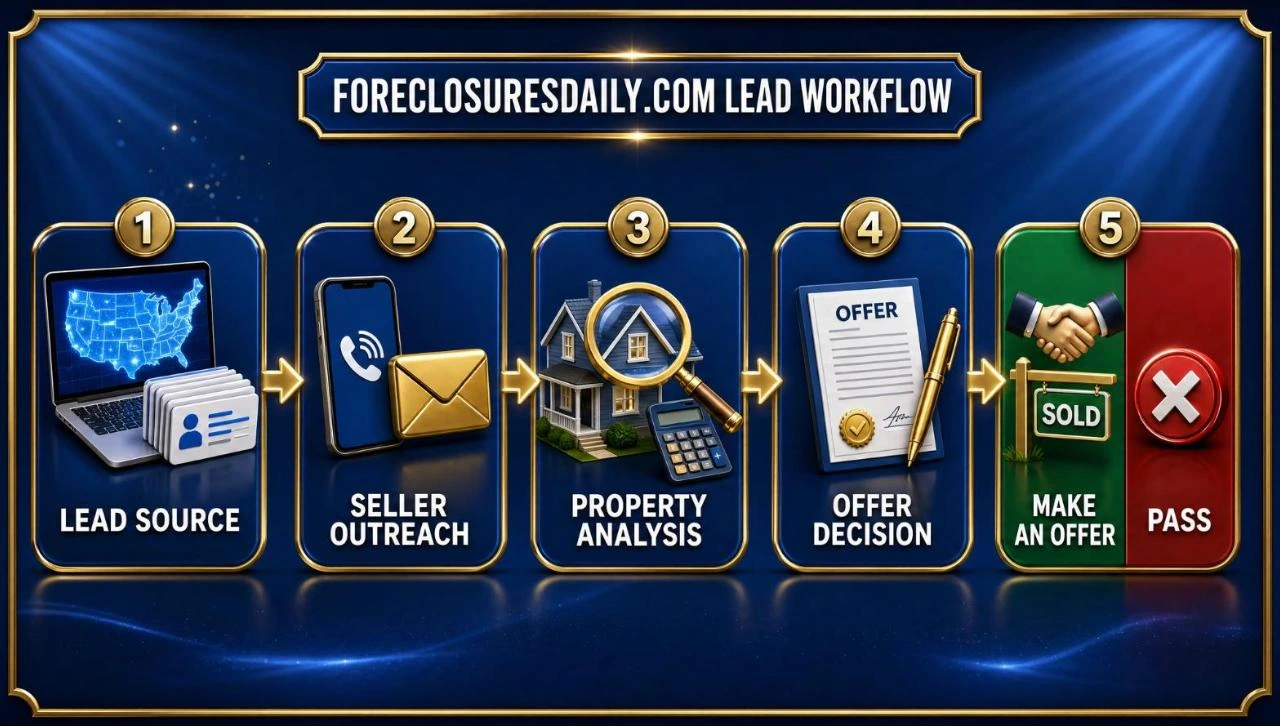
Motivated sellers who want to liquidate fast
For this reason, ForeclosuresDaily.com’s off-market real estate platform covers every major distress signal in Brooklyn, cross-referenced with tax rolls and property appraiser records.
 Probate leadsExecutors who must sell before the estate can close.See probate leads
 Pre-probate leadsFamilies who may sell before a probate case is filed.See pre-probate leads
 Inheritance leadsHeirs who want to sell because they won’t keep the home.View inheritance leads
 Foreclosure leadsOwners behind on payments who want to sell before auction.Explore foreclosure leadsDivorce leadsCouples who must sell when they divide shared assets.Find divorce leads
 Eviction leadsTired landlords who want out because of problem tenants.Browse eviction leads
 Code violation leadsOwners facing fines and repairs they can’t afford.See code violation leads
 Tax-delinquent leadsOwners behind on property taxes who need cash soon.Target tax-delinquent owners
 Absentee owner leadsOut-of-area owners, especially those far from the property.Reach absentee owners
 Life leads and FSBOOwners selling on their own rather than with an agent.Shop all lead products
How do you calculate a wholesale offer in Brooklyn?
Every offer starts with the ARV, which is what the home will be worth once it is fixed.
For example, the 70% Rule says your buyer should pay no more than 70% of ARV minus repairs. Because your assignment fee comes out of that number, your contract price must be even lower.

Wholesale offer example
| Step | Amount |
|---|---|
| ARV | $795,000 |
| 70% of ARV − repairs ($64,000) | $492,500 |
| Your assignment fee | − $24,000 |
| Your contract price |
Brooklyn ZIP codes to watch
Start your search in these Brooklyn ZIP codes, and then expand as you learn which areas your buyers want. Next, open a ZIP code below to open its investing data.
ZIP 11201 · New York · $1,425,000 · Negotiate
Market snapshot: New York (11201)
| Metric | Value |
|---|---|
| Median listing price | $1,425,000 ▼ 8.1% |
| Price per sq ft | $1,487 |
| Days on market | 71 days ▼ 22% |
| Median rent | $5,150 ▲ 7.4% |
| Active listings | 319 ▼ 17.9% |
| Gross rent yield | 4.3% |
In addition, the Zillow Home Value Index is $1,372,722 (up 4.3% from a year earlier) as of August 2026.
Investor note: Prices per square foot run higher here than anywhere else on this list. Meanwhile, the median price is down 8.1% from a year earlier, and inventory is down 17.9%. Consequently, assignment fees here depend on buying well below retail.
Max offer when the ARV equals the median price: $1,425,000 × 70% − $114,000 repairs = $883,500 max offer
Also see the full 11201 market report on Realtor.com →
Then view 11201 homes on Zillow →
ZIP 11208 · New York · $794,000 · Wholesale
Market snapshot: New York (11208)
| Metric | Value |
|---|---|
| Median listing price | $794,000 ▲ 2.6% |
| Price per sq ft | $514 |
| Days on market | 71 days ▼ 10.1% |
| Median rent | $3,200 |
| Active listings | 148 ▼ 9.8% |
| Gross rent yield | 4.8% |
In addition, the Zillow Home Value Index is $743,835 (up 4.9% from a year earlier) as of August 2026.
Investor note: Meanwhile, the median price is up 2.6% from a year earlier, and inventory is down 9.8%. In addition, absentee owners here are worth a direct mail campaign.
Max offer when the ARV equals the median price: $794,000 × 70% − $64,000 repairs = $491,800 max offer
Also see the full 11208 market report on Realtor.com →
Then view 11208 homes on Zillow →
ZIP 11210 · New York · $747,500 · Wholesale
Market snapshot: New York (11210)
| Metric | Value |
|---|---|
| Median listing price | $747,500 ▲ 10.7% |
| Price per sq ft | $536 |
| Days on market | 79 days |
| Median rent | $2,874 ▲ 10.5% |
| Active listings | 130 ▼ 19.1% |
| Gross rent yield | 4.6% |
In addition, the Zillow Home Value Index is $933,737 (up 5.7% from a year earlier) as of August 2026.
Investor note: Meanwhile, the median price is up 10.7% from a year earlier, and inventory is down 19.1%. Meanwhile, tired landlords here may welcome a quick cash offer.
Max offer when the ARV equals the median price: $747,500 × 70% − $60,000 repairs = $463,250 max offer
Also see the full 11210 market report on Realtor.com →
Then view 11210 homes on Zillow →
ZIP 11214 · New York · $728,900 · Negotiate
Market snapshot: New York (11214)
| Metric | Value |
|---|---|
| Median listing price | $728,900 ▼ 3% |
| Price per sq ft | $740 |
| Days on market | 98 days ▼ 10.1% |
| Median rent | $3,347 ▲ 1.5% |
| Active listings | 275 ▼ 9.7% |
| Gross rent yield | 5.5% |
In addition, the Zillow Home Value Index is $767,944 (up 3.1% from a year earlier) as of August 2026.
Investor note: Homes sit longer here than elsewhere, so long market times create motivated sellers. Meanwhile, the median price is down 3% from a year earlier, and inventory is down 9.7%. Also, check code-violation records here for distressed homes.
Max offer when the ARV equals the median price: $728,900 × 70% − $58,000 repairs = $452,230 max offer
Also see the full 11214 market report on Realtor.com →
Then view 11214 homes on Zillow →
ZIP 11218 · New York · $799,000 · Wholesale
Market snapshot: New York (11218)
| Metric | Value |
|---|---|
| Median listing price | $799,000 ▲ 9.7% |
| Price per sq ft | $810 |
| Days on market | 50 days ▲ 3.6% |
| Median rent | $3,699 ▲ 20.1% |
| Active listings | 143 ▼ 22.9% |
| Gross rent yield | 5.6% |
In addition, the Zillow Home Value Index is $956,106 (up 4% from a year earlier) as of August 2026.
Investor note: Homes sell faster here than anywhere else on the list. Meanwhile, the median price is up 9.7% from a year earlier, and inventory is down 22.9%. So, price your offer with the 70% Rule before you negotiate.
Max offer when the ARV equals the median price: $799,000 × 70% − $64,000 repairs = $495,300 max offer
Also see the full 11218 market report on Realtor.com →
Then view 11218 homes on Zillow →
ZIP 11220 · New York · $649,500 · Flip & wholesale
Market snapshot: New York (11220)
| Metric | Value |
|---|---|
| Median listing price | $649,500 |
| Price per sq ft | $881 |
| Days on market | 98 days ▲ 13.9% |
| Median rent | $2,925 ▼ 7.9% |
| Active listings | 194 ▼ 4.3% |
| Gross rent yield | 5.4% |
In addition, the Zillow Home Value Index is $944,474 (up 4.6% from a year earlier) as of August 2026.
Investor note: Meanwhile, the median price is up 0% from a year earlier, and inventory is down 4.3%. Then match each deal here with a buyer who knows the area.
Max offer when the ARV equals the median price: $649,500 × 70% − $52,000 repairs = $402,650 max offer
Also see the full 11220 market report on Realtor.com →
Then view 11220 homes on Zillow →
ZIP 11226 · New York · $585,000 · Negotiate
Market snapshot: New York (11226)
| Metric | Value |
|---|---|
| Median listing price | $585,000 ▼ 3.7% |
| Price per sq ft | $755 |
| Days on market | 73 days ▼ 5.2% |
| Median rent | $3,250 ▲ 3.2% |
| Active listings | 136 ▼ 15.4% |
| Gross rent yield | 6.7% |
In addition, the Zillow Home Value Index is $788,708 (up 1.4% from a year earlier) as of August 2026.
Investor note: Meanwhile, the median price is down 3.7% from a year earlier, and inventory is down 15.4%. As a result, focus on deep discounts from off-market sellers.
Max offer when the ARV equals the median price: $585,000 × 70% − $47,000 repairs = $362,500 max offer
Also see the full 11226 market report on Realtor.com →
Then view 11226 homes on Zillow →
ZIP 11229 · New York · $479,999 · Negotiate
Market snapshot: New York (11229)
| Metric | Value |
|---|---|
| Median listing price | $479,999 ▼ 21.8% |
| Price per sq ft | $452 |
| Days on market | 85 days ▼ 3.5% |
| Median rent | $2,900 ▲ 8.5% |
| Active listings | 309 ▲ 2.3% |
| Gross rent yield | 7.3% |
In addition, the Zillow Home Value Index is $772,829 (up 2% from a year earlier) as of August 2026.
Investor note: Meanwhile, the median price is down 21.8% from a year earlier. Therefore, line up cash buyers before you sign a contract here.
Max offer when the ARV equals the median price: $479,999 × 70% − $38,000 repairs = $297,999 max offer
Also see the full 11229 market report on Realtor.com →
Then view 11229 homes on Zillow →
ZIP 11233 · New York · $1,225,000 · Flip
Market snapshot: New York (11233)
| Metric | Value |
|---|---|
| Median listing price | $1,225,000 ▲ 11.4% |
| Price per sq ft | $823 |
| Days on market | 67 days ▼ 29.5% |
| Median rent | $3,450 ▲ 8.5% |
| Active listings | 133 ▼ 14% |
| Gross rent yield | 3.4% |
In addition, the Zillow Home Value Index is $1,014,452 (up 3.7% from a year earlier) as of August 2026.
Investor note: Meanwhile, the median price is up 11.4% from a year earlier, and inventory is down 14%. For this reason, compare ARV within this ZIP code rather than across the whole market.
Max offer when the ARV equals the median price: $1,225,000 × 70% − $98,000 repairs = $759,500 max offer
Also see the full 11233 market report on Realtor.com →
Then view 11233 homes on Zillow →
ZIP 11235 · New York · $479,000 · Negotiate
Market snapshot: New York (11235)
| Metric | Value |
|---|---|
| Median listing price | $479,000 ▼ 12.3% |
| Price per sq ft | $499 |
| Days on market | 95 days ▲ 10.2% |
| Median rent | $2,996 |
| Active listings | 458 ▲ 1% |
| Gross rent yield | 7.5% |
In addition, the Zillow Home Value Index is $595,560 (up 1.1% from a year earlier) as of August 2026.
Investor note: Entry prices are lower here than in the rest of the group, so it fits wholesaling and first flips. Meanwhile, the median price is down 12.3% from a year earlier. Because of this, pull probate and pre-foreclosure leads here first.
Max offer when the ARV equals the median price: $479,000 × 70% − $38,000 repairs = $297,300 max offer
Also see the full 11235 market report on Realtor.com →
Then view 11235 homes on Zillow →

Also, gross rent yield is 12 months of median rent divided by the median listing price; the max offer assumes repairs of 8% of the median price.
How do you build your buyers list in Brooklyn?
Build your buyers list before you sign your first contract. Your best buyers are cash buyers who can close quickly, such as flippers, landlords, and small builders.
What does assigning contracts mean in New York?

Wholesale Real Estate for Sale Brooklyn, New York
Wholesale real estate in Brooklyn is about finding properties that can be placed under contract below a buyer’s target value, then assigned or resold to an investor who can close.
The best opportunities are rarely the cleanest public listings; they often come from owner distress, property condition issues, probate timing, FSBO outreach, or relationship-driven referrals. This guide explains how investors search for deals, evaluate ARV, and think through which Brooklyn ZIP codes may fit different wholesale strategies.
What should buyers know about wholesale real estate in Brooklyn?
Brooklyn has many property types—brownstones, small multifamily buildings, mixed-use assets, condos, and older single-family homes—so the same discount does not mean the same thing across neighborhoods. A potential wholesale deal only works when the purchase price, repairs, closing costs, holding risk, and resale or rental plan leave enough room for the end buyer.
In practical terms, wholesale real estate opportunities in Brooklyn are usually evaluated by three questions: Can the seller legally and willingly sell? Can the property be verified?
Can an investor make the numbers work? That means the conversation is not just about “cheap property.” It is about clean title, realistic repair assumptions, financing timelines, tenant status, zoning, violations, and comparable sales.
Public research matters.
New York City’s ACRIS system lets users search property records and view document images for Brooklyn from 1966 to the present, which makes it a key starting point for deed history, mortgages, liens, and ownership clues.
NYC’s property tax portal, HPD Online, and ZoLa also help investors cross-check property taxes, housing violations, and zoning or land-use details before getting too excited about a lead.
Local market snapshot: Brooklyn

Local investors who track probate filings, divorces, and foreclosure notices in Brooklyn and reach owners early tend to find the best off-market deals.
How wholesale real estate deals usually work
In other cases, the wholesaler may use a double close, where they briefly purchase and resell the property. The exact structure depends on the contract, the parties, the title company or attorney, and applicable law, so local professional guidance matters.
The investor buying the deal is usually looking for one of several outcomes:
A seller dealing with inheritance, divorce, deferred maintenance, tax pressure, or a vacant property may value a simple closing more than a maximum retail price. Still, ethical wholesalers should be transparent, avoid pressure tactics, and make sure sellers understand what they are signing.
The numbers behind ARV and offer price
In Brooklyn, ARV is especially sensitive because a few blocks can change buyer demand, renovation style, rental expectations, and the quality of comparable sales. A brownstone near Prospect Heights is not evaluated the same way as a semi-detached house in Canarsie or a mixed-use building in Bensonhurst.
For investors researching real estate opportunities in Brooklyn, the biggest mistake is treating ARV as a hopeful resale number rather than a disciplined underwriting number.
A real ARV should be supported by comparable sales, not by the highest active listing nearby. NYC Department of Finance rolling sales data can help investors review recorded sales, while ACRIS can help confirm prior transfers and recorded documents.
Practical ways to find off-market properties in Brooklyn
Sometimes it means an owner who has not decided to sell yet but may respond to a relevant, respectful offer. In Brooklyn, the best off-market strategy is usually a combination of public-record research, neighborhood knowledge, and consistent follow-up.
Start with data, then make it human:
If a homeowner is facing foreclosures, family pressure, or a legal dispute, the conversation should be clear and professional. Investors should avoid giving legal advice unless they are qualified to do so, and sellers should be encouraged to consult their own attorney.
ZIP code spotlight for Brooklyn wholesale opportunities
Search demand for Brooklyn real estate market information is broad, but wholesale investors need to narrow their focus by ZIP code, property type, and exit strategy. The following areas are common starting points for investors reviewing investment properties in Brooklyn and comparing possible deal profiles.
11214 Brooklyn wholesale real estate: Bensonhurst and Bath Beach
These properties may appeal to buyers who understand local retail corridors, residential rental demand, and the renovation needs of older buildings. Mixed-use deals require extra attention to commercial lease terms, certificate of occupancy details, and zoning.
For wholesalers, 11214 can reward careful property-by-property research.
A small building with tired units and below-market presentation may still be valuable if the structure, legal use, and location make sense. The key is not assuming every multifamily is a deal; it is finding the specific owner situation where timing and price align.
11236, 11212, and 11234: Canarsie, East New York, and Flatlands
These areas can offer a higher volume of multifamily stock and more distressed or probate-related lead opportunities than some higher-priced waterfront or brownstone neighborhoods. They may also include small homes, two- to four-family properties, and buildings in need of significant repair.
This is where due diligence becomes the difference between a strong lead and a bad assignment.
Check open violations, tenant status, flood considerations where relevant, and repair complexity before estimating buyer demand. Distressed does not automatically mean discounted enough, especially when the renovation scope is uncertain.
11211 and 11249 Brooklyn wholesale real estate: Williamsburg and Greenpoint
In these areas, assignment fees can sometimes be larger because the underlying asset values are larger. However, competition is also intense, and sellers are often more aware of market value.
The best opportunities may involve complexity rather than obvious distress.
Think underused mixed-use property, ownership fatigue, estate timing, renovation challenges, or a seller who wants certainty over a drawn-out listing process. Buyers in these ZIP codes often move quickly, but they also expect clean documentation and realistic numbers.
11238 Brooklyn wholesale real estate: Prospect Heights and Crown Heights
These properties can have strong upside when layout, location, and renovation quality align. They can also carry higher risk because landmark considerations, older systems, tenant issues, and premium renovation expectations may affect the project.
For wholesalers, the opportunity is in understanding the buyer pool.
A cosmetic flipper, a luxury brownstone renovator, and a long-term rental investor may all value the same address differently. Strong wholesale property listings in this area should clearly present the asset: legal use, occupancy, condition notes, renovation assumptions, comparable sales, and the intended exit.
Ready to start? Talk to our team about leads in your market →
Motivated Sellers Who Want to Liquidate Fast
Probate Leads
Foreclosure Leads
Brooklyn at a glance
New York foreclosures always go through the state Supreme Court.
Lenders must send a notice at least 90 days before filing, a court-appointed referee auctions the home after judgment, and there is no right to buy it back afterward. An early contract can help a Brooklyn owner sell before the sale date.
Sources: U.S. Census Bureau QuickFacts, Kings County, New York (2020–2024 American Community Survey; population estimate for July 1, 2025) and state foreclosure law summary.
Divorce Leads
Inheritance Leads
Life Leads
What makes a wholesale property listing credible?
For Brooklyn investment properties, missing information is not always a deal killer, but unexplained gaps should affect the offer. If the wholesaler cannot explain how they reached the price, the buyer should slow down.
A simple due-diligence checklist before making an offer
This checklist may feel basic, but it protects both sides. Sellers deserve a buyer who can perform, and investors deserve a deal that has been presented honestly.
Final takeaway
The strongest opportunities come from disciplined lead generation, respectful seller outreach, careful ARV analysis, and ZIP-code-level knowledge. Whether you are reviewing foreclosures, inheritance situations, divorce-related sales, FSBO leads, or off-market conversations, the same rule applies: verify first, then negotiate.
If you focus on real property data, realistic repair assumptions, and neighborhoods you truly understand, Brooklyn becomes easier to navigate. The best wholesale deals are not just found; they are filtered, documented, and matched with the right investor buyer.
Get Off-Market Leads Before Your Competition
ForeclosuresDaily off-market opportunities before your competition
In fact, since 2004, ForeclosuresDaily.com has helped investors, wholesalers, flippers, and agents reach motivated sellers first.
Hear From Our Customers
Click a profile to watch their video or read their story.