Off-market properties in Cook County, Illinois
Off-market properties in Cook County, Illinois can be single-family homes, condos, two-flats or larger multifamily buildings whose owners may sell before anything reaches a public listing site. This guide covers how private deals work in Chicago and the suburbs, how to judge one, and how to stay within Illinois law while you pursue it.
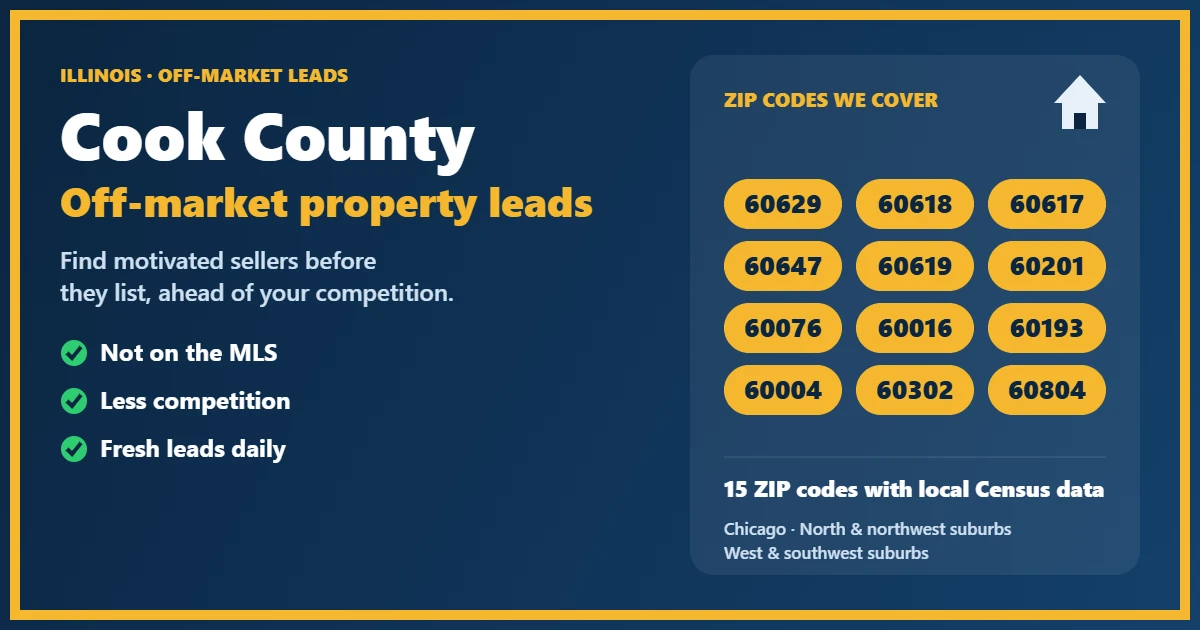
Off-market properties in Cook County Illinois, explained
An off-market property is a home the owner might sell even though it is not on the MLS or advertised to the general public.
The difference is exposure. The owner may accept a private offer, but the home is not being shown to every buyer, agent and investor at once. People also call these hidden, unlisted or private properties, and the aim is the same: find the opportunity before it gets crowded.
Cook County makes this both promising and complicated. Chicago is the county seat, and the county holds 134 municipalities, so one search can reach dense city blocks, North Shore suburbs, inner-ring west suburbs and south suburban towns. The Census counts about 5.2 million residents, which produces a steady stream of probate cases, divorces and foreclosure filings every year.
Possible sources include unlisted and exclusive listings, inherited homes, vacant or distressed houses, landlord-owned rentals and homes whose owners have not settled on a plan. Browse our lead products to see how each type is delivered.
- Listed on the MLS
- Advertised to the public
- Every shopper can see it
- Not listed on the MLS
- Not publicly advertised
- Found by buyers who look beyond the portals
These opportunities may include
Seller situations behind Cook County private sales
Every lead begins with a change in the owner’s life. Not every lead becomes a deal, and not every owner wants to sell, but these situations come up again and again.
Probate
An estate in probate often has to sell the house so executors can settle debts and divide assets among heirs.
Cook County probate leads →
Pre-foreclosure
A homeowner facing a filing deadline may protect remaining equity with a quick sale. These cases call for accuracy and real sensitivity.
Foreclosure leads →
Divorce
When a marriage ends, the shared home often has to be sold or divided, sometimes on a schedule set by the court.
Chicago divorce leads →
Inheritance
Heirs, often living out of state, may need time to decide whether to keep, rent, fix up or sell a house they did not plan to own.
Inheritance leads →
Absentee and aging landlords
Owners who live elsewhere, or who have held rentals for decades, may sell one unit or a whole small portfolio once management wears them out.
Absentee-owner leads →
Vacant and repair-heavy homes
Empty houses bring taxes, insurance and security costs, and homes with code problems rarely suit a retail listing. Stay factual and never assume distress.
Life changes such as a move or downsizing create sellers too. Wholesalers can compare notes in our guide to wholesaling real estate in Cook County.
Chicago and the suburbs behave like separate markets
Inside Chicago, a search might turn up condos, greystones, bungalows, two-flats, mixed-use buildings or larger apartment properties. Suburban Cook County covers Evanston, Skokie, Oak Park, Cicero, Berwyn, Des Plaines, Schaumburg, Harvey, Homewood, Oak Lawn, Orland Park, Arlington Heights, Wilmette, Crestwood and many more. Each has its own housing stock and its own rules. The Cook County Department of Public Health sorts the suburbs into north, west, south and southwest regions, which shows how far the county stretches beyond the city.
ZIP codes help narrow the field. Cook County and nearby areas use prefixes from 600xx to 608xx. A buyer hunting rentals near transit will weigh Oak Park differently from Chicago’s bungalow belt or the south suburbs. A rehabber cares about building age, code issues, lot size and resale demand. A long-term landlord looks at taxes, tenant profile, school boundaries and local rental licensing.
Phillip Warrick, a full-time investor since 2003 with more than 20 years of experience, has hosted ForeclosuresDaily.com webinars on finding these deals. For local price benchmarks, see wholesale house prices in Chicago and flipping houses in Chicago.

Legal ground rules for private sales in Illinois
Skipping the MLS does not mean skipping the law. Illinois sales still require honest communication, proper disclosures, fair housing compliance and sound contracts.
The Residential Real Property Disclosure Act requires a report on known material defects before the contract is signed, with some exemptions. If the report arrives after everyone signs, the buyer may get a short window to cancel. Illinois radon rules and federal lead-paint rules add their own disclosures, including a pamphlet and a chance to inspect for lead in older housing.
The Illinois Department of Human Rights notes that state and federal fair housing laws cover owners, brokers, salespeople and rental agents alike. If you work with a broker, wholesaler or consultant, check their license through the Illinois Department of Financial and Professional Regulation lookup.
Required in most sales
- Seller disclosure report under the Illinois Residential Real Property Disclosure Act
- Radon information for the buyer
- Federal lead-based paint disclosure for most homes built before 1978
- Fair housing compliance, listed or not
- A licensed broker where the law requires one
Compare Cook County ZIP codes
Choose a ZIP to see how its home values, ownership and vacancy compare with the county as a whole, along with how often people search for homes there. The Southwest and Southeast Side ZIPs draw the most searches, while the suburbs show higher ownership and lower vacancy.
60629 · Chicago Lawn / West Lawn / Gage Park: off-market investor snapshot
Southwest Side Chicago ZIP of brick bungalows and two-flats near Marquette Park and Midway Airport.
Local search demand
Resale demand: It tops this list at about 670 home searches a month, so resale exits have a deep buyer pool.
Investor note: The $243,600 median value sits about 25% under the Cook County figure, while owner-occupancy (62%) runs above it. Vacancy is low at 5.7%, and 57% of homes are single-family. Long-tenure bungalow owners and heirs are the main off-market source in this part of the bungalow belt.
60618 · Avondale / Irving Park / North Center: off-market investor snapshot
North Side Chicago ZIP that runs from Avondale through Irving Park to North Center.
Local search demand
Resale demand: About 290 searches a month rank it third, with buyers looking for both condos and houses.
Investor note: Values here ($562,700) are well above the county median, and only 26% of units are single-family, so two-flats, greystones and small apartment buildings dominate. Half of homes are owner-occupied. Owners of aging two- and three-flats are a natural target for value-add buyers.
60617 · South Chicago / East Side / South Deering: off-market investor snapshot
Southeast Side Chicago ZIP near the lake and the Indiana line, covering South Chicago, East Side and South Deering.
Local search demand
Resale demand: About 550 searches a month, the second highest, show strong interest from entry-level buyers.
Investor note: At $180,700 the median value is the lowest of the Chicago ZIPs here and about 44% below the county. Vacancy is 13.7%, well above the 7.7% county rate. With 57% owner-occupancy and 55% single-family, vacant homes and inherited properties make strong research targets.
60647 · Logan Square / Humboldt Park: off-market investor snapshot
Northwest Side Chicago ZIP centered on Logan Square and the eastern edge of Humboldt Park.
Local search demand
Resale demand: About 180 searches a month; many buyers here search by neighborhood rather than ZIP.
Investor note: This is the highest-value Chicago ZIP on the page ($586,200), yet only 39% of homes are owner-occupied and just 18% are single-family. Renters fill most units. Small-building landlords who have owned for years may welcome a private sale.
60619 · Chatham / Avalon Park: off-market investor snapshot
South Side Chicago ZIP that includes Chatham, Avalon Park and parts of Burnside.
Local search demand
Resale demand: About 240 monthly searches put it fourth; demand is steady at lower price points.
Investor note: The median value ($219,600) is about a third under the county figure, and vacancy reaches 14.7%, the highest on this page. Only 45% of homes are owner-occupied. Probate and absentee-owner research tends to uncover the most willing sellers, but check repair needs closely.
60201 · Evanston (central and north): off-market investor snapshot
Lakefront city just north of Chicago, home to Northwestern University and a mix of older houses and apartments.
Local search demand
Resale demand: Only about 40 ZIP searches a month, as buyers usually search for Evanston by name.
Investor note: At $590,700 Evanston has the highest median value on this list. Only 39% of units are single-family and 55% are owner-occupied, reflecting many apartments and student rentals. Estate sales of large older homes and owners of rental buildings are the usual off-market leads.
60076 · Skokie: off-market investor snapshot
North suburb bordering Chicago, with mid-century single-family homes and a strong retail base.
Local search demand
Resale demand: About 70 searches a month for houses, showing steady family-buyer demand.
Investor note: Skokie posts 81% owner-occupancy, 73% single-family homes and only 3.5% vacancy, all much stronger than the county. The $396,200 median is above the county. Expect motivated sellers to be retirees and estates rather than distressed owners.
60016 · Des Plaines: off-market investor snapshot
Northwest suburb near O’Hare, with ranches, split-levels and some condo buildings.
Local search demand
Resale demand: About 60 searches a month, a moderate signal for a large suburb.
Investor note: The $320,400 median is close to the county figure, and owner-occupancy (68%) is ten points higher. About half of homes (52%) are single-family. Airport-area homes and older ranches often need updates, which opens room for rehab buyers.
60193 · Schaumburg (south): off-market investor snapshot
Northwest suburb built mostly after 1960, with subdivisions, townhomes and the Woodfield area.
Local search demand
Resale demand: Only about 20 ZIP searches a month; the area draws more interest by city name.
Investor note: Owner-occupancy is 76% and vacancy only 3.9%, and the $329,900 median is near the county figure. Townhome and condo owners make up part of the market here. Relocation and job-change sellers are a common off-market lead.
60004 · Arlington Heights: off-market investor snapshot
Northwest suburb with a busy downtown, strong schools and Metra service.
Local search demand
Resale demand: About 60 searches a month, steady for a high-value suburb.
Investor note: The $424,200 median and $128,979 median income are both well above the county. Owner-occupancy is 78% and 66% of homes are single-family. Teardown-and-rebuild buyers watch this area, so older homes on good lots can draw strong offers.
60302 · Oak Park (north): off-market investor snapshot
Inner-ring suburb on Chicago’s west border, known for historic homes and easy transit access.
Local search demand
Resale demand: About 60 searches a month; a small but well-funded buyer pool.
Investor note: The $474,200 median value is far above the county figure, and 62% of homes are owner-occupied. Only 40% of units are single-family, since condos and apartments line the main streets. Historic-home estates and rental owners near transit are worth tracking.
60804 · Cicero: off-market investor snapshot
Dense working-class town directly west of Chicago, with bungalows, two-flats and industrial corridors.
Local search demand
Resale demand: About 20 searches a month by ZIP; buyers mostly search for Cicero by town name.
Investor note: Values ($249,400) run below the county median, and 55% of homes are owner-occupied, close to the county rate. Vacancy is just 6.8%. Two-flats are common here, which suits house-hacking buyers and small landlords.
60402 · Berwyn: off-market investor snapshot
West suburb next to Cicero, with long blocks of Chicago-style bungalows.
Local search demand
Resale demand: About 80 searches a month and a relatively high click cost suggest active buyer competition.
Investor note: The $294,600 median is somewhat below the county figure, while owner-occupancy (64%) and single-family share (57%) both run higher. Vacancy is 7.3%. Many bungalows have had one owner for decades, so inheritance and downsizing leads are a good fit.
60453 · Oak Lawn: off-market investor snapshot
Southwest suburb of brick ranches and bungalows near the Chicago city line.
Local search demand
Resale demand: About 50 searches a month; buyers here often move from nearby Chicago neighborhoods.
Investor note: At 83% owner-occupancy and 69% single-family, Oak Lawn is among the most stable ZIPs here, with 5.2% vacancy. The $281,200 median is below the county. Long-time owners selling to downsize are the most common private sellers.
60462 · Orland Park: off-market investor snapshot
Southwest suburb with newer subdivisions, large lots and a regional shopping hub.
Local search demand
Resale demand: About 60 searches a month, a modest but steady signal.
Investor note: Orland Park shares the top owner-occupancy rate on this list (83%) and has the highest single-family share (75%). The $348,900 median is a bit above the county. Sellers here usually want clean terms and timing help rather than a quick discount sale.
U.S. Census Bureau, American Community Survey 2020–2024 5-year estimates. Figures cover the whole ZIP code, which can cross county lines. Home values are medians for owner-occupied homes, not current list prices.
Average monthly U.S. Google searches as of October 2026. Home searches combine “homes for sale”, “houses for sale” and “real estate” for each ZIP code. Seller searches combine “sell my house fast”, “we buy houses” and “cash home buyers” for the nearest city.
Want to find off-market properties in a specific neighborhood? ZIP-based lead lists make your outreach more relevant and help you work more efficiently.
What our customers say
Real investors share their experience with ForeclosuresDaily.com in short video reviews and press releases.









A repeatable system for finding Cook County deals
- 1
Define the buy box
Pick property type, price range, ZIPs, condition and exit plan. A Chicago condo, a Berwyn bungalow and a south suburban rental each need different numbers.
- 2
Research the record
Look up the parcel in the Cook County Assessor’s database by address or Property Index Number (PIN). Deeds, mortgages and liens once filed with the Recorder of Deeds are now handled by the Cook County Clerk’s Office. Organized off-market lead lists speed this up, but they are a starting point, not a substitute for due diligence.
- 3
Reach out, then verify
Contact owners by compliant mail, phone or in person, and make clear you are asking whether they would sell, not claiming the home is for sale. Before you offer, confirm ownership, occupancy, condition, title, taxes and repair costs.
Your due diligence checklist
- Confirm the legal owner and mailing address
- Pull recent sales from the same neighborhood or suburb
- Get a contractor or inspector to price repairs
- Review taxes, exemptions and assessment history
- Ask about tenants, leases, unpaid utilities and municipal violations
- Check zoning for multifamily, mixed-use or conversion plans
Have an Illinois real estate attorney review the contract and closing. In Chicago, look hard at building age, permits, porches, basements and condo association finances. In the suburbs, check village inspection and point-of-sale rules, transfer stamps and school district lines.
Questions about Cook County off-market deals
What buyers, investors and agents in Chicago and the suburbs ask us most.
Have another question? Tell us your target ZIP codes and we will help you choose the right leads.
Does off-market mean a Cook County home is undervalued?
No No. A private seller may still expect full market price. The advantage is timing and less competition, not a built-in discount, so underwrite every deal on comparable sales and repair costs.
Which strategies fit off-market properties here?
Fix-and-flip, buy-and-hold, house hacking in a two-flat, small multifamily and portfolio purchases all work. Homebuyers can also reach unlisted homes in specific neighborhoods or suburbs where few homes are for sale.
Do Illinois disclosure rules apply to a private sale?
Yes Yes. Most residential sellers must provide the state disclosure report, radon information and, for pre-1978 homes, lead-paint disclosures, whether or not the home is listed.
How should I approach an owner who has not listed?
State who you are and why you are reaching out, give the owner room to say no, put terms in writing, suggest legal or tax advice, and keep a record of every contact. Avoid pressure and never target or exclude anyone based on protected traits.
Is an off-market deal right for everyone?
No It suits buyers willing to research, talk directly with owners and weigh risk without a listing agent’s structure. If you want full transparency, broad price validation or a turnkey process, a public listing may serve you better.
Get ahead of the Cook County market
ForeclosuresDaily.com has supplied off-market leads nationwide since 2004. Tell us which Chicago neighborhoods or suburbs you target, and we will match you with probate, foreclosure, divorce and inheritance leads there.