Wholesale Real Estate Saint Paul, Minnesota
Wholesale real estate in Saint Paul rewards investors who reach motivated sellers first. Instead of competing on the MLS, ForeclosuresDaily.com helps you find owners facing probate, foreclosure, or divorce, so you can sign a discounted contract and assign it to a cash buyer.
Market data: Realtor.com Ramsey County housing market, October 2026. Zillow Home Value Index for Ramsey County: $337,589 (up 1.8% from a year earlier), August 2026. View homes on Zillow.

Listed and sold 25 properties and personally bought and sold four fix-and-flip properties, all generated from probate leads.
Carolynn Castillo
Realtor & Broker · eXp Realty
Why wholesale real estate in Saint Paul?
Wholesaling needs little capital because you control a property with a contract and an earnest money deposit, not a mortgage. In addition, your buyer handles the repairs, so you never manage contractors, and many assignments close in weeks rather than months.
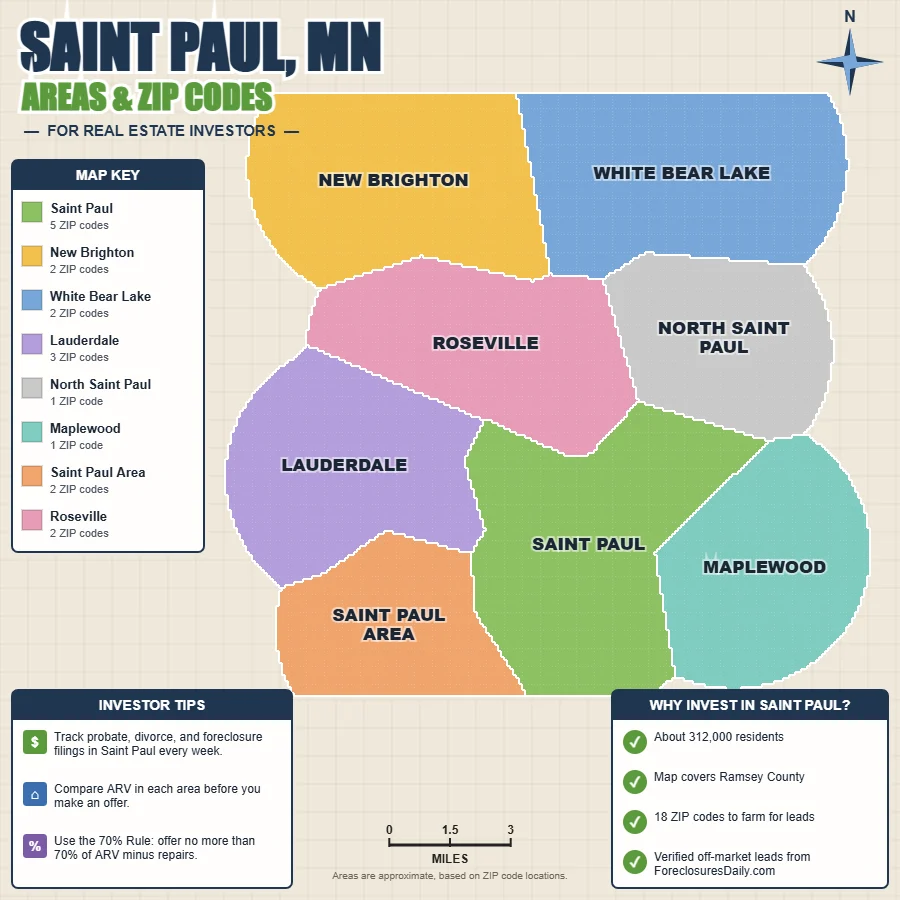
Saint Paul has about 311,527 residents (2020 census) and sits in Ramsey County. The ZIP codes with the most homes for sale today are 55106, 55104, and 55102, so that is where most motivated sellers are.

Shannon Thompson
Investor · Joe Homebuyer of Atlanta
Watch Shannon Thompson share their experience using ForeclosuresDaily.com.
How does wholesaling real estate work in Saint Paul?
Every wholesale deal follows the same path, from the first lead to the assignment fee:
Find a distressed property
Initially, use targeted lead generation to find owners with a reason to sell, such as heirs, tired landlords, or owners facing foreclosure.
Run the numbers
Next, estimate the after-repair value (ARV) from nearby sales, because your offer depends on it.
Sign a purchase contract
Then agree on a price that leaves room for your buyer’s profit as well as your assignment fee.
Find a cash buyer
After that, match the deal with a flipper, landlord, or other cash buyer from your list.
Assign the contract
In addition, transfer your rights under the contract to the buyer in exchange for your fee.
Collect your fee
Finally, the title company or closing attorney usually pays your assignment fee at closing.

Andrew Litchfield
Webinar host
Andrew Litchfield hosted a ForeclosuresDaily.com monthly webinar for real estate investors.
Motivated sellers who want to liquidate fast
For this reason, ForeclosuresDaily.com’s off-market real estate platform covers every major distress signal in Saint Paul, cross-referenced with tax rolls and property appraiser records.

Anthony Coletti
Real estate investor
Watch Anthony Coletti share their experience using ForeclosuresDaily.com.
How do you calculate a wholesale offer in Saint Paul?
Every offer starts with the ARV, which is what the home will be worth once it is fixed. For example, the 70% Rule says your buyer should pay no more than 70% of ARV minus repairs. Because your assignment fee comes out of that number, your contract price must be even lower.
For instance, here is the math using the Ramsey County median listing price as the ARV, an 8% repair budget, and a typical assignment fee.
Wholesale offer example

Jeremy Resmer
Webinar host
Jeremy Resmer hosted a ForeclosuresDaily.com monthly webinar for real estate investors.
Saint Paul ZIP codes to watch
Start your search in these Saint Paul ZIP codes, and then expand as you learn which areas your buyers want. Next, choose a ZIP code from the menu to open its investing data.
DowntownZIP 55101$189,900Negotiate
Downtown (55101) market snapshot
In addition, the Zillow Home Value Index is $169,807 (down 11.4% from a year earlier) as of August 2026.
Investor note: Entry prices are lower here than in the rest of the group, so it fits wholesaling and first flips. Meanwhile, the median price is down 15.6% from a year earlier, and inventory is down 6.9%. As a result, focus on deep discounts from off-market sellers.
Also see the full 55101 market report on Realtor.com →Then view 55101 homes on Zillow →
Choose a ZIP code from the menu to see its investing data, then compare markets. Market data: Realtor.com, October 2026, and Zillow Home Value Index, August 2026. Also, gross rent yield is 12 months of median rent divided by the median listing price; the max offer assumes repairs of 8% of the median price.

Antonio Stringfield
Probate investor · Los Angeles
Watch Antonio Stringfield share their experience using ForeclosuresDaily.com.
How do you build your buyers list in Saint Paul?
Build your buyers list before you sign your first contract. Your best buyers are cash buyers who can close quickly, such as flippers, landlords, and small builders.
- First of all, attend local real estate investor meetups.
- Also, review recent cash sales in county records to find active buyers.
- Then connect with title companies, hard money lenders, and property managers.
- Finally, ask every buyer for their buy box: areas, price range, and rehab level.
What does assigning contracts mean in Minnesota?
Assigning contracts means transferring your rights as the buyer under a purchase agreement to another investor. However, the rules differ by state, so review your contracts with a Minnesota real estate attorney before you start.

Nancy Wallace-Laab
Investor · nearly 20 years
Nancy focuses on the best outcome for both the seller and the investor, drawing on nearly 20 years of real estate investing experience.
Wholesale Real Estate Saint Paul, Minnesota
Wholesale real estate in Saint Paul, Minnesota, offers investors a practical way to find properties before they reach the open market. For sellers, it can create a simpler path when life events make a traditional listing feel slow or stressful. This guide explains how Saint Paul real estate wholesaling works, what kinds of situations often create off-market opportunities, and how buyers can evaluate real estate deals with more confidence.
What makes wholesale real estate in Saint Paul worth watching?
Wholesale real estate in Saint Paul is worth watching because the city has a mix of older housing, established neighborhoods, investor activity, and owners who may need flexible sale options. A real estate wholesale transaction usually starts when a wholesaler contracts with a seller, then assigns that contract or otherwise connects the opportunity to an end buyer. The investor is not just buying a property; they are buying access to a deal that may not be publicly listed.
For many buyers, the appeal is speed and access. Wholesale homes can surface because an owner wants certainty, privacy, or a faster sale timeline. These properties may need repairs, have title complications, or require a buyer who understands renovation costs and local demand.
That is why the best investors do not treat wholesale housing as a shortcut. They treat it as a sourcing channel. The opportunity is real, but it still needs careful review, clear numbers, and a plan for what happens after closing.
Local market snapshot: Saint Paul
Saint Paul is home to about 312,000 residents as of the 2020 census. Its ZIP codes cover neighborhoods across the city, and motivated-seller situations such as inherited homes, tired rentals, and pre-foreclosures show up in every one of them.
With a population of this size, Saint Paul produces a steady flow of probate filings, divorces, and foreclosure notices every year. Investors who track these records and reach owners early tend to find the best off-market deals.
How real estate wholesale works in simple terms
Real estate wholesale is a strategy built around finding motivated sellers and connecting their properties with buyers who are ready to act. The wholesaler typically identifies a property, negotiates an agreement with the seller, and presents the deal to investors, landlords, rehabbers, or other qualified buyers. The investor then evaluates whether the property fits their goals.
In Saint Paul, this process often focuses on properties that require extra attention. A house may need cosmetic updates, structural repairs, cleanup, or a faster closing than a conventional buyer can provide. Some owners are not interested in open houses, repeated showings, or waiting for retail financing approvals.
Investors seeking Wholesale Real Estate opportunities in Saint Paul should pay close attention to the details of the deal. A low price alone does not make a property good. The best real estate deals are the ones where the numbers, timeline, and risks are all visible before a buyer commits.
Local ZIP codes and neighborhood context matter
Saint Paul is not one uniform market. Property values, buyer demand, rental potential, renovation costs, and resale expectations can vary by block, housing style, and ZIP code. That local context is especially important when reviewing homes for wholesale because the buyer often has to make decisions quickly.
Investors commonly watch areas across 55101, 55104, 55106, 55107, and 55116, among others. Each ZIP code can include different property types and buyer expectations. A property near downtown activity may require a different strategy than a single-family home in a quieter residential pocket. A duplex, an older bungalow, or a small rental property may each have different repair profiles and financing considerations.
A Daily off-market real estate Platform can help investors track opportunities more consistently, but local judgment still matters. Data and deal flow are useful starting points. The final decision should be based on property-specific analysis.
Why do off-market properties become available?
Off-market properties become available because owners often face situations where a conventional sale is not the easiest option. Some sellers value speed, privacy, simplicity, or certainty more than maximum exposure. In those cases, a direct buyer or wholesale connection can feel more practical than preparing a home for the public market.
Common life events and property situations include Inheritance, Divorce, Foreclosures, and Pre-probate concerns. These situations can be emotional, time-sensitive, and complicated. A property may also be vacant, behind on repairs, occupied by tenants, or tied to family decisions.
For example, an inherited property might need cleanup, repairs, or agreement among family members. A divorce-related sale may require discretion and a clear closing timeline. A foreclosure situation may involve urgency and financial stress. Pre-probate conversations can be sensitive because ownership and the decision-making process may not yet be fully settled.
Ethical communication is essential in every case. Sellers should not feel pressured, confused, or rushed into terms they do not understand. Investors and wholesalers who build a long-term presence in Saint Paul real estate should focus on clarity, fair dealing, and realistic expectations.
Key points for Saint Paul investors
The strongest investors move quickly because they have a system, not because they ignore risk. Wholesale real estate opportunities in Saint Paul can be competitive, especially when a property has a clear spread between the purchase price, repair costs, and its potential resale or rental value. A disciplined review process helps buyers avoid emotional decisions.
Start with the property’s current condition. Photos are helpful, but they do not replace a walkthrough when access is available. Older homes may have issues with roofing, plumbing, electrical systems, foundations, windows, heating, or water intrusion. Even cosmetic rehabs can expand once walls, floors, and mechanical systems are inspected more closely.
Next, estimate your total project cost. This should include the purchase price, assignment fee (if applicable), closing costs, holding costs, utilities, insurance, taxes, repairs, contingency funds, and selling or refinancing expenses. New investors sometimes focus only on the purchase price and repair budget, but the smaller costs can quietly change the deal.
Good wholesale housing opportunities do not require guesswork. They require enough information for a buyer to make a fast, informed, and responsible decision.
What should buyers expect from a reliable deal source?
Buyers should expect a reliable deal source to provide timely opportunities, clear property details, honest limitations, and straightforward communication. No deal source can remove every risk, but a professional process can help investors understand what they are reviewing. If a property is occupied, inaccessible, damaged, or time-sensitive, that should be stated plainly.
A strong off-market source should make it easier to compare opportunities without having to chase scattered information. This is where a Daily off-market real estate Platform can be valuable for investors who want consistent access to Saint Paul and broader Minnesota opportunities. The benefit is not just seeing more properties; it is creating a repeatable review workflow.
Investors should also be ready on their side. That means having funding lined up, knowing your buy box, understanding preferred ZIP codes, and building relationships with contractors, title professionals, lenders, and property managers. Wholesale deal flow rewards preparation.
Ready to start? Talk to our team about leads in your market →
Motivated Sellers Who Want to Liquidate Fast
Every lead starts with a life event that gives the owner a reason to sell. Click any lead type to see our products.
Probate Leads
Estates in probate, where executors and heirs often need to sell the property to settle the estate.
Foreclosure Leads
Pre-foreclosure filings for homeowners facing a deadline, where a quick sale can protect their equity.
Divorce Leads
Divorce filings where the marital home must be sold or divided, often on a court timeline.
Inheritance Leads
Heirs who have inherited a property, often while living out of state, and would rather sell than manage it.
Life Leads
Owners facing major life changes, such as a move or downsizing, who need a fast sale.
Seller situations require respect and clarity
Although investors often focus on returns, every wholesale transaction begins with a person or family making a real decision. Owners dealing with Inheritance, Divorce, Foreclosures, vacant property, major repairs, or Pre-probate uncertainty may already be under pressure. The tone of the conversation matters.
A seller may not know what their property is worth as-is. They may also be comparing a direct sale with listing the property, repairing it first, renting it, or keeping it in the family. A clear explanation of options can help them choose the path that fits their needs.
For wholesalers and buyers, this means avoiding exaggerated promises. Do not imply that every seller must accept a fast cash offer. Do not minimize legal or family issues. Do not treat distress as a tactic. Long-term credibility in Saint Paul depends on professional conduct, not just closed deals.
Practical strategies for investors entering the market
If you are new to wholesale real estate in Saint Paul, start with a focused strategy. Trying to analyze every property in every neighborhood can lead to confusion. Instead, define what you actually want to buy and why.
The goal is not to win every opportunity. The goal is to recognize the right opportunity faster than less-prepared buyers.
Wholesale homes can be an important part of an investor’s acquisition strategy, but they should not be the only source of opportunities. Public listings, direct seller outreach, agent relationships, auctions, referrals, and networking can all play a role. The more balanced your sourcing strategy, the less pressure you place on any single channel.
In Minnesota, seasonality, financing conditions, renovation capacity, and local buyer demand can all influence how attractive a deal feels. A property that works for one investor may not work for another. A landlord may value long-term rent potential, while a rehabber may focus on resale spread and speed. A newer investor may need a smaller project, while an experienced buyer may be comfortable with heavier repairs.
That is why the best question is not simply, “Is this a good deal?” A better question is, “Is this a good deal for my capital, skills, team, timeline, and risk tolerance?” When the answer is yes, wholesale real estate can help investors act with confidence.
Key takeaways for Saint Paul buyers and sellers
Wholesale real estate opportunities in Saint Paul can serve both investors and sellers when the process is transparent and realistic. Buyers gain access to off-market properties that may fit rental, renovation, or resale strategies. Sellers may gain a simpler path when a traditional sale is not ideal.
Saint Paul has a varied housing landscape, and that variety creates opportunities for disciplined investors. Whether you are reviewing your first wholesale property or refining an existing acquisition system, focus on clear numbers, ethical communication, and local insight. Those habits will serve you better than chasing volume without a plan.
Get Off-Market Leads Before Your Competition
ForeclosuresDaily.com has supplied off-market real estate leads since 2004 on a nationwide platform. Reach motivated sellers before their homes are listed on the MLS.

Phillip Warrick
Full-time investor since 2003
Full-time real estate investor since 2003, with over 20 years of experience.
ForeclosuresDaily off-market opportunities before your competition
In fact, since 2004, ForeclosuresDaily.com has helped investors, wholesalers, flippers, and agents reach motivated sellers first.
More wholesaling guides in Minnesota
Compare nearby markets before you choose where to farm. For example, these local guides cover other Minnesota cities and counties:
Anoka County · Dakota County · Hennepin County · Ramsey County · Washington County
Also, see Wholesaling Real Estate for Profit for the profit math and guides in every state.
Wholesaling questions for Saint Paul
How do you wholesale real estate in Saint Paul?
First of all, find a motivated seller through probate, pre-foreclosure, or absentee-owner leads. Then sign a contract at a discount, and finally assign it to a cash buyer for a fee.
Is wholesaling legal in Minnesota?
Wholesaling is legal in most states, but the rules vary. For example, some states require disclosures or a license for certain activities, so have a Minnesota real estate attorney review your contracts.
How much can you make wholesaling in Saint Paul?
Assignment fees vary by deal. For instance, a fee of about 3% on a home priced near the Saint Paul median of $318,000 would be roughly $10,000.
Which Saint Paul ZIP codes have the lowest entry prices?
Among the ZIP codes in this guide, the lowest median listing prices are in 55101 (Downtown) at $189,900, 55103 (Frogtown) at $232,450, and 55106 (Dayton's Bluff) at $247,400, based on Realtor.com data from October 2026.
Where do Saint Paul foreclosures come from?
Most start with missed mortgage payments, so pre-foreclosure filings appear months before an auction. As a result, investors who reach owners early can buy before the home is listed.
Get Saint Paul wholesale leads today
Fresh, targeted, off-market data for Downtown, West Seventh - Fort Road, Frogtown, and beyond.
Get Started →