Off-market properties in Illinois
Off-market properties Illinois owners have not listed on the MLS can still be available to buy. For investors, agents and buyers, these unlisted homes open the door to direct conversations, flexible terms and less competition than a crowded public listing. This guide covers how to find off-market deals, what the key terms mean, and how to evaluate an Illinois property before you make an offer.
What off-market real estate means in Illinois
An off-market property is a home that is not listed on the Multiple Listing Service (MLS) or advertised through the public channels most buyers watch.
Some owners are quietly considering a sale. Others are managing an inherited property or would accept a private offer if the timing and terms fit. In Illinois, off-market inventory can include single-family homes, two- and three-flats, vacant houses, distressed properties, FSBO sales, inherited homes and landlord-owned rentals.
These are not automatic bargains. They are leads that need research, respectful outreach, careful valuation and due diligence.
A short glossary
- Off-market listing: a private or limited-exposure sale, sometimes shared by agents, wholesalers or investors.
- FSBO: for sale by owner, with no listing agent.
- ARV: after-repair value, the expected resale price once work is done.
- Motivated seller: an owner with a reason to sell, such as relocation, inheritance, vacancy, deferred maintenance or financial pressure.
- Driving for dollars: scouting neighborhoods in person for vacant, neglected or distressed homes.
- Listed on the MLS
- Advertised to the public
- Every shopper can see it
- Not listed on the MLS
- Not publicly advertised
- Found by buyers who look beyond the portals
These opportunities may include
Where Illinois off-market deals come from
Converting motivated sellers is a process, not a single tactic. Strong investors combine several sources and track every conversation.
Public records and county data
Recorder, assessor and court records show ownership, mailing addresses, tax status and history. Formats vary by county.
Driving for dollars
Works best in neighborhoods you know. Spot vacancy or neglect, then research ownership before you make contact.
FSBO sellers
Owners testing the market without the MLS, found through yard signs, local groups, classifieds and word of mouth.
Inheritance and estates
Heirs may want a fast sale of a vacant or worn house. Approach with care: grief, several decision-makers and legal timing are common.
Inheritance leads →
Wholesalers and investor networks
Local wholesalers market deals to cash buyers. Check ARV, repairs, title and assignment terms on every one.
Chicago wholesale prices →
Lead generation services
Verified lists by seller situation from ForeclosuresDaily.com. Treat any list as a starting point, not a substitute for due diligence.
See lead products →
Probate, foreclosure, divorce, inheritance and life-event leads each start with an event that gives the owner a reason to sell.
How to evaluate off-market properties Illinois sellers offer
Confirm ownership, estimate value, price the repairs, check for legal or title issues, and decide whether the deal fits your exit. The common mistake is treating the lead itself as the opportunity. The opportunity exists only if the numbers, condition, seller expectations and closing path all work.
Start with ARV based on sold comparables of similar style, size, condition and location. Asking prices are not proof of value. Then estimate repairs conservatively; a cosmetic-looking house may still need electrical, plumbing, roof, foundation or code work. Illinois cities and villages can add inspection, permit, rental registration or transfer requirements, so the municipality matters as much as the county.

Is an Illinois flip worth it?
Flipping works when you understand the market, buy with a margin of safety and manage the renovation professionally. It becomes dangerous when the decision rests on optimism, social media examples or the belief that every off-market home is profitable.
For beginners, the cheapest flip is rarely the lowest price. It is the project with the clearest scope, the simplest repairs, the strongest buyer demand and the fewest surprises. A very cheap house can turn expensive if it has structural, environmental, title or municipal problems.
Can you flip with no money? Some investors use partners, private lenders, hard money, seller financing or wholesale assignments, but each brings costs, risks and compliance rules. Even with outside capital, you still need reserves, credibility, a plan and a clear way to close.
Evaluation checklist
- Confirm the owner’s name and mailing address in public records.
- Ask why the owner may sell, without pressure.
- Inspect the property where access is allowed.
- Estimate repairs with contractor input.
- Calculate ARV from relevant sold comps.
- Review taxes, liens, utilities, occupancy and title.
- Choose the exit: flip, rental, wholesale or owner-occupant sale.
- Put every agreement in writing and use local professionals.
Legal, ethical and local rules in Illinois
Outreach should be professional and transparent. Owners may be facing financial stress, family duties, vacancy or an inheritance. Never imply that a seller must sell, that you represent a government agency, or that you know their full situation.
If you wholesale, assign contracts, represent buyers or hold a license, learn the rules for your role. Illinois deals can involve attorneys, title companies, municipal requirements, disclosures, taxes and local ordinances. A fair conversation lets the seller compare options and decide whether speed, convenience, price or certainty matters most.
A repeatable system beats random searching: pick specific markets, build or buy lists that match your criteria, verify data before outreach, contact owners through compliant channels, log every follow-up, analyze each deal with the same formula, and refine your criteria from results. Skip tracing helps when the owner lives elsewhere.
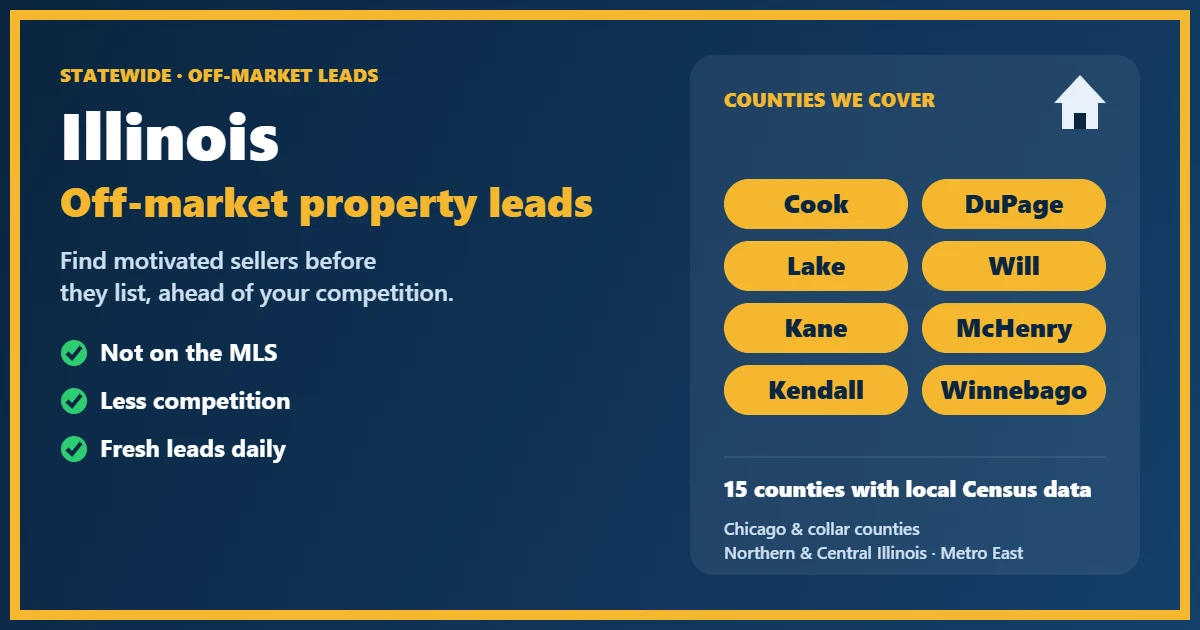
Illinois counties we cover
Below are Illinois’s 15 most populous counties. Each one is compared with the state medians: $263,300 home value, 67% owner-occupancy, 64% single-unit homes and 7.7% vacancy.
Cook County gets fewer county-level searches than its size suggests because most buyers search by city or neighborhood.
Cook County (Chicago): off-market investor snapshot
Chicago and its many suburbs, from Evanston and Oak Park to the south suburbs.
Local search demand
Resale demand: About 110 monthly searches for Cook County homes (led by “homes for sale cook county il”) point to a thinner buyer pool, so a rental or wholesale exit may be safer than a retail flip.
Investor note: Median home value is $324,500, 23% above the Illinois median of $263,300; 58% of homes are owner-occupied, 45% are single-unit, and 7.7% sit vacant. Only 45% of homes are single-unit, so two-flats, three-flats and condos make up much of the lead pool. Absentee landlords and estates are key targets; see our Cook County page.
DuPage County (Naperville, Wheaton): off-market investor snapshot
Naperville, Wheaton, Downers Grove, Elmhurst and other western suburbs.
Local search demand
Resale demand: About 910 monthly searches for DuPage County homes (led by “homes for sale dupage county il”) point to one of the deepest retail buyer pools on this list, which supports fix-and-flip exits.
Investor note: Median home value is $391,400, 49% above the Illinois median of $263,300; 73% of homes are owner-occupied, 70% are single-unit, and 4.5% sit vacant. The highest median value in Illinois and a 4.5% vacancy rate mean few distressed homes. Downsizing and estate sellers are the main openings; more on our DuPage page.
Lake County (Waukegan, Libertyville): off-market investor snapshot
Waukegan, North Chicago, Libertyville, Highland Park and the North Shore.
Local search demand
Resale demand: About 530 monthly searches for Lake County homes (led by “homes for sale lake county il”) point to steady mid-pack buyer interest, so resales should move at a fair price with realistic marketing time.
Investor note: Median home value is $345,700, 31% above the Illinois median of $263,300; 75% of homes are owner-occupied, 77% are single-unit, and 4.5% sit vacant. High incomes sit alongside older housing in Waukegan and North Chicago, so lead types vary sharply by town. See our Lake County page.
Will County (Joliet): off-market investor snapshot
Joliet, Bolingbrook, Plainfield and New Lenox southwest of Chicago.
Local search demand
Resale demand: About 180 monthly searches for Will County homes (led by “homes for sale will county il”) point to a thinner buyer pool, so a rental or wholesale exit may be safer than a retail flip.
Investor note: Median home value is $319,600, 21% above the Illinois median of $263,300; 83% of homes are owner-occupied, 86% are single-unit, and 3.9% sit vacant. 83% ownership and 86% single-unit homes make this a family resale market. Inherited houses and relocating owners are the best leads; details are on our Will County page.
Kane County (Aurora, Elgin): off-market investor snapshot
Aurora, Elgin, St. Charles and Geneva along the Fox River.
Local search demand
Resale demand: About 370 monthly searches for Kane County homes (led by “houses for sale kane county il”) point to steady mid-pack buyer interest, so resales should move at a fair price with realistic marketing time.
Investor note: Median home value is $327,000, 24% above the Illinois median of $263,300; 76% of homes are owner-occupied, 81% are single-unit, and 3.3% sit vacant. The vacancy rate of 3.3% is among the lowest in the state, so competition for any listed home is stiff. Off-market outreach to heirs and long-time owners pays off here.
McHenry County (Crystal Lake): off-market investor snapshot
Crystal Lake, Algonquin, McHenry and Woodstock in the far northwest suburbs.
Local search demand
Resale demand: About 1,040 monthly searches for McHenry County homes (led by “houses for sale mchenry county il”) point to one of the deepest retail buyer pools on this list, which supports fix-and-flip exits.
Investor note: Median home value is $308,100, 17% above the Illinois median of $263,300; 83% of homes are owner-occupied, 87% are single-unit, and 3.1% sit vacant. Buyers search here more than in any other county on this list, and vacancy is just 3.1%. Strong resale demand supports retail flips.
Kendall County (Oswego, Yorkville): off-market investor snapshot
Oswego, Yorkville and Plano, a fast-growing exurb west of Chicago.
Local search demand
Resale demand: About 60 monthly searches for Kendall County homes (led by “homes for sale kendall county il”) point to a thinner buyer pool, so a rental or wholesale exit may be safer than a retail flip.
Investor note: Median home value is $322,400, 22% above the Illinois median of $263,300; 84% of homes are owner-occupied, 91% are single-unit, and 2.6% sit vacant. The highest ownership (84%) and lowest vacancy (2.6%) in this group mean newer homes and few distressed sales. Life-event leads are the realistic path.
Winnebago County (Rockford): off-market investor snapshot
Rockford, Loves Park and Machesney Park in north-central Illinois.
Local search demand
Resale demand: About 190 monthly searches for Winnebago County homes (led by “homes for sale winnebago county il”) point to a thinner buyer pool, so a rental or wholesale exit may be safer than a retail flip.
Investor note: Median home value is $164,500, 38% below the Illinois median of $263,300; 66% of homes are owner-occupied, 75% are single-unit, and 7.2% sit vacant. Values are about 38% below the state median, which suits buy-and-hold investors. Tax-delinquent and probate homes are common lead types.
Rock Island County (Quad Cities): off-market investor snapshot
Rock Island, Moline and East Moline on the Illinois side of the Quad Cities.
Local search demand
Resale demand: About 70 monthly searches for Rock Island County homes (led by “homes for sale rock island county il”) point to a thinner buyer pool, so a rental or wholesale exit may be safer than a retail flip.
Investor note: Median home value is $150,400, 43% below the Illinois median of $263,300; 70% of homes are owner-occupied, 74% are single-unit, and 7.5% sit vacant. The lowest median value among these counties keeps entry prices low. Price repairs carefully, since resale buyers are fewer.
Peoria County (Peoria): off-market investor snapshot
Peoria, Peoria Heights and surrounding central Illinois towns.
Local search demand
Resale demand: About 410 monthly searches for Peoria County homes (led by “homes for sale peoria county il”) point to steady mid-pack buyer interest, so resales should move at a fair price with realistic marketing time.
Investor note: Median home value is $158,500, 40% below the Illinois median of $263,300; 67% of homes are owner-occupied, 76% are single-unit, and 8.4% sit vacant. One of the lowest-value markets on this list, with 76% single-unit homes. Inexpensive entry points favor cash-flow rentals over retail flips.
McLean County (Bloomington-Normal): off-market investor snapshot
Bloomington, Normal and Illinois State University.
Local search demand
Resale demand: About 730 monthly searches for McLean County homes (led by “homes for sale mclean county il”) point to one of the deepest retail buyer pools on this list, which supports fix-and-flip exits.
Investor note: Median home value is $208,400, 21% below the Illinois median of $263,300; 65% of homes are owner-occupied, 66% are single-unit, and 6.8% sit vacant. Steady buyer searches and moderate values give flippers a workable resale market, while student housing creates landlord leads.
Champaign County (Champaign-Urbana): off-market investor snapshot
Champaign, Urbana and the University of Illinois.
Local search demand
Resale demand: About 800 monthly searches for Champaign County homes (led by “homes for sale champaign county il”) point to one of the deepest retail buyer pools on this list, which supports fix-and-flip exits.
Investor note: Median home value is $211,500, 20% below the Illinois median of $263,300; 54% of homes are owner-occupied, 57% are single-unit, and 10.1% sit vacant. Only 54% of homes are owner-occupied because of the student rental market. Small landlords ready to exit are natural off-market sellers.
Sangamon County (Springfield): off-market investor snapshot
Springfield, the state capital, and nearby towns such as Chatham.
Local search demand
Resale demand: About 810 monthly searches for Sangamon County homes (led by “homes for sale sangamon county il”) point to one of the deepest retail buyer pools on this list, which supports fix-and-flip exits.
Investor note: Median home value is $176,300, 33% below the Illinois median of $263,300; 71% of homes are owner-occupied, 79% are single-unit, and 9.2% sit vacant. Values are a third below the state median and vacancy is above 9%. Estate and tired-landlord leads fit well with rental strategies.
Madison County (Edwardsville, Alton): off-market investor snapshot
Edwardsville, Alton, Granite City and Collinsville in the Metro East near St. Louis.
Local search demand
Resale demand: About 650 monthly searches for Madison County homes (led by “homes for sale madison county il”) point to steady mid-pack buyer interest, so resales should move at a fair price with realistic marketing time.
Investor note: Median home value is $173,000, 34% below the Illinois median of $263,300; 74% of homes are owner-occupied, 82% are single-unit, and 7.6% sit vacant. Lower values and 82% single-unit housing make modest flips and rentals workable. Older river towns can produce vacant and code-violation leads.
St. Clair County (Belleville): off-market investor snapshot
Belleville, O’Fallon, East St. Louis and Scott Air Force Base.
Local search demand
Resale demand: About 370 monthly searches for St. Clair County homes (led by “homes for sale st clair county il”) point to steady mid-pack buyer interest, so resales should move at a fair price with realistic marketing time.
Investor note: Median home value is $180,300, 32% below the Illinois median of $263,300; 68% of homes are owner-occupied, 77% are single-unit, and 12.8% sit vacant. At 12.8%, vacancy is the highest on this list. Vacant-property, tax and military-relocation leads deserve a close look.
U.S. Census Bureau, American Community Survey 2020–2024 5-year estimates. Home values are medians for owner-occupied homes, not current list prices.
Average monthly U.S. Google searches as of October 2026. Home searches combine “homes for sale” and “houses for sale” for each area. Seller searches combine “sell my house fast”, “we buy houses” and “cash home buyers”.
Want to find off-market properties in a specific neighborhood? ZIP-based lead lists make your outreach more relevant and help you work more efficiently.
What our customers say
Real investors share their experience with ForeclosuresDaily.com in short video reviews and press releases.









An Illinois lead workflow that holds up
- 1
Define the deal
Set your target property type, county or village, budget and exit before pulling any list.
- 2
Verify and contact
Confirm owner and property details, then reach out through respectful, compliant channels and track each response.
- 3
Offer on the numbers
Make written offers only when ARV, repairs and municipal requirements support them.
Your due diligence checklist
- Owner and mailing address confirmed
- Village or city transfer and inspection rules checked
- Sold comps, not active listings, used for ARV
- Repairs priced with contractor input
- Taxes, liens and title reviewed
- Attorney or title company lined up for closing
Some leads are worth pursuing now, some need follow-up later, and some should be skipped.
Illinois off-market questions
Answers to common buyer questions.
Have another question? Tell us your target ZIP codes and we will help you choose the right leads.
Are off-market deals the same as foreclosures?
No No. Foreclosure leads are one type. Off-market deals also come from probate, FSBO, absentee owners, code violations, tax delinquency, inheritance and eviction situations.
Can I buy an Illinois off-market property without an agent?
Yes Sometimes buyers and sellers deal directly. Many investors still use agents, attorneys, title companies, inspectors or contractors depending on the transaction.
How do I know if a deal is good?
Compare price, repair costs, ARV, holding costs, resale demand and your exit. A home that looks discounted may not work if repairs or timing go against you.
Are heirs always motivated sellers?
Often, but not always. Heirs who do not want to manage or repair a property may prefer a quick sale. Keep outreach respectful and based on verified information.
Start your Illinois off-market search
ForeclosuresDaily.com has supplied off-market leads nationwide since 2004. Define what a good deal means to you, build your list, verify the facts and speak with sellers respectfully.
Off-market deals reward patience and process. Make offers based on realistic numbers, and your property search becomes a system rather than a hunt.