Off-market properties in Rhode Island
Off-market properties Rhode Island owners sell privately can give investors, agents and buyers a head start before a home reaches the public portals. They include FSBO homes, inherited houses, distressed properties and owners open to flexible terms who have not listed. Whether you run a flipping business or want long-term holds, the job is the same: find motivated sellers, check the numbers carefully, and act before the wider market sees the deal.
What counts as an off-market property in Rhode Island
An off-market property is a home that may be available to buy even though it is not listed on the Multiple Listing Service (MLS) or advertised through other public channels.
Buyers usually find these homes through direct outreach, referrals, data providers, driving for dollars or targeted lead generation. That privacy is what gives off-market lists their value. Instead of competing with every buyer watching public listings, you can focus on owners who may have a reason to sell quietly.
The benefit is not a guaranteed discount. It is access, timing and, often, less competition.
Terms worth knowing
- Off-market property lists: curated records of potential sellers, filtered by owner situation, equity, condition or location.
- ARV: after-repair value, the expected resale price once renovations are done. It drives every flip budget.
- FSBO: “for sale by owner,” a sale without a listing agent.
- Verified leads: seller records checked for accuracy, motivation or contact quality before outreach.
- Private home sales: deals handled outside the most visible listing channels.
- Listed on the MLS
- Advertised to the public
- Every shopper can see it
- Not listed on the MLS
- Not publicly advertised
- Found by buyers who look beyond the portals
These opportunities may include
How beginners can find off-market properties Rhode Island sellers offer
Rhode Island is small and competitive. Well-priced listings draw owner-occupants, cash buyers and investors at the same time. Repeatable lead channels beat chasing random tips.
Driving for dollars
Drive target neighborhoods, note vacant or neglected homes, then research ownership before you reach out.
Direct mail
Send respectful letters to owners of inherited, vacant or absentee-owned property.
Absentee-owner leads →
FSBO outreach
Contact owners already selling privately who may prefer a faster or simpler transaction.
Inheritance leads
Reach heirs who do not want to maintain, repair or rent a property they inherited.
Inheritance leads →
Agent relationships
Build ties with agents who hear about sellers before they list.
Data platforms
Use off-market lists and ForeclosuresDaily.com’s platform to spot likely sellers and organize records.
See lead products →
A list alone does not buy a house. Conversations do, so pair data with steady human follow-up.
Can you flip a Rhode Island house with little or no money?
Sometimes, but “no money” usually means using someone else’s capital, not avoiding costs. Beginners may use private lenders, hard money, partnerships, seller financing or wholesale-style assignments where legal and appropriate. Each option carries obligations, risk and paperwork. Creative structures such as subject-to deals need careful legal review.
Flipping means buying a property, fixing or upgrading it, and reselling it quickly for a profit. It works only when the price, repair budget, holding costs and ARV leave room for risk. The cheapest flip is usually the one where you avoid over-renovating: focus on safety, function, curb appeal and updates that support resale value. Cosmetic projects cost less than structural repairs, but only if the numbers still work after purchase costs, utilities, insurance, taxes and selling expenses.
Beginner checklist
- Estimate ARV conservatively.
- Get repair quotes before closing when you can.
- Build in a contingency for surprises.
- Know your exit before you buy.
- Skip deals that only work in the best case.
- Track every cost like a business.
Evaluating an off-market deal before you commit
Exclusive access means little if the deal does not pencil out. Before you buy a cheap house, ask why it is cheap. It may need major repairs, have title problems, sit in a difficult location or come with a seller timeline you cannot meet.
Rhode Island’s small size makes neighborhood knowledge critical. A few streets can change buyer demand, renovation expectations and resale strategy.
| Question | What to check |
|---|---|
| Seller motivation | Is the owner after speed, certainty, privacy, convenience or price? |
| Property condition | Which repairs are obvious, and which hidden problems could exist? |
| Comparable sales | What have similar homes nearby sold for after upgrades? |
| Exit strategy | Will you flip, rent, wholesale or hold? |
| Offer structure | Could flexible terms solve the seller’s problem better than a higher price? |
Rhode Island counties we cover
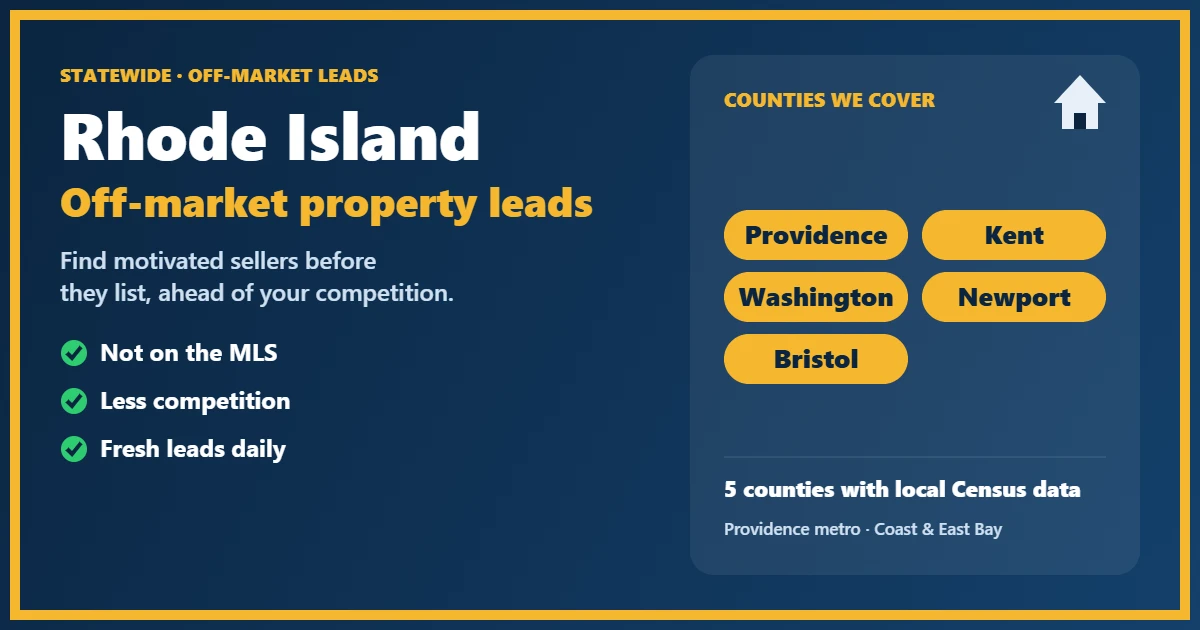
Rhode Island has five counties, and they behave very differently. Pick one to compare its Census figures with the state medians: $404,200 home value, 64% owner-occupancy and 9.1% vacancy.
Search counts reflect county-level home searches; most buyers search by town, so treat them as a floor.
Providence County: off-market investor snapshot
The urban core: Providence, Pawtucket, Cranston, East Providence, Woonsocket and North Providence, plus rural towns to the northwest.
Local search demand
Resale demand: Local listing searches are too few to measure, so assume a small buyer pool and price any resale or hold plan conservatively.
Investor note: Median home value is $373,600, 8% below the Rhode Island median of $404,200; 57% of homes are owner-occupied, 49% are single-unit, and 6.7% sit vacant. Fewer than half of homes are single-unit, so two- and three-family houses dominate the lead pool. Absentee landlords and inherited multifamily buildings are the best targets. See our Providence County page for more.
Kent County: off-market investor snapshot
Warwick, Coventry, West Warwick and East Greenwich, a mostly suburban belt south of Providence.
Local search demand
Resale demand: About 10 monthly searches for Kent County homes (led by “homes for sale kent county ri”) point to a thinner buyer pool, so a rental or wholesale exit may be safer than a retail flip.
Investor note: Median home value is $366,100, 9% below the Rhode Island median of $404,200; 73% of homes are owner-occupied, 71% are single-unit, and 4.8% sit vacant. The tightest vacancy rate in the state leaves few empty homes, so leads come from life events such as probate, divorce and downsizing rather than neglect. More detail is on our Kent County page.
Washington County (South County): off-market investor snapshot
South Kingstown, Narragansett, Westerly, North Kingstown and Charlestown along the southern shore.
Local search demand
Resale demand: About 90 monthly searches for South County homes (led by “homes for sale washington county ri”) point to one of the deepest retail buyer pools on this list, which supports fix-and-flip exits.
Investor note: Median home value is $510,800, 26% above the Rhode Island median of $404,200; 78% of homes are owner-occupied, 80% are single-unit, and 20.8% sit vacant. One in five homes is vacant, mostly seasonal beach houses. Out-of-state owners and heirs of summer cottages are natural prospects for a quiet sale.
Newport County: off-market investor snapshot
Newport, Middletown, Portsmouth, Jamestown, Tiverton and Little Compton on Aquidneck Island and the East Bay.
Local search demand
Resale demand: About 20 monthly searches for Newport County homes (led by “homes for sale newport county ri”) point to steady mid-pack buyer interest, so resales should move at a fair price with realistic marketing time.
Investor note: Median home value is $609,700, 51% above the Rhode Island median of $404,200; 68% of homes are owner-occupied, 69% are single-unit, and 15.6% sit vacant. Newport County has the highest median value in Rhode Island and many second homes. Estate sales and owners who want privacy are the main off-market openings.
Bristol County: off-market investor snapshot
Bristol, Warren and Barrington on the East Bay peninsula.
Local search demand
Resale demand: About 20 monthly searches for Bristol County homes (led by “homes for sale bristol county ri”) point to steady mid-pack buyer interest, so resales should move at a fair price with realistic marketing time.
Investor note: Median home value is $513,800, 27% above the Rhode Island median of $404,200; 72% of homes are owner-occupied, 70% are single-unit, and 7% sit vacant. Incomes are the highest in the state and vacancy is low. Expect fewer distressed deals and more downsizing or estate sellers who value a simple, private sale.
U.S. Census Bureau, American Community Survey 2020–2024 5-year estimates. Home values are medians for owner-occupied homes, not current list prices.
Average monthly U.S. Google searches as of October 2026. Home searches combine “homes for sale” and “houses for sale” for each area. Seller searches combine “sell my house fast”, “we buy houses” and “cash home buyers”.
Want to find off-market properties in a specific neighborhood? ZIP-based lead lists make your outreach more relevant and help you work more efficiently.
What our customers say
Real investors share their experience with ForeclosuresDaily.com in short video reviews and press releases.









Working a Rhode Island lead from list to offer
- 1
Narrow the target
Choose a county or town and one or two seller types, such as absentee owners of Providence multifamily or heirs of South County cottages.
- 2
Check the record
Confirm the owner, mailing address, liens and occupancy before any outreach. Many seasonal owners live out of state.
- 3
Make a clear offer
Talk with the owner, inspect where allowed, price repairs and comps, and put every term in writing.
Your due diligence checklist
- Owner identity and authority to sell
- Lead-paint and age-of-home issues for older housing
- Multifamily rent rolls and lease status
- Flood-zone and coastal insurance costs
- Sold comps from the same neighborhood
- Clear title and municipal liens
Better data points you to owners with a real reason to talk. The final decision still rests on due diligence.
Rhode Island off-market FAQ
Quick answers for investors and buyers.
Have another question? Tell us your target ZIP codes and we will help you choose the right leads.
Is flipping houses in Rhode Island worth it?
Only when the deal leaves enough margin for repairs, holding time, financing and resale uncertainty. It is not worth it if you are guessing at renovation costs or counting on unrealistic resale prices.
Are off-market listings legal?
Yes Yes. Private sales are legal, but marketing, contracts, disclosures, licensing and assignment rules vary, so work with qualified local professionals when needed.
Who uses off-market property lists?
Investors, wholesalers, agents and buyers use them to find potential sellers before a property is widely advertised.
What makes Rhode Island different?
It is compact and dense, and many of its homes are older multifamily or seasonal coastal properties. Street-level knowledge matters more here than in larger states.
Find your next Rhode Island deal
Off-market properties can give you less competition, earlier seller conversations and more control over deal flow. Combine reliable lead data, careful analysis and respectful outreach.
Whether this is your first flip or your fiftieth, focus on verified data, conservative numbers and sellers whose needs you can truly meet.