Wholesale Real Estate Lowell Massachusetts
Wholesale real estate in Lowell rewards investors who reach motivated sellers first. Instead of competing on the MLS, ForeclosuresDaily.com helps you find owners facing probate, foreclosure, or divorce, so you can sign a discounted contract and assign it to a cash buyer.
Market data: Realtor.com Middlesex County housing market, October 2026. Zillow Home Value Index for Middlesex County: $814,047 (up 1.6% from a year earlier), August 2026. View homes on Zillow.

Listed and sold 25 properties and personally bought and sold four fix-and-flip properties, all generated from probate leads.
Carolynn Castillo
Realtor & Broker · eXp Realty
Why wholesale real estate in Lowell?
Wholesaling needs little capital because you control a property with a contract and an earnest money deposit, not a mortgage. In addition, your buyer handles the repairs, so you never manage contractors, and many assignments close in weeks rather than months.
Lowell has about 115,554 residents and sits in Middlesex County. The ZIP codes with the most homes for sale today are 01852, 01854, and 01851, so that is where most motivated sellers are.

Shannon Thompson
Investor · Joe Homebuyer of Atlanta
Watch Shannon Thompson share their experience using ForeclosuresDaily.com.
How does wholesaling real estate work in Lowell?
Every wholesale deal follows the same path, from the first lead to the assignment fee:
Find a distressed property
Initially, use targeted lead generation to find owners with a reason to sell, such as heirs, tired landlords, or owners facing foreclosure.
Run the numbers
Next, estimate the after-repair value (ARV) from nearby sales, because your offer depends on it.
Sign a purchase contract
Then agree on a price that leaves room for your buyer’s profit as well as your assignment fee.
Find a cash buyer
After that, match the deal with a flipper, landlord, or other cash buyer from your list.
Assign the contract
In addition, transfer your rights under the contract to the buyer in exchange for your fee.
Collect your fee
Finally, the title company or closing attorney usually pays your assignment fee at closing.

Andrew Litchfield
Webinar host
Andrew Litchfield hosted a ForeclosuresDaily.com monthly webinar for real estate investors.
Motivated sellers who want to liquidate fast
For this reason, ForeclosuresDaily.com’s off-market real estate platform covers every major distress signal in Lowell, cross-referenced with tax rolls and property appraiser records.

Anthony Coletti
Real estate investor
Watch Anthony Coletti share their experience using ForeclosuresDaily.com.
How do you calculate a wholesale offer in Lowell?
Every offer starts with the ARV, which is what the home will be worth once it is fixed. For example, the 70% Rule says your buyer should pay no more than 70% of ARV minus repairs. Because your assignment fee comes out of that number, your contract price must be even lower.
For instance, here is the math using the Middlesex County median listing price as the ARV, an 8% repair budget, and a typical assignment fee.
Wholesale offer example

Jeremy Resmer
Webinar host
Jeremy Resmer hosted a ForeclosuresDaily.com monthly webinar for real estate investors.
Lowell ZIP codes to watch
Start your search in these Lowell ZIP codes, and then expand as you learn which areas your buyers want. Next, choose a ZIP code from the menu to open its investing data.
CentralvilleZIP 01850$517,999Flip & wholesale
Centralville (01850) market snapshot
In addition, the Zillow Home Value Index is $452,294 (up 0.5% from a year earlier) as of August 2026.
Investor note: Meanwhile, the median price is up 18.6% from a year earlier, and inventory is up 51.9%. Also, check code-violation records here for distressed homes.
Also see the full 01850 market report on Realtor.com →Then view 01850 homes on Zillow →
Choose a ZIP code from the menu to see its investing data, then compare markets. Market data: Realtor.com, October 2026, and Zillow Home Value Index, August 2026. Also, gross rent yield is 12 months of median rent divided by the median listing price; the max offer assumes repairs of 8% of the median price.

Antonio Stringfield
Probate investor · Los Angeles
Watch Antonio Stringfield share their experience using ForeclosuresDaily.com.
How do you build your buyers list in Lowell?
Build your buyers list before you sign your first contract. Your best buyers are cash buyers who can close quickly, such as flippers, landlords, and small builders.
- First of all, attend local real estate investor meetups.
- Also, review recent cash sales in county records to find active buyers.
- Then connect with title companies, hard money lenders, and property managers.
- Finally, ask every buyer for their buy box: areas, price range, and rehab level.
What does assigning contracts mean in Massachusetts?
Assigning contracts means transferring your rights as the buyer under a purchase agreement to another investor. However, the rules differ by state, so review your contracts with a Massachusetts real estate attorney before you start.

Nancy Wallace-Laab
Investor · nearly 20 years
Nancy focuses on the best outcome for both the seller and the investor, drawing on nearly 20 years of real estate investing experience.
Wholesale Real Estate Lowell Massachusetts
Wholesale real estate in Lowell, Massachusetts connects investors, cash buyers, landlords, flippers, and motivated sellers with opportunities that may not be visible on the open market. If you are looking for Lowell investment properties, a private house sale, a cheap house for sale, or wholesale real estate deals tied to situations like Divorce, Inheritance, Pre-probate, or distress, an off-market approach can help you move faster and evaluate options with less noise. ForeclosuresDaily off-market Platform is built for people who want a more direct way to find, review, and act on local property opportunities in Lowell and the surrounding Merrimack Valley.
Key points for Lowell investors
The Lowell housing market has a wide range of property types, from older multifamily buildings and single-family homes to small rental properties and value-add houses that may need repairs. For investors, that variety can create opportunity, but it also makes clean deal flow important. A location-focused wholesale strategy helps buyers focus on ZIP codes, seller situations, property condition, and exit strategies, rather than wasting time on listings that do not align with their goals.
Wholesale real estate is about identifying a property opportunity, evaluating whether it works for an investor, and connecting the right buyer with the right seller. In Lowell, that may mean a landlord looking to sell a tired rental, a family managing an inherited house, an owner facing financial pressure, or a property that isn't a fit for the traditional listing process. These situations require speed, discretion, and realistic numbers.
For buyers
Wholesale real estate searches in Lowell, Massachusetts, are usually driven by one goal: finding properties with enough room for repairs, holding costs, resale plans, rental income, or long-term appreciation. Not every property is a deal, and not every discounted property is worth buying. The value comes from reviewing opportunities through a local lens before spending time on walkthroughs, offers, and due diligence.
For sellers
A private house sale can be appealing when privacy, timing, convenience, or the property's condition matters more than preparing the house for public showings. Some owners do not want open houses. Others do not want to repair an older property before selling. A wholesale or investor-focused sale may provide a simpler path when the seller understands the tradeoff between convenience and a traditional retail sales process.
ForeclosuresDaily off-market Platform supports this kind of local search by helping users focus on motivated seller signals and off-market opportunities. The platform is especially useful for people who want to monitor the market consistently rather than wait for the perfect MLS listing to appear. In a city like Lowell, where small differences between neighborhoods, property types, and repair needs can change the outcome of a deal, organized off-market access can make the process more practical.
What makes a Lowell wholesale real estate deal worth reviewing?
A Lowell wholesale real estate deal is worth reviewing when the property, seller situation, location, price expectation, and buyer strategy all have a reasonable path to alignment. A low asking price alone is not enough. Investors also need to account for repairs, closing costs, holding time, resale value, tenant issues, title concerns, and the condition of the surrounding Lowell housing market.
The best opportunities often begin with a clear reason the owner may prefer a direct sale. That reason might involve Divorce, Inheritance, Pre-probate, deferred maintenance, vacancy, an out-of-area owner, or a property that no longer fits the family’s plans. These circumstances do not automatically create a discount, but they can create a need for a practical solution.
What this means in Lowell
A good review process considers both the numbers and the real-world friction around the property. A house may look attractive online but need major work after inspection. A multifamily property may have rental upside but require careful review of leases, utilities, and occupancy. A cheap house for sale may still be too expensive if the repairs, code issues, or resale path do not make sense.
When reviewing wholesale real estate deals in Lowell, buyers should pay attention to:
This kind of review protects both sides. Sellers get more serious conversations instead of vague promises. Buyers avoid chasing properties that do not match their capital, risk tolerance, or timeline.
Local market snapshot: Lowell
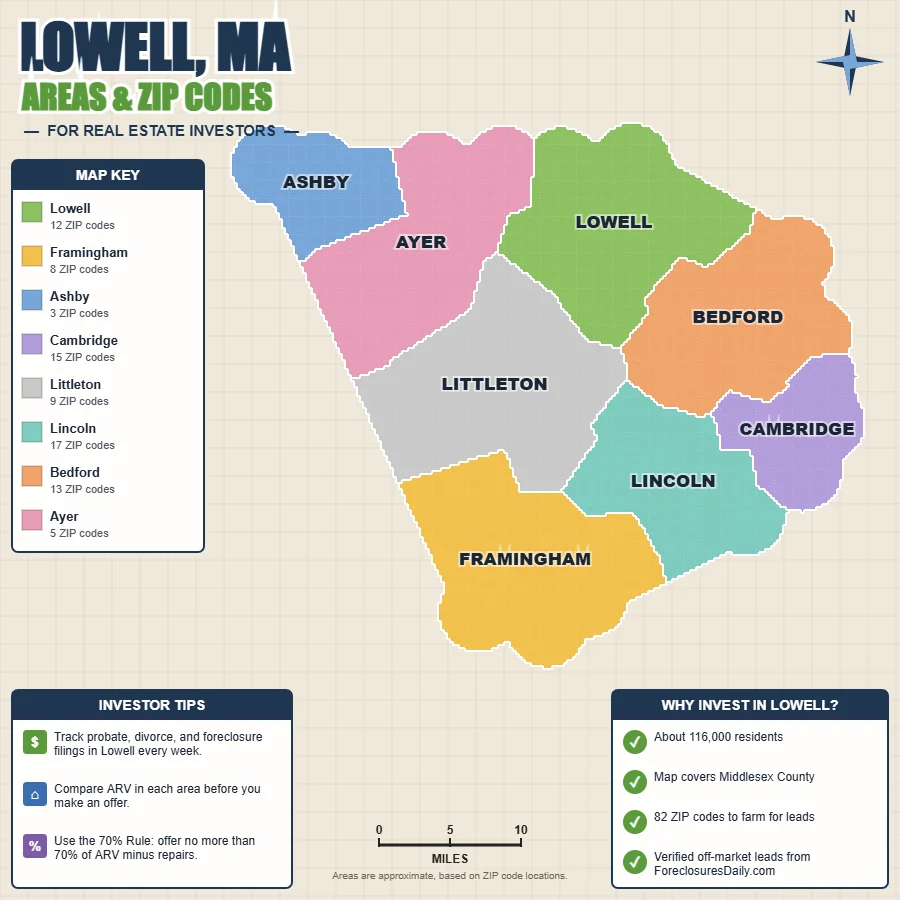
Lowell is home to about 116,000 residents. Its ZIP codes cover neighborhoods across the city, and motivated-seller situations such as inherited homes, tired rentals, and pre-foreclosures show up in every one of them.
With a population of this size, Lowell produces a steady flow of probate filings, divorces, and foreclosure notices every year. Investors who track these records and reach owners early tend to find the best off-market deals.
Off-market opportunities across Lowell ZIP codes
Lowell is not one uniform market. A property in 01850 may require a different investment lens than a similar-looking property in 01852, and a multifamily property in 01854 may call for a different strategy than a single-family home in 01851. Investors searching for wholesale real estate opportunities in Lowell, Massachusetts, should think locally, not just citywide.
The primary Lowell ZIP codes are 01850, 01851, 01852, 01853, and 01854. These ZIP codes can include different housing stock, neighborhood patterns, commute considerations, rental demand, and renovation expectations. A strong off-market strategy uses those details to filter opportunities before the buyer spends time on deep analysis.
In practical terms, ZIP code awareness helps investors decide which type of property to pursue and which numbers to use. A rental investor may prioritize stable tenant demand and manageable repair scope. A fix-and-flip buyer may care more about resale buyer expectations and how much renovation the neighborhood can support. A buy-and-hold investor may be more comfortable with an older building if the long-term rent and maintenance assumptions work.
For sellers, ZIP-code targeting can also be helpful. A homeowner considering selling a private home may not know which investors are interested in their part of Lowell. When the property matches the needs of buyers already focused on the area, the conversation can become more direct and realistic.
Useful local filters for Lowell investment properties include:
Using these filters makes the search more focused. Instead of asking whether Lowell is a good market in general, the better question is whether a specific property in a specific ZIP code can support a specific plan.
Why investors use off-market deal flow in Lowell
Public listings can be useful, but many investors also want access to properties before they become widely marketed. Once a property reaches a large audience, competition can rise quickly. That does not mean every off-market lead is better, but it does mean the buyer may have a chance to evaluate the situation before the market becomes crowded.
Off-market deal flow is especially important for investors looking for distressed, under-improved, inherited, or privately sold properties. These houses may not show well online. Some may need cleanout, repairs, or title coordination. Others may involve sensitive family or financial circumstances where the seller does not want public exposure.
ForeclosuresDaily off-market Platform can fit into this process by helping users monitor opportunities tied to distress indicators and owner motivation. The goal is not to chase every possible lead. The goal is to build a repeatable pipeline so buyers can recognize patterns, compare options, and act when the numbers make sense.
Investors in Lowell often use off-market searches for:
A consistent deal flow system also helps investors avoid emotional decision-making. When a buyer only sees one potential deal every few months, it is easy to overpay or overlook problems. When the buyer sees more opportunities and tracks them carefully, the decision becomes more disciplined.
A private house sale is not only for distressed owners. It can be useful whenever a homeowner wants a quieter, faster, or more flexible selling process. In Lowell, that may include older homes needing work, rental properties with management headaches, inherited houses, properties with deferred maintenance, or homes tied to major life changes.
A seller may choose a private sale because the property is not ready for photos, open houses, or traditional buyer financing. They may not want to repair peeling paint, outdated kitchens, old flooring, broken systems, or long-neglected exterior issues. They may also prefer to avoid repeated showings, public price reductions, or weeks of uncertainty.
Common situations that can lead to off-market or wholesale conversations include:
These situations are personal, and not every owner should choose an investor sale. A traditional listing may produce a higher price in some cases, especially if the home is in good condition and the seller has time. The benefit of an off-market conversation is that the owner can compare options and decide whether convenience, certainty, speed, and reduced preparation are worth considering.
A practical path from lead to closing
A wholesale or off-market transaction should be organized, transparent, and grounded in due diligence. Buyers need enough information to make a serious decision. Sellers need to know what is being offered, what happens next, and what obligations exist before they sign anything.
The process can vary depending on property condition, title status, buyer financing, local requirements, and the seller’s timeline. Still, most conversations about Lowell investment properties follow a practical sequence. When each step is handled carefully, the process is easier to understand and less stressful for everyone involved.
A typical path may look like this:
Identify the opportunity:
A property may surface through off-market research, ForeclosuresDaily off-market Platform, seller outreach, referrals, public records, foreclosure-related data, or owner contact.
Understand the seller’s goals:
The first conversation should clarify why the owner is considering a sale, how soon they want to move, whether anyone else has ownership interest, and what concerns need to be addressed.
Review basic property details:
Buyers should gather information about property type, condition, occupancy, utilities, repairs, liens, taxes, and access for inspection.
Estimate value and repair costs:
The buyer compares local sales, rental expectations, visible condition, and the likely scope of repairs. Conservative numbers are usually safer than optimistic assumptions.
Make or review an offer:
An offer should reflect the property's condition, the buyer’s costs, and the seller’s priorities. It should be clear, written, and easy to understand.
Complete due diligence:
This can include inspections, contractor reviews, title work, lease reviews, municipal checks, and confirmation that all decision-makers are involved.
Coordinate closing or assignment:
If the transaction moves forward, the parties will work toward closing or a properly documented assignment, depending on the deal structure and applicable requirements.
Prepare for transfer:
The final stage may involve cleanout planning, tenant communication, utility coordination, access, keys, and final settlement details.
This sequence matters because wholesale real estate deals can move quickly. Speed should not replace clarity. A buyer who skips due diligence may inherit expensive problems, and a seller who signs without understanding the terms may feel trapped. The best outcomes happen when both sides know what is expected.
Local market awareness matters more than broad assumptions
It is easy to speak about the Lowell housing market as if a single trend applied everywhere, but investors should be more specific. A property’s value can be affected by the block, nearby sales, layout, parking, unit mix, condition, tenant status, repair history, and the amount of work needed to meet buyer expectations. Two houses with similar square footage can produce very different outcomes.
Local market
Awareness also helps investors avoid over-improving a property. A renovation should match the realistic resale or rental audience. Spending too much on finishes that the market will not reward can reduce profit, while under-improving a property can make it harder to sell or rent. The right scope depends on the property’s condition and the buyer’s plan.
For rental buyers
The Lowell housing market requires careful attention to income and expenses. Property taxes, insurance, utilities, repairs, vacancy, management, and capital reserves all affect performance. A building may look profitable before these items are included, then become thin once the full cost picture is considered.
For flippers
Resale value and timing are critical. A project that requires heavy renovation needs enough spread between acquisition, repairs, carrying costs, and resale value. If that spread is too narrow, the investor may be taking construction risk without enough upside.
For wholesalers
Accurate local numbers are essential because buyers will quickly reject unrealistic deals. A wholesale opportunity should be presented with enough context for the end buyer to evaluate it, not with inflated after-repair values or vague repair guesses. Credibility grows when the deal summary is practical, and the risks are clear.
Ready to start? Talk to our team about leads in your market →
Motivated Sellers Who Want to Liquidate Fast
Every lead starts with a life event that gives the owner a reason to sell. Click any lead type to see our products.
Probate Leads
Estates in probate, where executors and heirs often need to sell the property to settle the estate.
Foreclosure Leads
Pre-foreclosure filings for homeowners facing a deadline, where a quick sale can protect their equity.
Divorce Leads
Divorce filings where the marital home must be sold or divided, often on a court timeline.
Inheritance Leads
Heirs who have inherited a property, often while living out of state, and would rather sell than manage it.
Life Leads
Owners facing major life changes, such as a move or downsizing, who need a fast sale.
How ForeclosuresDaily off-market Platform supports Lowell deal discovery
ForeclosuresDaily off-market Platform is useful for investors and real estate professionals who want to monitor potential opportunities rather than relying solely on public listings. In a market like Lowell, where older housing stock and varied owner situations can create off-market potential, consistent research can help users stay organized.
The platform’s value is strongest when it is used as part of a disciplined workflow. It can help point users toward potential leads, but buyers still need to verify property details, confirm ownership, understand the seller's needs, inspect the property, and run their own numbers. Technology can improve discovery, but it does not replace judgment.
Investors can use an off-market platform to:
A strong buy box is important before using any platform. Investors should define the property type they want, the ZIP codes they prefer, the minimum spread they need, and the repairs they can handle. Without those rules, even a good lead source can become overwhelming.
Buyer profiles served in Lowell
Different investors look for different kinds of Lowell investment properties. A landlord may want durable rental income, while a flipper may want a house that can be renovated and resold. A wholesaler may focus on finding opportunities that fit another buyer’s exact criteria. A developer or experienced operator may be willing to solve more complex problems if the numbers justify the work.
The same property can be a good fit for one buyer and a poor fit for another. For example, an older two-family property with tenants may appeal to a landlord who understands local rental operations. The same property may not work for a flipper who needs vacancy and a quick resale timeline. Matching the deal to the buyer profile is what turns raw lead data into usable opportunity.
ForeclosuresDaily off-market Platform can support several buyer types in Lowell:
Each buyer should still perform independent due diligence. Off-market access is the first step in the process, not the final decision. The best buyers combine lead flow with local analysis, contractor input, title review, and a clear investment plan.
Property types commonly reviewed by Lowell investors
Lowell’s housing stock gives investors multiple ways to approach the market. Some buyers prefer simple single-family properties because they are easier to understand and may appeal to a broad resale audience. Others prefer small multifamily properties because the income potential can support a long-term rental strategy.
Property type affects everything: financing, repairs, buyer pool, rent assumptions, resale expectations, inspection concerns, and management. Before pursuing a wholesale deal, investors should know which property types align with their goals and which to avoid.
Common property types include:
A cheap house for sale may catch attention, but the property type and condition determine whether the price is actually attractive. A low entry point can quickly become a liability if the roof, systems, foundation, or interior needs major work. Investors should review the whole project, not just the purchase price.
How sellers benefit from a direct investor conversation
Sellers considering a private house sale in Lowell often want a clear answer to a simple concern: “Can I sell without fixing everything first?” In many investor-focused conversations, the answer may be yes, depending on the property, title, buyer interest, and sale terms. This can be especially useful for owners dealing with Inheritance, Divorce, vacancy, major repairs, or a house that would be difficult to show to retail buyers.
A direct investor conversation can reduce the need for preparation. Instead of painting, staging, cleaning out every room, or completing renovations before listing, the owner can market the property as-is. That does not mean every offer will meet the seller’s expectations, but it gives the seller another option to compare against a traditional sale.
Seller benefits may include:
The tradeoff is important. Investor offers are often based on risk, repairs, and resale or rental economics, so they may be lower than a retail price. A seller should consider both price and convenience before deciding.
Responsible outreach and respectful communication
Off-market real estate only works when communication is respectful. Owners dealing with Divorce, Inheritance, Pre-probate, foreclosure pressure, or family transitions may be under stress. A pushy approach can damage trust and make the process harder for everyone.
Responsible investors should be clear about who they are, why they are reaching out, and what kind of transaction they are proposing. If the owner is not interested, that should be respected. If the owner is interested, the next step should be explained in simple language.
Good outreach practices include:
This approach is not only more ethical but also better business. Serious sellers are more likely to engage when they feel respected. Serious buyers are more likely to close when the seller understands the process from the beginning.
Due diligence before buying a Lowell wholesale property
Due diligence protects the buyer from surprises that can turn a promising deal into a costly mistake. It also protects the seller by making sure the buyer understands the property before closing. In wholesale real estate, speed matters, but speed without verification is risky.
A buyer should start by confirming the basics. Who owns the property? Are all owners willing and able to sign? Is the property occupied? Are there tenants, leases, or access restrictions? Are there liens, unpaid taxes, or title issues that must be resolved?
The next step is property-level review. The condition should be evaluated against a realistic repair budget, not a hopeful guess. If the buyer is not experienced in estimating repairs, contractor input is important. Older homes may have hidden costs, especially when systems have not been updated.
A practical due diligence checklist includes:
This checklist does not guarantee a successful investment, but it creates a more disciplined process. A buyer who knows what to verify is less likely to rely on guesswork.
Wholesale deals, assignments, and clear expectations
Wholesale real estate can involve a direct purchase, an assignment of contract, or another structure depending on the parties and applicable requirements. The key is that everyone should understand the arrangement. If a contract may be assigned, that should be handled clearly and properly.
Sellers should know who is involved, what price has been agreed to, what contingencies apply, and what happens before closing. Buyers should know whether they are purchasing directly from the seller or receiving an assigned contract from another buyer. Confusion creates mistrust and can jeopardize the transaction.
For wholesalers, credibility depends on accurate numbers and transparent communication. Overstating the after-repair value, underestimating repair costs, or hiding important property issues may attract short-term attention but cause long-term damage. Serious cash buyers want realistic opportunities, not inflated marketing language.
A clean wholesale presentation should include:
The more complete the information, the easier it is for a serious buyer to decide. Vague deals attract questions. Clear deals attract action.
A realistic example of a Lowell off-market opportunity
Consider a family that inherited an older single-family house in Lowell. The home may be located in one of the primary ZIP codes, such as 01851 or 01852, and it may need cleaning, cosmetic updates, and system repairs. The heirs live outside the area and do not want to manage contractors, showings, or months of preparation.
A traditional listing might be a strong option if the family has time, the house is safe to show, and they want maximum exposure. But if the property needs work, contains personal belongings, or has unresolved family logistics, a private house sale may also be worth considering. An investor can review the house as-is and make an offer based on the required repairs, the closing timeline, and the expected resale or rental plan.
From the buyer’s side, the opportunity still needs careful review. The investor would estimate cleanout, repairs, carrying costs, and resale value. If the numbers work, the buyer can proceed. If the spread is too thin or title issues are unresolved, the buyer may pass or wait until the situation becomes clearer.
This example shows why off-market real estate is not only about finding discounted property. It is about matching a seller’s need for simplicity with a buyer’s ability to solve property problems while still making the numbers work.
Using Lowell investment properties as part of a broader strategy
Investors should treat Lowell investment properties as part of a defined portfolio strategy, not as isolated deals. A buyer who wants rental income should consider tenant demand, maintenance capacity, financing, cash reserves, and long-term management. A buyer who wants flips should consider contractor availability, resale timing, renovation scope, and buyer expectations.
Wholesale real estate deals can support both strategies, but the evaluation is different. A rental buyer may accept a lower immediate spread if the property can produce durable income and long-term value. A flipper usually needs a wider margin because the investment depends on the execution of renovation and resale.
A practical investor strategy should answer:
Without these answers, a buyer may waste time reviewing properties that were never a fit. With these answers, off-market deal flow becomes easier to filter and act on.
Foreclosure-related opportunities require speed and care
Foreclosure-related property searches can attract investors looking for motivated sellers, but these situations require special care. An owner facing foreclosure pressure may be dealing with financial stress, limited time, and uncertainty about options. Investors should avoid fear-based tactics and focus on clear communication.
For buyers, foreclosure-related opportunities may involve title review, payoff information, deadlines, and coordination with the seller’s advisors or lender-related processes. A property can look promising but fail to close if the timeline is too short or the payoff cannot be handled. This is why verification matters early.
For sellers, a direct conversation with an investor may be one option among several. The owner may also need to speak with a housing counselor, attorney, lender, or financial advisor depending on the situation. No marketing page should replace professional advice when legal, tax, or foreclosure questions are involved.
ForeclosuresDaily off-market Platform can help identify possible foreclosure-related leads, but the human process still matters. The best outcomes come from respectful outreach, realistic timelines, and clear documentation.
Inheritance and Pre-probate property conversations in Lowell
Inherited property can create opportunity and complexity at the same time. A home may have emotional value, deferred maintenance, multiple heirs, unclear expectations, or unresolved legal steps. In Lowell, inherited houses may also be older properties that need updates before a traditional buyer would be comfortable buying them.
Pre-probate situations require particular caution. Family members may be discussing what will happen to a property before all legal authority is finalized. Investors can express interest, gather general information, and discuss possible options, but the transaction should not proceed unless the proper parties have the authority to sell and the necessary legal process is followed.
For families, a private house sale may reduce the burden of repairs, cleanout, and long-distance management. For buyers, the opportunity may be attractive if the property needs repairs and the family values convenience. But patience is important because inheritance-related transactions can require more communication and documentation than a simple owner-occupied sale.
A respectful inheritance or Pre-probate process should include:
These conversations are often sensitive. A good investor understands that the property is not just an asset on a spreadsheet; it may represent years of family history.
Divorce-related property sales need privacy and structure
Divorce can make property decisions difficult because timing, equity, communication, and court-related requirements may all be involved. In some cases, selling the house is part of moving forward. In others, one party may want to keep the property while the other wants to sell.
A private house sale may appeal to divorcing owners who want less public exposure and fewer showings. It can also help when the home needs work, and neither party wants to coordinate repairs. However, both parties must understand and agree to the process when required, and legal guidance may be important.
For investors, Divorce-related opportunities should be handled with extra care. Communication should be neutral, documents should be clear, and pressure should be avoided. The goal is to provide a practical option, not to exploit stress.
A structured process helps reduce conflict. Written offers, defined timelines, clear contingencies, and professional closing coordination can make the transaction easier to evaluate. If the offer does not work for the owners, they can choose another path.
Start reviewing Lowell wholesale real estate opportunities
If you are searching for wholesale real estate deals in Lowell, the next step is to define your buy box and use a consistent off-market process. Focus on the ZIP codes that matter to your strategy, including 01850, 01851, 01852, 01853, and 01854. Decide whether you want single-family houses, multifamily rentals, affordable houses for sale, private house-sale leads, foreclosure-related properties, Inheritance situations, Divorce-related sales, or Pre-probate conversations.
ForeclosuresDaily off-market Platform can help you build a more organized approach to Lowell investment properties. Use it to identify potential leads, compare opportunities, and prioritize properties that warrant deeper review. Then support every lead with local analysis, respectful outreach, and careful due diligence.
For sellers, the next step is simple: gather basic information about the property, think through your ideal timeline, and compare a direct conversation with an investor to a traditional listing. You do not need to know the cost of every repair before starting the conversation. You do need to understand your priorities, ask clear questions, and review any offer carefully before moving forward.
For buyers, the best time to prepare is before the deal appears. Line up your capital, contractor input, title support, and decision-making process now. When a serious Lowell opportunity comes through, you will be ready to evaluate it quickly and confidently.
Get Off-Market Leads Before Your Competition
ForeclosuresDaily.com has supplied off-market real estate leads since 2004 on a nationwide platform. Reach motivated sellers before their homes are listed on the MLS.

Phillip Warrick
Full-time investor since 2003
Full-time real estate investor since 2003, with over 20 years of experience.
ForeclosuresDaily off-market opportunities before your competition
In fact, since 2004, ForeclosuresDaily.com has helped investors, wholesalers, flippers, and agents reach motivated sellers first.
More wholesaling guides in Massachusetts
Compare nearby markets before you choose where to farm. For example, these local guides cover other Massachusetts cities and counties:
Norfolk County · Plymouth County · Wholesale House Prices Boston · Worcester County
Also, see Wholesaling Real Estate for Profit for the profit math and guides in every state.
Wholesaling questions for Lowell
How do you wholesale real estate in Lowell?
First of all, find a motivated seller through probate, pre-foreclosure, or absentee-owner leads. Then sign a contract at a discount, and finally assign it to a cash buyer for a fee.
Is wholesaling legal in Massachusetts?
Wholesaling is legal in most states, but the rules vary. For example, some states require disclosures or a license for certain activities, so have a Massachusetts real estate attorney review your contracts.
How much can you make wholesaling in Lowell?
Assignment fees vary by deal. For instance, a fee of about 3% on a home priced near the Lowell median of $849,900 would be roughly $25,000.
Which Lowell ZIP codes have the lowest entry prices?
Among the ZIP codes in this guide, the lowest median listing prices are in 01854 (Pawtucketville) at $449,900, 01852 (Lowell) at $469,900, and 01850 (Centralville) at $517,999, based on Realtor.com data from October 2026.
Where do Lowell foreclosures come from?
Most start with missed mortgage payments, so pre-foreclosure filings appear months before an auction. As a result, investors who reach owners early can buy before the home is listed.
Get Lowell wholesale leads today
Fresh, targeted, off-market data for Centralville, Lowell, Pawtucketville, and beyond.
Get Started →