First time home buyer programs and loans: a complete guide
First time home buyer programs make the jump from renting to owning far more manageable.
Down payment assistance, grants and low-interest loans cut the upfront cost of a house, condo or townhome, and many include education that walks you through each step. Here is how they work, who qualifies and how to choose.










Hear From Our Customers
Click a profile to watch their video or read their story.





Who counts as a first-time home buyer?
For most programs, a first-time buyer is someone who hasn’t owned a home in the past three years. That surprises many people.
In other words, if you sold a home several years ago and have rented since, you may qualify again. Still, rules vary, so check each program’s definition before you rule yourself out.

First time home buyer programs exist at the federal, state and local level, and through nonprofits and lenders. Some give cash toward a down payment or closing costs, some offer grants you never repay and others offer loans with low down payments or lower rates.
| Without a program | With a program |
|---|---|
| Larger down payment | Down payment assistance |
| Market interest rate | Possibly a lower rate |
| Navigating alone | Education and support |
Benefits of first time home buyer programs
Owning a home is a big milestone, and the right mix of help can save thousands of dollars upfront and over the life of the loan.


Every program has trade-offs, such as residency rules or repayment if you sell early. Read the terms so the benefits stay benefits.
Types of first time home buyer programs and loans
Most help falls into three groups, and many buyers combine more than one, such as a low-down-payment loan with a grant:
Common misconceptions

Two myths keep many people from applying. First, these programs aren’t only for low-income buyers or people with poor credit. Second, the paperwork is manageable, and many programs help with applications.
Typical requirements
How much do you need for a down payment?
The down payment is often the biggest hurdle for first-time buyers. However, low-down-payment loans and assistance can shrink it dramatically.
Start with simple math: home price times the down payment percentage, then subtract any grant or assistance, then add closing costs unless a program covers them.
| Home price | Down payment % | Down payment before help |
|---|---|---|
| $300,000 | 20% | $60,000 |
| $300,000 | 5% | $15,000 |
| $300,000 | 3.5% | $10,500 |
A lower down payment usually means a larger loan and often mortgage insurance. Compare the monthly payment and total cost over time, and keep savings in reserve for repairs and emergencies.
Applying for a first-time buyer program, step by step
The process is easier when you take it one step at a time:
- Research and compare.
Look at federal, state and local programs, nonprofits and housing counseling agencies.
- Gather your documents.
Expect proof of income, ID and tax returns, plus a homebuyer education certificate for some programs.
- Apply and stay organized.
Submit the application and respond quickly to lender requests.
What to weigh side by side

Tips for navigating the home buying process
Assistance lowers the cost of buying, but the purchase still involves many steps. Choose an agent who works with first-time buyers often and a lender familiar with the programs in your area. Get pre-approved early so you know your price range and sellers take your offer seriously.
- Set a budget.
Know a monthly payment you are comfortable with.
- Check your credit.
Fix errors before you apply.
- Find programs.
Federal, state and local options.
- Get pre-approved.
Show sellers you are ready.
- Shop and offer.
Compare homes and terms.
- Inspect and close.
Verify condition before you buy.

Competition for listed starter homes can be intense. Some buyers also look at off-market homes sold directly by owners who need to move quickly because of a financial change or a death in the family.
Motivated sellers looking for a fast sale
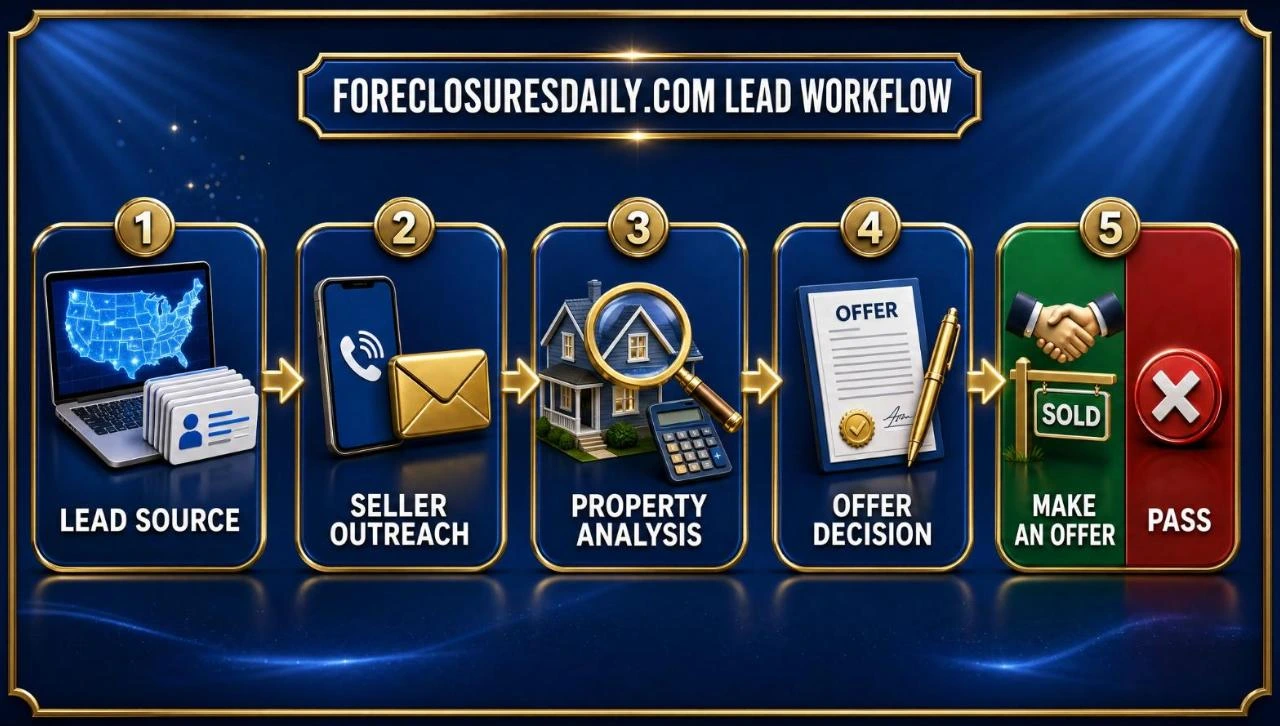
ForeclosuresDaily.com’s off-market platform tracks every major distress signal nationwide and cross-references it with tax rolls and property appraiser records.





First time home buyer programs: FAQ
 What makes someone a first-time home buyer?
Usually anyone who hasn’t owned a home in the past three years, though each program sets its own definition.
 Do you need a low income to qualify?
No. Many are open to a broad range of incomes and credit scores, though some have limits.
 Do grants have to be repaid?
Usually not. A grant is a gift toward your down payment or closing costs. Down payment assistance loans work differently: some must be repaid when you sell or refinance, while others are forgiven gradually if you stay in the home long enough.
Can I combine programs?
In many cases, yes. A common pairing is a low-down-payment mortgage plus a state or local grant, though each program sets its own rules on what it can be combined with, so confirm the details with your lender before you apply.
 Where do I find programs?
Your state housing finance agency, city or county housing office, HUD-approved counselors, nonprofits and participating lenders.
Related guide: first time home buyer programs: grants, down payment help and loans explained.
Your next step toward buying a home
Understand the benefits, the types of help and the rules, then compare programs to find the best fit. Investors and agents can also reach motivated sellers with ForeclosuresDaily.com.