Eviction leads in Washington, DC: tired landlords in one of the most tenant-protective cities in the US
Washington, DC has about 681,000 residents and a median home value near $737,000 in recent Census estimates. Only about 42% of homes are owner-occupied and only about 33% are single-unit, so the city is a renter-majority market of rowhouses, small multi-unit buildings and condos.
DC also has some of the strongest tenant protections in the country, including rent stabilization for many units and the Tenant Opportunity to Purchase Act, which can give tenants rights when a landlord sells. For small landlords, a long eviction case under those rules is often the point at which they decide to sell. This guide explains the rules in general terms, compares neighborhoods and shows how to work eviction leads fairly. It is not legal advice.
Tenant protections every DC investor should understand
DC’s rules are detailed and change often. These are general points. Investors and landlords should consult a DC attorney before acting.
Notice and the Landlord and Tenant Branch
DC evictions generally require written notice, often with a longer period than in many states, followed by a case in the Landlord and Tenant Branch of DC Superior Court. Tenants have many defenses, and the city restricts evictions in certain weather conditions.
- Notice
- Superior Court
Expect longer timelines than most markets.
Tenant Opportunity to Purchase Act
When a landlord sells a rental, TOPA may require offering tenants a chance to buy or assign their rights, with notice periods that can add months. Single-family homes were largely exempted in 2018, with exceptions for some elderly and disabled tenants.
- TOPA
- Notice periods
Confirm TOPA status before you sign.
Rent stabilization
Many older rental buildings are covered by DC rent stabilization, which limits increases. Exemptions exist for some small landlords and newer buildings.
- Rent control
- Exemptions
Check the building’s registration status.
Fair dealing with landlords and tenants
Investors who contact landlords should be honest, avoid pressure and respect tenants’ rights, including TOPA and rent rules. Never contact tenants in a way that interferes with a case or a TOPA process. Follow federal and DC rules for calls and texts.
Fair dealing protects everyone and your reputation.
Questions to ask a DC landlord
- 1How many units are in the building?
- 2Is it rent-stabilized or exempt?
- 3Does TOPA apply to a sale?
- 4Is the eviction case finished or pending?
- 5What repairs does the property need?
- 6What do you need to walk away with?
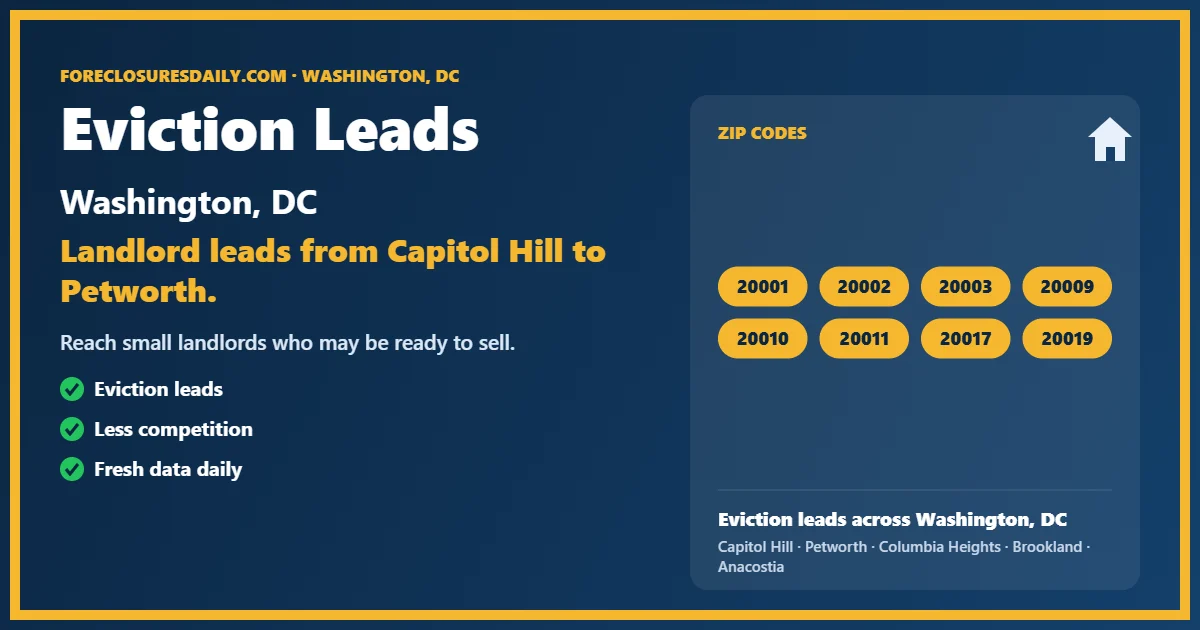
DC ZIP codes for eviction leads
Recent Census estimates show DC medians from about $408,000 to about $1.29 million.
Georgetown, Chevy Chase and Tenleytown 20007, 20015 and 20016
Medians near $1.22 million to $1.29 million and owner-occupancy near 56% to 77%, with fewer rentals.
Capitol Hill and Cleveland Park 20003 and 20008
Medians near $958,000 to $965,000 and owner-occupancy near 36% to 37%, with rowhouse and condo rentals.
Columbia Heights, Shaw and NoMa 20010 and 20001
Medians near $853,000 to $887,000 and owner-occupancy near 33% to 41%, with many small landlords.
Petworth, Brookland and Woodridge 20011, 20017 and 20018
Medians near $697,000 to $724,000 and owner-occupancy near 52% to 58%, with rowhouses and detached homes.
Northeast and H Street 20002
A median near $826,000 and owner-occupancy near 38%, with many renovated rowhouses and rentals.
East of the river 20019, 20020 and 20032
Medians near $408,000 to $457,000 and owner-occupancy near 23% to 42%, with lower entry prices and many rentals.
ZIP medians are recent Census estimates. Use recent sales to set every offer.
Running the numbers on a DC rowhouse after an eviction
Run the numbers before you make an offer. DC renovations often need permits, historic review in some districts and specialized trades. Transfer and recordation taxes add to selling costs.
Profit = After-repair value − Purchase + repairs + holding and selling costs
All figures are illustrative. Local costs vary widely.
Occupied buildings price differently. If tenants remain under rent stabilization or TOPA applies, buyers value the property on its rent roll and timeline, usually at a lower price.
TOPA can add months
Factor notice periods into your timeline.
Permits take time
Plan for city review.
Transfer taxes are high
Budget for them on both ends.
Track your results
Measure cost per deal by ward.
Washington, DC in numbers
DC has about 681,000 residents, a median home value near $737,000 and a median household income around $110,000 in recent Census estimates, with about 42% of homes owner-occupied, about 33% single-unit homes and vacancy near 10%.
The federal government, contractors, universities, healthcare and international organizations support demand.
Rowhouses converted into two or more units are common in many neighborhoods.
Historic districts cover large parts of the city and affect exterior changes.
DC’s eviction, TOPA and rent rules are among the most protective of tenants in the country.
- Skip TOPA review
- Ignore rent registration
- Cold-call without scrubbing
- Confirm TOPA status
- Check rent stabilization
- Follow call and text rules
Related resources
How to work DC eviction leads
- 1
Pull new filings regularly
Landlord and tenant cases are filed in DC Superior Court. Match filings to property records and look for small landlords.
- 2
Research before you reach out
Confirm ownership, liens, unit count, rent stabilization status, TOPA applicability and any open permits or violations.
- 3
Follow up with care
Use mail and compliant calls and texts. Scrub numbers against do-not-call lists, get consent where required and never interfere with a case or contact tenants about it.
Checklist
- Verify ownership
- Check case status
- Confirm TOPA rules
- Check rent registration
- Review open permits
- Get legal advice
See also off-market property in Washington, DC and the guide to eviction in California.
What DC renters, owners and investors search for
Homes for sale in Washington, DC draw about 1,300 searches a month. DC real property tax draws about 480.
Court and rights draw interest
DC landlord tenant court and DC tenant rights each draw about 390 searches a month.
Purchase rights matter
TOPA DC draws about 260 searches a month and DC rent control about 210.
Landlords look up the steps
DC eviction process draws about 140 searches a month.
- 1Homes for sale Washington DCAbout 1,300
- 2DC real property taxAbout 480
- 3DC landlord tenant courtAbout 390
- 4DC tenant rightsAbout 390
- 5Houses for rent Washington DCAbout 390
- 6TOPA DCAbout 260
- 7DC rent controlAbout 210
- 8DC eviction processAbout 140
How investors can use this data
Turn filings into fair offers:
Search volumes are approximate. Figures are recent monthly estimates and change over time. Use them to understand interest, not as exact counts.
ForeclosuresDaily.com hosts monthly webinars with investors such as Carolynn Castillo, who share how they find and evaluate deals.
What our customers say
Real investors share their experience with ForeclosuresDaily.com in short video reviews and press releases.









Eviction leads in Washington, DC: FAQ
Short general answers. This is not legal advice. Tap a question to open it.
QWhere are DC evictions filed?Yes
In the Landlord and Tenant Branch of DC Superior Court.
QWhat is TOPA?
A DC law that can give tenants a chance to buy before a rental is sold to someone else.
QDoes TOPA apply to single-family homes?
Largely not since 2018, with exceptions for some elderly and disabled tenants.
QCan I call and text landlords?Yes
Only within federal and DC rules. Scrub lists and get consent where required.
QWhich ZIP has the highest median?
Georgetown, 20007, at about $1.29 million.
QAre DC evictions fast?
Usually not. Expect longer timelines than in most states.
Want DC eviction leads? Tell us your target wards and ZIP codes and we will help you choose landlord leads.
Reach tired DC landlords first
In a renter-majority city with strong tenant protections, a long eviction case is often when a small landlord decides to sell. Investors who understand DC’s rules and approach owners with fair offers find deals others miss.
ForeclosuresDaily.com supplies eviction, probate, preforeclosure and absentee owner leads across Washington, DC. Explore our lead products.