How to find the owner of a house: public records, assessors and investor tools
Knowing how to find the owner of a house is useful whether you want to buy a property, research a neighborhood, resolve a boundary question or reach an off-market seller. In most of the United States, basic ownership information is public record.
This guide explains where ownership records live, how to search them step by step, how to trace previous owners, when online databases and real estate professionals can help, and how investors turn ownership data into respectful conversations with potential sellers.
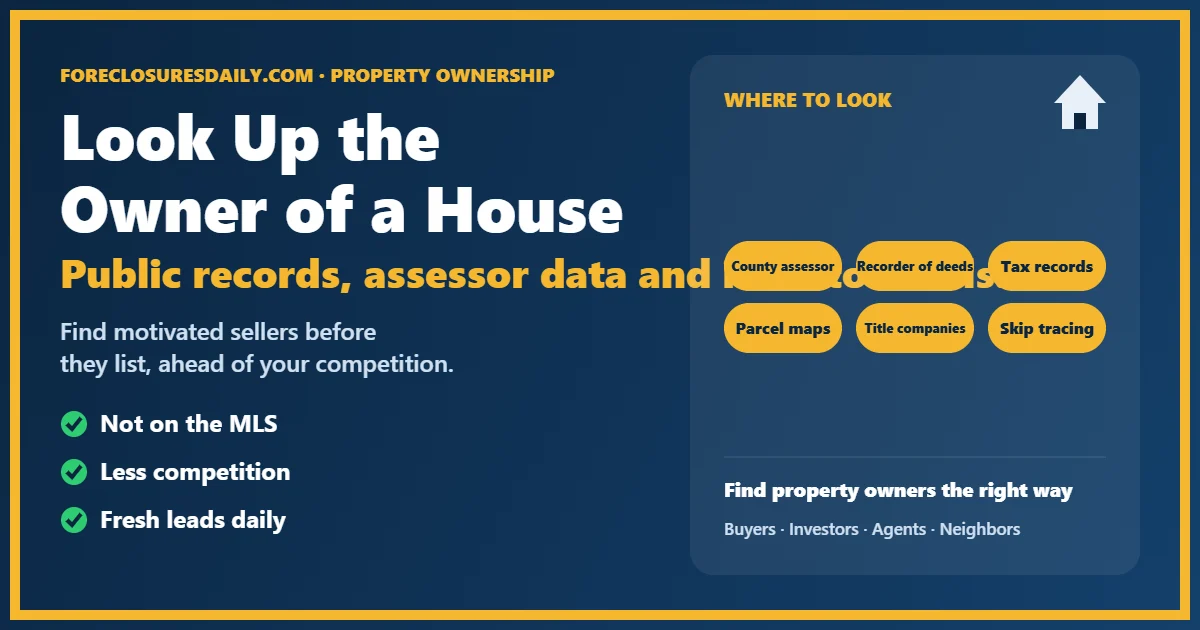
Why property ownership information is public
Local governments keep property ownership records so taxes can be assessed and title can be transferred reliably, and most of those records are open to the public.
When a house sells, the deed is recorded with a county office, often called the recorder, register of deeds or county clerk. The county assessor uses ownership records to value the property for taxes, and the tax collector tracks who pays the bill.
Together, these offices hold the owner’s name, the mailing address for tax bills, the parcel number, the assessed value, the sale history and sometimes the purchase price. Many counties publish this information through online portals; others require a visit or a phone call.
Ownership records show who holds title, but they may list an LLC, a trust or an estate rather than a person. In those cases you may need a few more steps to identify the decision-maker.
Online people-search and real estate data sites also compile ownership information from these public sources. They can be convenient, but their data may be out of date, so confirm anything important with the county records before you rely on it.
- Knocking on random doors
- Relying on neighbors
- Outdated information
- Official ownership data
- Parcel and tax details
- Verified, current facts
Investor resources

Listed and sold 25 properties and personally bought and sold four fix-and-flip properties, all generated from probate leads.
Carolynn Castillo
Realtor & Broker · eXp Realty
Why people look up the owner of a house
Ownership research is useful far beyond investing. Here are the most common, legitimate reasons people search property records.
Buying a home
Confirm the seller actually owns the property and check for liens before you make an offer.
Off-market purchases
Contact an owner directly about a house that is not listed, such as a vacant or neglected property.
Absentee owners →
Boundary questions
Identify a neighbor to discuss a fence, tree, driveway or shared maintenance issue.
Due diligence
Verify ownership history, taxes and recorded documents before investing or lending.
Legal and estate matters
Locate the right party for an estate, a property dispute or a code compliance issue.
Market research
See who owns properties in a neighborhood, how long they have owned them and what they paid.
Whatever the reason, start with official county records. They are the most reliable source and usually cost little or nothing.

Shannon Thompson
Investor · Joe Homebuyer of Atlanta
Watch Shannon Thompson share their experience using ForeclosuresDaily.com.
How to look up the owner of a house by address
- 1
Start with the county assessor
Search the assessor’s website by address or parcel number. You will usually find the owner of record, the tax mailing address, the assessed value and basic property details.
- 2
Check the recorder or register of deeds
Look up recorded deeds and mortgages to confirm the current owner, see when the property last sold and trace previous owners through the chain of title.
- 3
Confirm with tax and map records
The tax collector shows whether taxes are current or delinquent, and county GIS parcel maps confirm boundaries and the exact parcel you are researching.
Make your search faster
- Use the exact parcel number when you can
- Try address variations and unit numbers
- Search the owner name for other properties
- Note the tax mailing address
- Check for LLC, trust or estate ownership
- Write down document numbers for later
If a county has no online portal, call or visit the office. Staff can usually point you to the right records, though some copies carry a small fee.

Andrew Litchfield
Webinar host
Andrew Litchfield hosted a ForeclosuresDaily.com monthly webinar for real estate investors.
How to find previous owners of a house
Every recorded deed names the seller (grantor) and the buyer (grantee). By searching deeds backward from the current owner, you can build the chain of title and see who owned the property before. Many recorder offices let you search by name, address or document number.
Title companies
A title company can run a professional title search showing past owners, liens and recorded documents. It is standard before a purchase and useful when records are complicated.
Real estate professionals
Agents and brokers have access to listing histories and local knowledge, and can often tell you how long an owner has held a property and whether it has been listed before.
- 1AssessorOwner, value, property details
- 2RecorderDeeds, mortgages, liens
- 3Tax collectorPayment status, mailing address
- 4GIS mapsParcel boundaries
- 5CourtsProbate, divorce, foreclosure
- 6Title companyFull chain of title
When the owner is not a person
Records may show other kinds of owners:
Use ownership data responsibly. Owner information is public for legitimate purposes such as buying, selling and due diligence. Respect privacy, follow contact and do-not-call rules, and never use records to harass anyone.
ForeclosuresDaily.com hosts monthly webinars where investors such as Phillip Warrick explain how they research owners and approach sellers.

Anthony Coletti
Real estate investor
Watch Anthony Coletti share their experience using ForeclosuresDaily.com.

Antonio Stringfield
Probate investor · Los Angeles
Watch Antonio Stringfield share their experience using ForeclosuresDaily.com.

Nancy Wallace-Laab
Investor · nearly 20 years
Nancy focuses on the best outcome for both the seller and the investor, drawing on nearly 20 years of real estate investing experience.

Phillip Warrick
Full-time investor since 2003
Full-time real estate investor since 2003, with over 20 years of experience.
Why investors look up property owners
Investors use ownership research to find off-market opportunities. The goal is to reach the person who can actually sign a deed.
Absentee and vacant properties
Neglected or empty houses often have owners who live elsewhere. The tax mailing address shows where to send a letter.
- Tax mailing address
- Absentee
An out-of-area owner may welcome a simple sale.
Probate and inheritance
When an owner has died, the estate’s executor or heirs become the decision-makers. Probate records point to them.
- Executor
- Heirs
Approach families gently and patiently.
Tax delinquency and foreclosure
Unpaid taxes or foreclosure filings can signal an owner who needs to sell.
- Tax records
- Court filings
Offer options, not pressure.
Let a lead platform do the matching
Searching county records one address at a time is slow. Lead platforms match life-event filings with ownership and property data so you can focus on outreach.
ForeclosuresDaily.com gathers probate, foreclosure, divorce and other records and organizes them by area.
Verify these facts first
- 1Is the owner of record still current?
- 2Is the owner a person, LLC, trust or estate?
- 3Who can legally sign for the property?
- 4Is the mailing address up to date?
- 5Are taxes current or delinquent?
- 6Is there a recent filing or life event?

Jeremy Resmer
Webinar host
Jeremy Resmer hosted a ForeclosuresDaily.com monthly webinar for real estate investors.
Finding the owner of a house: FAQ
Short answers to common questions about property ownership searches. Tap a question to open it.
QHow can you find the owner of a house?
Search the county assessor or recorder of deeds by address or parcel number. Most counties list the owner of record.
QIs property ownership information public?Yes
Yes, in most U.S. counties the owner of record, sale history and tax data are public records.
QHow do I find previous owners of a house?
Search recorded deeds backward to build the chain of title, or ask a title company for a title search.
QCan I find an owner’s phone number in public records?No
Usually no. Public records typically show names and mailing addresses. Investors use skip tracing to find current contact details.
QWhat if an LLC owns the house?
Look up the LLC in your state’s business records to find its registered agent or managers.
QIs it legal to contact a property owner?Yes
Yes, for legitimate purposes, as long as you follow mail, calling and texting rules and respect opt-outs.
Want owners matched for you? Tell us your market and we will help you choose leads with owner and property data.
Turn ownership data into real estate opportunities
Identifying property owners and getting accurate information is the foundation of success in real estate. Public records, assessor and recorder offices, title companies and real estate professionals all help you verify who owns a property and who can sell it.
ForeclosuresDaily.com takes the legwork out of the process by delivering motivated seller leads with owner and property details. See our lead products or read our skip tracing guide.