Off-market properties in New York County, New York
Off-market properties in New York County, New York give investors, agents and buyers a way into Manhattan deals before they hit the open market. Private outreach can surface unlisted co-ops, estate apartments, FSBO owners and buildings in need of work that the big portals never show.
This guide covers how private sales work in Manhattan, where the leads come from and how to judge each one with discipline.
Off-market properties in New York County: how they differ from MLS listings
An off-market property is a home, apartment, mixed-use building or development site that is not being promoted through public listing channels, though the owner may still welcome a private offer.
The MLS is a broker database that markets listings to other agents and feeds consumer sites. Once a Manhattan apartment is listed, alerts go out and competition starts fast. That exposure helps sellers, but it also creates bidding wars.
A private deal might be a co-op on the Upper West Side, a walk-up in Harlem, a Chelsea condo or an inherited apartment on the Lower East Side. Owners choose this route for discretion, fewer showings, an estate situation or because they are not ready for a full listing. Buyers gain less competition and room for flexible terms. Off-market is still not informal: every deal needs valuation, legal review and due diligence.
- Listed on the MLS
- Advertised to the public
- Every shopper can see it
- Not listed on the MLS
- Not publicly advertised
- Found by buyers who look beyond the portals
These opportunities may include
Lead types that fit Manhattan
The best lists are filtered, verified and matched to one strategy. A foreclosure buyer needs different data than an agent looking for empty-nester sellers on the Upper West Side or an investor chasing small Harlem buildings.
Inheritance leads
Heirs and estates holding co-ops in Yorkville, condos near Lincoln Square or walk-ups in East Harlem.
NYC probate leads →
Life-event leads
Relocation, downsizing, divorce, retirement and family changes that force a decision about a property.
Distress indicators
Deferred maintenance, long vacancy, building violations or financial pressure.
FSBO and private sale
Owners already signaling that they would sell without broad exposure.
Absentee and long-term owners
People who own a unit or building but no longer live nearby or want to manage it.
Skip tracing →
Foreclosure-related leads
Owners under financial strain who may want options before a forced sale.
Our lead products →
Choose verified leads over raw volume. Bad contact data, outdated ownership and loose targeting waste time and hurt your reputation.
Why buyers and investors look off-market in Manhattan
Manhattan is dense and intensely local. A buyer in Tribeca has a different plan from someone looking in Washington Heights, Inwood or the Financial District. Private deals let you focus on specific blocks, buildings, owners and motives instead of waiting for the right listing.
Do not assume every private lead is a bargain. Location, building rules, renovation limits, monthly carrying costs and resale demand can matter as much as price. With only 25% of Manhattan homes owner-occupied, many sellers are landlords, estates or owners of second homes.
Common reasons to search
- Specific location goals, such as SoHo, Greenwich Village or the Upper East Side, where public inventory is thin
- Value-add units, small multifamily buildings or fix-and-flips
- Owners who want privacy: no open houses, photos or neighbor attention
- Timing flexibility when a seller needs months before closing
- Estate, repair, vacancy, tax or ownership problems a direct offer can solve
Where to find off-market property in Manhattan
Good lead generation is a system, not one list. It finds likely sellers, verifies ownership and starts respectful conversations, organized by neighborhood, ZIP code, property type and motive. Our video walkthrough shows how that process works.
Public records and ownership research
Ownership data can point to long-held units, absentee owners, estate ownership and buildings that need capital work. Investors study Midtown East, Murray Hill, Kips Bay and Hell’s Kitchen for older condos and small buildings. A targeted letter that explains your interest beats a generic postcard.
Inheritance and probate outreach
Heirs may want to sell when a property needs repairs, carries high costs or no longer fits the family. Approach with care. People may be handling grief, paperwork and family decisions at once.
FSBO, expired and private-seller signals
Some owners test the market quietly through word of mouth, building staff, lawyers or neighborhood groups. Others tried to sell, then paused over price, timing or repairs. In the East Village, NoHo, Chelsea and the Garment District these signals can be subtle, so steady follow-up matters.
Driving for dollars, Manhattan style
Walk the blocks. Note vacant storefronts, neglected small buildings, scaffolding that never comes down and underused properties in Harlem, Washington Heights, Inwood, Two Bridges and the Lower East Side. Always verify: a building that looks neglected may have active plans or legal limits.
Evaluating a Manhattan deal before you offer
Transaction costs, board rules, permits and timelines can all change the math on a Manhattan flip. Do not buy just because a property is off-market. Buy because the numbers, risk, timeline and resale plan work.
Once a seller responds, ask about their goals first: speed, certainty, price, privacy, timing or convenience. Someone selling an inherited Midtown East condo may care more about a clean closing than top dollar. A Tribeca owner may sell only if the offer beats public marketing. If the owner could list and draw stronger bids, your offer must solve something else, such as fewer disruptions, a flexible closing, as-is terms or certainty.
For local buyer and exit data, see our page on wholesaling real estate in New York County, or compare with off-market properties in Brooklyn.
Quick evaluation checklist
- Confirm you are talking to the owner or an authorized representative
- Estimate ARV from renovated units in the same micro-market
- Review co-op board rules, condo bylaws, landmark status and alteration agreements
- Price repairs with Manhattan labor, elevator access and permits in mind
- Add maintenance, common charges, taxes, insurance, financing and utilities
- Pick an exit: resale, rental, wholesale, partnership or long-term hold
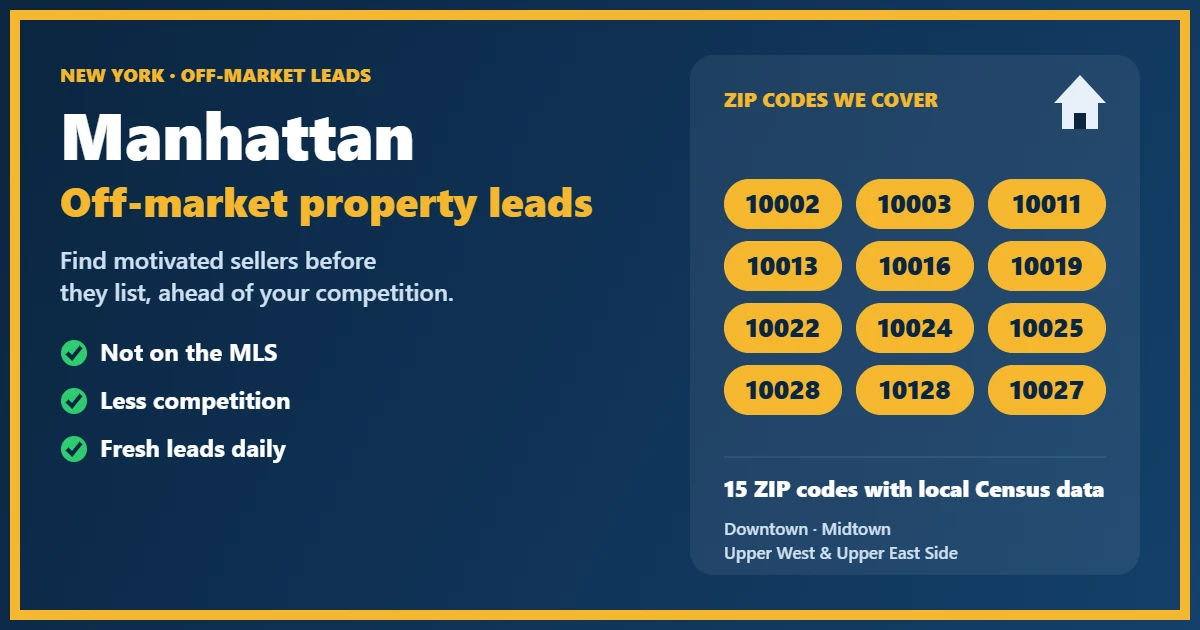
Manhattan ZIP codes we cover
These are the Manhattan ZIP codes named on our original guide, from the Lower East Side to Inwood.
Pick one to compare its median value, owner occupancy, vacancy and buyer search demand with New York County as a whole.
10002 · Lower East Side & Two Bridges: off-market investor snapshot
Tenement walk-ups, co-ops and public housing between the Bowery and the East River.
Local search demand
Resale demand: About 70 buyer searches a month make this the most searched ZIP on this list.
Investor note: Owner occupancy is 19%, below the 25% county rate, and household income of $48,386 is less than half the county figure. The $827,800 median value is about $263,000 under the county. Inherited co-op units and long-held walk-up buildings are the realistic off-market targets.
10003 · Greenwich Village & East Village: off-market investor snapshot
Brownstones, prewar co-ops and NYU-area rentals around Union Square and Washington Square.
Local search demand
Resale demand: Only about 10 measurable buyer searches a month, so buyers here tend to search by neighborhood or building.
Investor note: The $1,123,200 median value is close to the county figure, and 37% of homes are owner-occupied, above the county rate. Vacancy is 19.4%, which includes second homes and units held off the rental market. Estate sales and owners of underused units are worth tracking.
10011 · Chelsea: off-market investor snapshot
Townhouse blocks, converted lofts and new condos between the High Line and Sixth Avenue.
Local search demand
Resale demand: About 20 buyer searches a month show steady but modest demand.
Investor note: Chelsea has a $1,181,200 median value, a little above the county, and 36% owner occupancy. Vacancy runs 20.2%, well above the 15.7% county rate, which points to second homes and investor-held condos. Owners who no longer use a unit are a natural fit for a quiet sale.
10013 · Tribeca & SoHo West: off-market investor snapshot
Cast-iron loft buildings and luxury condos south of Canal and west of Broadway.
Local search demand
Resale demand: About 50 buyer searches a month, almost all for real estate in this ZIP, signal strong high-end interest.
Investor note: The Census tops out its value estimate at $2 million or more here, the highest on this list. Owner occupancy is 30% and vacancy is 22.5%. Deals are about discretion: owners of large lofts often prefer a private sale over months of public showings.
10016 · Murray Hill & Kips Bay: off-market investor snapshot
Prewar co-ops, postwar rental towers and townhouses east of Midtown.
Local search demand
Resale demand: About 20 buyer searches a month suggest modest retail demand.
Investor note: Only 25% of homes here are owner-occupied, matching the county, and the $905,000 median value is about $185,000 below it. Vacancy is 18.8%. Long-held condo units and small buildings make public-records research worth the effort here.
10019 · Hell’s Kitchen & Midtown West: off-market investor snapshot
Walk-up tenements, new high-rises and theater-district co-ops west of Sixth Avenue.
Local search demand
Resale demand: About 40 buyer searches a month show solid interest from buyers.
Investor note: Owner occupancy is just 21% and vacancy is 19.4%, both signs of a renter and investor market. The $1,061,300 median value is near the county figure. Absentee owners of older condo units and small walk-up buildings are the main targets.
10022 · Midtown East & Sutton Place: off-market investor snapshot
Prewar co-ops and full-service towers from Grand Central to the East River.
Local search demand
Resale demand: About 30 buyer searches a month indicate steady demand.
Investor note: This ZIP has the highest vacancy on this list at 26.9%, much of it seasonal or second-home use, and 52% owner occupancy. The $1,108,200 median value is close to the county. Owners who rarely use a pied-à-terre are a strong off-market prospect.
10024 · Upper West Side (70s & 80s): off-market investor snapshot
Classic prewar co-ops and brownstones between Central Park and Riverside Park.
Local search demand
Resale demand: About 20 buyer searches a month show modest but consistent interest.
Investor note: The $1,687,800 median value is about $600,000 above the county figure, and 37% of homes are owner-occupied. Vacancy is 18.1%. Empty-nester co-op owners and estates are the most common reasons for a private sale here.
10025 · Upper West Side & Morningside Heights: off-market investor snapshot
Prewar apartment buildings near Columbia University, from the 90s up to 110th Street.
Local search demand
Resale demand: About 60 buyer searches a month rank this second on the list for buyer demand.
Investor note: This is the most populous ZIP on this list at 93,065 residents. The $1,106,900 median value matches the county, owner occupancy is 31% and vacancy is 13.4%, below the county rate. Long-time owners near Columbia and Riverside Drive are worth steady follow-up.
10028 · Upper East Side (Yorkville west): off-market investor snapshot
Park and Madison Avenue co-ops and townhouses in the high 70s and 80s.
Local search demand
Resale demand: Buyer searches for this ZIP were too low to measure; buyers tend to search by building.
Investor note: The $1,602,600 median value is about $512,000 above the county and owner occupancy is 38%. Vacancy is 14.0%. Strict co-op boards shape every deal, so check board rules before you price a renovation.
10128 · Yorkville & Carnegie Hill: off-market investor snapshot
Co-ops, condos and brownstones from East 86th to East 96th Street.
Local search demand
Resale demand: About 20 buyer searches a month suggest modest retail demand.
Investor note: Yorkville has a $1,442,000 median value, well above the county, with 31% owner occupancy and 15.4% vacancy. Inherited co-ops are common here, and heirs may want a clean, quick closing over the best possible price.
10027 · Central Harlem & Manhattanville: off-market investor snapshot
Brownstones, walk-ups and new condos from 110th to 130th Street.
Local search demand
Resale demand: Buyer searches for this ZIP did not reach measurable levels.
Investor note: Only 17% of homes are owner-occupied, and household income of $59,587 is well below the county. The $899,600 median value is about $191,000 under the county figure. Small multifamily buildings and townhouses with deferred maintenance are the main value-add plays.
10029 · East Harlem: off-market investor snapshot
Walk-up buildings, public housing and new rentals east of Fifth Avenue above 96th Street.
Local search demand
Resale demand: About 50 buyer searches a month show real interest for an uptown ZIP.
Investor note: Owner occupancy is just 7%, among the lowest on this list, and household income is $38,695. The $892,200 median value reflects a small number of owned units. Walk-up building owners and estates are the realistic leads; expect landlord-to-investor conversations.
10032 · Washington Heights (south): off-market investor snapshot
Prewar apartment buildings and a few row houses near Columbia’s medical campus.
Local search demand
Resale demand: Buyer searches for this ZIP were too low to measure.
Investor note: At $606,500, the median value is roughly half the county figure, and owner occupancy is 9%. Vacancy is low at 7.3%. Lower entry prices make co-op and small-building deals here easier to finance than downtown.
10034 · Inwood: off-market investor snapshot
Art Deco co-ops and rentals at the northern tip of Manhattan near Inwood Hill Park.
Local search demand
Resale demand: About 40 buyer searches a month show steady demand for one of Manhattan’s more affordable ZIPs.
Investor note: Inwood has the lowest median value on this list at $519,700, less than half the county. Owner occupancy is 12% and vacancy is 7.5%. Co-op owners and small landlords here often look for buyers who can close without a long public process.
U.S. Census Bureau, American Community Survey 2020–2024 5-year estimates. Figures cover the whole ZIP code, which can cross county lines. Home values are medians for owner-occupied homes, not current list prices.
Average monthly U.S. Google searches as of October 2026. Home searches combine “homes for sale”, “houses for sale” and “real estate” for each ZIP code. Seller searches combine “sell my house fast”, “we buy houses” and “cash home buyers” for the nearest city.
Want to find off-market properties in a specific neighborhood? ZIP-based lead lists make your outreach more relevant and help you work more efficiently.
What our customers say
Real investors share their experience with ForeclosuresDaily.com in short video reviews and press releases.








Outreach that works with Manhattan owners
- 1
Be specific
Name the neighborhood, building type or reason the property caught your eye. Say plainly whether you are an investor, buyer, agent or representative.
- 2
Offer real options
Let the owner know they can sell, ask questions, decline or come back later. Be ready to talk about funds, timing, contingencies and next steps.
- 3
Respect privacy
Avoid pressure, repeated contact and guesses about the owner’s situation. A thoughtful note today may turn into a deal months from now.
Your due diligence checklist
- Verify ownership in city property records
- Check for open building violations
- Read the co-op or condo financials
- Confirm sublet and renovation rules
- Model closing costs and transfer taxes
- Keep strict ARV and repair assumptions
Manhattan rewards precision and punishes optimism.
Manhattan off-market questions
What investors and buyers ask before working private deals in New York County.
Have another question? Tell us your target ZIP codes and we will help you choose the right leads.
Are off-market Manhattan properties always discounted?
No No. The appeal is access, not a guaranteed discount. Many owners will sell privately only if the offer is strong enough to skip public marketing.
Can co-op boards block an off-market deal?
Yes Yes. Co-op boards must approve buyers, and their rules can limit renovations, subletting and resale. Review them before you price a deal.
Which Manhattan ZIP codes are most affordable?
In the Census data on our list, Inwood 10034 and Washington Heights 10032 have the lowest median values, both roughly half the county figure of $1,090,500.
Do I need a large list to start?
No No. A small, verified list matched to one strategy and one area usually beats a large list sent to every owner in the county.
Start your Manhattan off-market search
Tell us your target neighborhoods, ZIP codes, budget and strategy. We will help you build focused lists of off-market properties in New York County, New York.