Off-Market Property in Washington DC
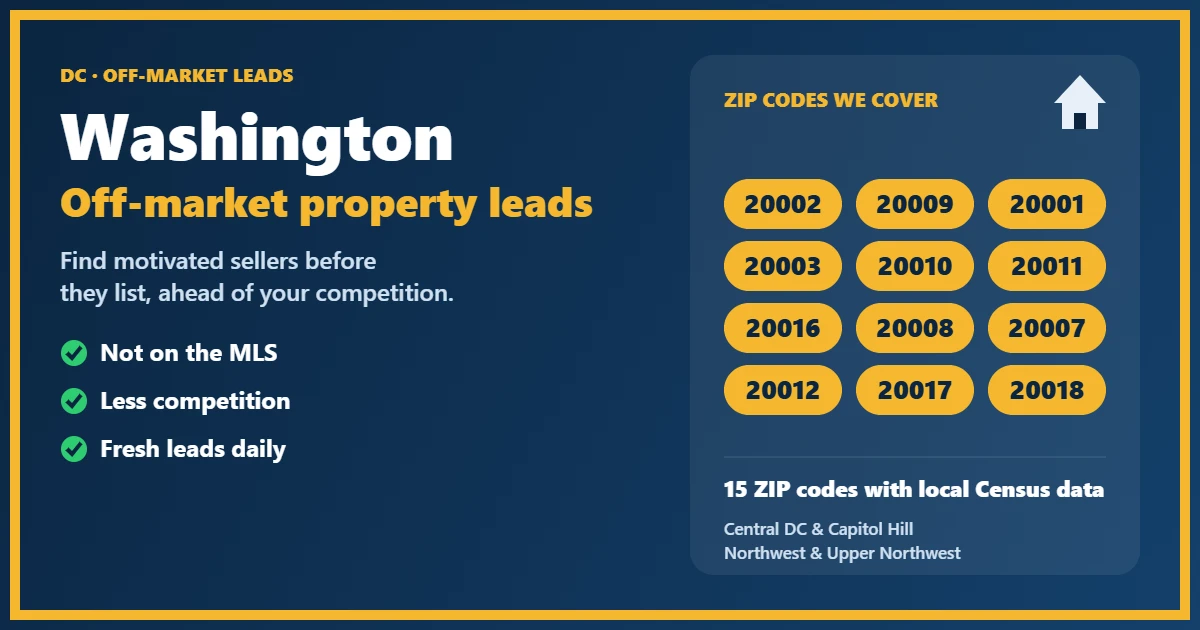
Off-market property in Washington DC never reaches the MLS or the big listing portals. These homes change hands privately, often through probate, inheritance or a landlord who wants out. This page covers who those sellers are in the District, how their numbers look ZIP by ZIP, and how ForeclosuresDaily helps you reach them before other buyers do.
What off-market property means in Washington, DC
An off-market property is a home sold privately, without a public listing on the MLS or consumer real estate sites.
In a city where only 42% of homes are owner-occupied and the median home value is $737,100, a large share of DC housing belongs to landlords, estates and owners who live elsewhere. Many of them would rather sell quietly than prepare a rowhouse for a listing, schedule showings and wait for offers.
Buying this way means fewer competing buyers. You can negotiate directly, take time to inspect the property, and agree on terms that suit both sides instead of racing a bidding war. That applies whether you are an investor looking for a discount or a buyer who wants a specific block on Capitol Hill.
- Listed on the MLS
- Advertised to the public
- Every shopper can see it
- Not listed on the MLS
- Not publicly advertised
- Found by buyers who look beyond the portals
These opportunities may include
Where DC off-market property deals come from
Most private sales in the District start with a change in the owner’s life. These are the lead types we track.
Probate estates
When a DC homeowner dies, the executor gets court authority to sell. Some estates need to sell fast to cover debts or split proceeds among heirs.
Probate investing in DC →
Inherited homes
Heirs who live in another state, or who simply don’t want a second house to maintain, often accept a fair cash offer over a long listing.
Inheritance leads →
Absentee landlords
With 58% of DC homes renter-occupied, many owners manage from afar. Tired landlords with older rowhouse units are a steady source of deals.
Absentee-owner leads →
Motivated sellers
A motivated seller will trade some price for speed or certainty, often because of a strict deadline such as a divorce, a job move or financial strain.
Top off-market leads →
Skip tracing
A lead only helps if you can reach the owner. Skip tracing finds current contact details for heirs and out-of-town owners.
Skip tracing →
Wholesalers in the District can also read our guide to wholesaling real estate in Washington, DC.
Why DC owners sell off-market property below retail
A motivated seller is an owner willing to sell for less than full market value, or on terms that favor the buyer, because something else matters more. Usually that is time: a strict deadline means they need to sell soon and will accept a discount to do it.
Common reasons include divorce, relocation, financial difficulty, and a house that needs more repairs than the owner wants to take on. Repairs are an opening for investors. You can buy at a lower price, add value with targeted work, and then resell or rent the property.
Private deals are also more personal. You usually talk with the seller or their representative directly, which makes room for flexible closing dates, seller financing and creative fixes to problems that come up during the sale.
The old saying is that if a deal sounds too good to be true, it probably is. Some off-market deals are the exception, but only for buyers who do their homework. We handle the research so you can focus on being competitive.

Probate and inherited off-market property in Washington DC
When someone dies, their estate goes through probate. The executor has the court’s authority to sell the property and is expected to get fair market value. In some cases, though, the estate needs to move quickly and will take a lower offer.
Why estates and heirs sell fast
- The estate faces financial pressure and needs cash quickly.
- The heirs live and work in another state or country and do not plan to return to DC.
- The heirs need money now.
- The house is a burden, and nobody wants to keep paying for maintenance.
- They prefer a fast cash sale.
- Few heirs are real estate professionals, so a simple sale appeals to them.
Many deceased owners had paid off their mortgages or had low balances, which leaves significant equity. That equity is what gives an executor room to accept a below-retail offer.
Who we are
ForeclosuresDaily has supplied off-the-grid real estate leads since 2004, and many of our new customers come through referrals from existing ones. Our products include probate real estate leads as they enter the market, so you can reach sellers first.
Doing the research up front saves you time and money and leaves you free to focus on wholesaling, rehabbing and flipping. We measure our own success by the success of our customers.
We also host monthly webinars with active investors. Recent sessions include a webinar with Phillip Warrick, how to find an Airbnb with Nancy Wallace-Laabs, and a session hosted by Jeremy Resmer.

Washington, DC ZIP codes for off-market property
Census figures for the 15 most populous DC ZIP codes, compared with the District as a whole (median value $737,100, income $109,870, 42% owner-occupied, 10.1% vacant). Monthly buyer searches show how much resale demand each ZIP draws online.
Seller searches such as “we buy houses Washington DC” run at about 920 a month across the city, so motivated owners are actively looking for buyers.
20002 · Capitol Hill NE, H Street & Trinidad: off-market investor snapshot
Rowhouse blocks running from Union Station and NoMa east through H Street, Trinidad and Carver Langston.
Local search demand
Resale demand: About 60 buyer searches a month, a mid-pack figure for its size, which suggests much of the activity happens off the portals.
Investor note: The most populous ZIP in the District, with a median value of $826,400, about 12% above the DC figure of $737,100. Only 38% of homes are owner-occupied and vacancy is 10.8%, so landlord-held rowhouses and long-time owners who rent out a unit are the core lead pool. Absentee-owner lists tend to work better here than door knocking.
20009 · Dupont Circle, Adams Morgan & U Street: off-market investor snapshot
Dense rowhouse and condo neighborhoods around Dupont Circle, Logan Circle, Adams Morgan and the U Street corridor.
Local search demand
Resale demand: About 60 buyer searches a month, though many condo buyers search by building or neighborhood name instead of ZIP.
Investor note: Values ($722,500) track the DC median, but only 11% of homes are single-unit. This is condo and co-op territory, and 35% of units are owner-occupied. Off-market deals here are often condos owned by out-of-town investors or estates, so check condo fees and building rules before you make an offer.
20001 · Shaw, Bloomingdale & Mount Vernon Square: off-market investor snapshot
Central rowhouse neighborhoods from Mount Vernon Square and Shaw north to Bloomingdale and LeDroit Park.
Local search demand
Resale demand: Only about 20 searches a month by ZIP; buyers here tend to search by neighborhood name instead.
Investor note: At $852,600 the median is about 16% above DC as a whole, and incomes are high ($138,059). Owner-occupancy is just 33% and vacancy is 11.4%, so rowhouses split into rental units are common. Look for tired landlords and inherited rowhouses that need a full renovation.
20003 · Capitol Hill SE & Navy Yard: off-market investor snapshot
Southeast Capitol Hill, Barracks Row, Hill East and the newer towers around Navy Yard and the Capitol Riverfront.
Local search demand
Resale demand: About 40 searches a month; Hill rowhouses usually draw buyers by name and block rather than ZIP.
Investor note: The median value is $957,700, about 30% above the DC median, with the highest incomes among the central ZIPs ($159,846). Owner-occupancy is 37% and vacancy is 11.3%, partly because of new apartment buildings near the river. Rowhouse estates on the Hill are the high-value off-market targets.
20010 · Columbia Heights & Mount Pleasant: off-market investor snapshot
Rowhouse and apartment blocks around the Columbia Heights Metro and the Mount Pleasant village strip.
Local search demand
Resale demand: Only about 10 searches a month by ZIP, the lowest in this list; buyers search by neighborhood name instead.
Investor note: Values ($886,600) are about 20% above DC. Owner-occupancy is 41% and 30% of homes are single-unit, with vacancy at 10.2%. Many rowhouses hold basement units or are split into flats. Owners who are tired of managing two or three units can be good off-market sellers.
20011 · Petworth, Brightwood & Fort Totten: off-market investor snapshot
Ward 4 neighborhoods of porch-front rowhouses and detached homes north of Georgia Avenue and Kennedy Street.
Local search demand
Resale demand: Around 120 searches a month, third in the city, so a well-priced resale should find buyers quickly.
Investor note: Values sit near the DC median at $723,900, but ownership is high at 56% and half of the homes are single-unit. Vacancy is low at 7.0%. Expect fewer vacant shells and more estates, older owners and inherited houses, which makes probate and inheritance leads the main angle.
20016 · AU Park, Tenleytown & Spring Valley: off-market investor snapshot
Upper Northwest neighborhoods around American University, Tenleytown, Spring Valley and Wesley Heights.
Local search demand
Resale demand: The strongest buyer demand in the city at about 330 searches a month, which supports resale exits.
Investor note: At $1,216,000 the median value is about 65% above DC, and owner-occupancy is high at 65% with low vacancy (7.7%). These are long-held detached homes, so estates and downsizing owners matter more than distress. Deals here are larger, so line up capital before you start calling owners.
20008 · Cleveland Park, Woodley Park & Van Ness: off-market investor snapshot
Connecticut Avenue neighborhoods from Woodley Park through Cleveland Park and Van Ness to Forest Hills.
Local search demand
Resale demand: About 40 searches a month; detached homes here sell on neighborhood reputation more than ZIP searches.
Investor note: The median value is $965,100, about 31% above DC, but only 20% of homes are single-unit, because large co-op and condo buildings line the avenue. Vacancy is the lowest in this list at 6.9%. Detached houses on the side streets and co-op units in estates are the main targets.
20007 · Georgetown, Burleith & Glover Park: off-market investor snapshot
Georgetown, Burleith, Foxhall and Glover Park, west of Rock Creek Park.
Local search demand
Resale demand: About 170 searches a month, second in the city, so demand for well-presented homes is solid.
Investor note: This is the highest-value ZIP in the list at $1,292,400, about 75% above DC. Owner-occupancy is 56%, but vacancy is 12.4%, partly because of student rentals and second homes. Out-of-area owners and estates of long-time Georgetown residents are the off-market angle.
20012 · Takoma & Shepherd Park: off-market investor snapshot
The northern tip of the District around Takoma, Shepherd Park and Brightwood Park, along the Maryland line.
Local search demand
Resale demand: About 110 searches a month, strong demand for a smaller ZIP.
Investor note: At $863,900 the median is about 17% above DC. This ZIP has the highest ownership (65%, tied with 20016) and the highest single-unit share (61%) in the list. Long-held detached homes and estates are the main sources of off-market deals.
20017 · Brookland & Michigan Park: off-market investor snapshot
Brookland, Michigan Park and University Heights, near Catholic University in Ward 5.
Local search demand
Resale demand: About 120 searches a month, high for a ZIP of its size, which signals steady buyer interest.
Investor note: Values ($702,600) sit about 5% below the DC median, with 58% owner-occupancy and 54% single-unit homes. Vacancy is low at 7.0%. Older owners in detached homes are common, so estate and inheritance leads are the main source of motivated sellers.
20018 · Woodridge, Langdon & Fort Lincoln: off-market investor snapshot
Ward 5 neighborhoods along Rhode Island Avenue NE near the Maryland line.
Local search demand
Resale demand: About 40 searches a month; resale buyers are often priced out of Brookland and looking just east.
Investor note: The median value of $697,000 is about 5% below DC, and household income ($90,639) is under the city median. Ownership is 52% and 54% of homes are single-unit. Detached homes that need updating are a good fit for light rehabs aimed at first-time buyers.
20019 · Deanwood, Benning & Capitol View: off-market investor snapshot
East of the Anacostia River in Ward 7, with detached frame houses, duplexes and garden apartments.
Local search demand
Resale demand: About 50 buyer searches a month; plan exit pricing around local comps rather than city-wide demand.
Investor note: At $456,800, the median value is about 38% below the DC figure, and household income ($58,296) is roughly half the city median. Owner-occupancy is 42% and 48% of homes are single-unit. The lower entry price leaves room for rehab margins and buy-and-hold rentals, but budget carefully for repairs on older frame stock.
20020 · Anacostia, Hillcrest & Fairlawn: off-market investor snapshot
Historic Anacostia, Fairlawn, Randle Highlands and the larger detached homes of Hillcrest in Wards 7 and 8.
Local search demand
Resale demand: About 60 searches a month, in line with its neighbors east of the river.
Investor note: The median value is $456,000, about 38% under the DC median, and vacancy is 12.0%, among the highest in this list. With only 30% owner-occupancy, many properties are held by landlords or heirs who live elsewhere. Vacant-property and absentee-owner lists are the best place to start.
20032 · Congress Heights & Bellevue: off-market investor snapshot
Ward 8 neighborhoods at the southern tip of the District, including Congress Heights, Bellevue and Washington Highlands.
Local search demand
Resale demand: About 40 searches a month, so rental exits are usually more reliable than quick flips.
Investor note: This ZIP has the lowest median value in the list ($407,700, about 45% below DC) and the lowest owner-occupancy (23%). Most homes are rentals, and vacancy runs at 10.6%. Landlords with aging small multifamily buildings are the main lead type, and rental yields matter more here than resale margins.
U.S. Census Bureau, American Community Survey 2020–2024 5-year estimates. Figures cover the whole ZIP code, which can cross county lines. Home values are medians for owner-occupied homes, not current list prices.
Average monthly U.S. Google searches as of October 2026. Home searches combine “homes for sale”, “houses for sale” and “real estate” for each ZIP code. Seller searches combine “sell my house fast”, “we buy houses” and “cash home buyers” for the nearest city.
Want to find off-market properties in a specific neighborhood? ZIP-based lead lists make your outreach more relevant and help you work more efficiently.
What our customers say
Real investors share their experience with ForeclosuresDaily.com in short video reviews and press releases.









From DC lead to signed contract
- 1
Pull the record early
Probate filings and ownership changes reach us soon after they are recorded, before the property is listed or widely marketed.
- 2
Find the decision maker
Identify the executor, heir or landlord who can sign, and skip trace current contact details if they live outside the District.
- 3
Make a clear offer
Base the offer on block-level comps, repair costs and your exit, whether that is a flip, a rental or an assignment.
Your due diligence checklist
- Confirm who holds legal authority to sell (executor, heirs or owner of record).
- Order a title search and check for liens, unpaid DC property taxes and water bills.
- Check for tenants and their rights before you plan a renovation.
- For condos and co-ops, review fees, reserves and board approval rules.
- Look up historic district rules on Capitol Hill, Georgetown and other protected areas.
- Price repairs on older rowhouses, including roofs, party walls and basements.
Many DC rowhouses are over a century old. A careful inspection protects your margin.
Questions about off-market property in Washington, DC
Short answers to what buyers ask most about private deals in the District.
Have another question? Tell us your target ZIP codes and we will help you choose the right leads.
Can I buy a DC home that is not listed on the MLS?
Yes Yes. Owners can sell privately to any buyer. Probate estates, heirs and landlords often do, especially when they want a quick or simple sale.
Which DC neighborhoods have the most off-market activity?
Areas with low owner-occupancy and high vacancy, such as 20032, 20020 and 20001, have many absentee owners. High-ownership areas like 20012 and 20016 produce more estate and inheritance sales.
Is every off-market deal a bargain?
No No. Some sellers want full price. The discount comes from motivated sellers with a deadline, and you still need to check comps, title and repairs.
Do I need cash to buy off-market property in DC?
Cash makes offers stronger and closings faster, but sellers may also accept financing, seller carry-back or subject-to terms when that solves their problem.
Start your Washington, DC off-market search
Get probate, inheritance and absentee-owner leads for the District and reach sellers before their homes hit the market.