First-time real estate investor guide: financing, deal math and your first property
Every first-time real estate investor faces the same early questions: how to pay for a property, how to tell a good deal from a bad one and where to find sellers who will negotiate.
This guide walks through financing, deal math and the steps from first idea to first closing.
























Hear From Our Customers
Click a profile to watch their video or read their story.





Four common strategies for a first-time real estate investor
A first-time real estate investor is someone buying their first property primarily for income or profit rather than as a long-term personal residence, although some strategies combine the two. The right strategy depends on how much cash you have, how much time you can commit and how much risk you can handle.
Most first deals fall into one of four categories: house hacking, a buy-and-hold rental, a fix-and-flip or a wholesale assignment. House hacking means buying a two- to four-unit property or a home with extra space, living in one part and renting the rest.
Because you live there, you may qualify for owner-occupant financing with a smaller down payment. Buy-and-hold investors purchase a rental and keep it for cash flow and long-term appreciation. Flippers buy, renovate and resell for a profit. Wholesalers put properties under contract and assign them to other investors for a fee, which takes less capital but requires strong deal-finding skills.
Whatever strategy you choose, start with a property you can understand and manage. Many experienced investors recommend a first deal that is simple, in a familiar area and priced so that it still works if repairs cost more or rents come in lower than expected.
The topics first-time investors research most
National search data shows which questions new investors ask most.Financing and math terms are even more popular.
Financing dominates

DSCR loan searches run about 49,500 a month, 1031 exchange about 40,500 and hard money loan about 9,900. Understanding these tools is often the first hurdle.
Strategies are well known

Investors want to run the numbers
Landlord insurance also draws about 14,800.
- 1DSCR loanAbout 49,500
- 21031 exchangeAbout 40,500
- 3Cap rateAbout 14,800
- 4Landlord insuranceAbout 14,800
- 5Hard money loanAbout 9,900
- 6BRRRR methodAbout 6,600
- 7How to start investing in real estateAbout 5,400
- 8House hackingAbout 4,400
What to learn first

Treat these as a map of what beginners wonder about. These volumes are rough estimates. They are national monthly figures that shift from season to season.
Read the totals as a gauge of interest rather than precise tallies. Each month ForeclosuresDaily.com runs a webinar where working investors like Carolynn Castillo explain how they located and closed their first few deals.
Motivated sellers ready to liquidate quickly
For this reason, every major distress signal nationwide is covered on ForeclosuresDaily.com’s off-market real estate platform, cross-referenced with tax rolls and property appraiser records.






Financing options for a first-time real estate investor
Most first-time investors use one or more of these financing tools. Each has different requirements, costs and risks.
Owner-occupant loans

Conventional, FHA and VA loans can be used to buy a one- to four-unit property you will live in, often with lower down payments than investor loans.
Conventional investment loans

Bank loans for non-owner-occupied properties usually require larger down payments and reserves, but offer long-term fixed rates.
DSCR loans

Debt service coverage ratio loans qualify the property based on its rental income relative to the mortgage payment, rather than your personal income.
Hard money loans

Short-term, asset-based loans used for flips and renovations. They close quickly but carry higher rates and fees.
Private money

Loans from individuals in your network. Terms are negotiated directly and should always be documented in writing.
Seller financing

Some sellers will carry a note, letting you pay them over time. This can help when bank financing is difficult. Loan terms, rates and requirements vary by lender and change over time. Compare offers and ask about all fees before committing.
Running the numbers on your first rental
Two numbers tell you a lot about a rental. Cap rate shows how much income the property produces relative to its price, and cash-on-cash return shows how much your invested cash earns each year after the mortgage.
Cap rate = Net operating income ÷ Purchase price Net operating income is rent minus operating expenses, before the mortgage. On a $50,000 cash investment, that is about an 8% cash-on-cash return.
Budget for reserves

Set aside money for repairs, capital expenses such as roofs and furnaces, and months when the property is vacant.
Do not skip insurance

Landlord insurance differs from homeowners insurance. Get quotes early, since premiums can change your numbers significantly.
From first idea to first closing
Most successful first deals follow a similar path. Taking each step in order reduces mistakes.
Set your goals and budget
Decide whether you want cash flow, a renovation profit or a place to live with rental income. Then set a firm budget, including reserves.
Choose a market and property type
Pick an area you can learn well and a property type you can manage, such as a single-family home or small multifamily.
Analyze, offer and close
Run the numbers on many properties, make offers on the ones that fit and complete inspections and due diligence before closing.
Build your team early
First-time investors benefit from a team: an investor-friendly agent, a lender, an inspector, a contractor, an insurance agent, an attorney and an accountant who understands real estate. Ask other investors for referrals.
Questions to answer before your first offer
- 1What are realistic rents for this property?
- 2What will taxes and insurance cost?
- 3What repairs are needed now and soon?
- 4How much cash do you need at closing?
- 5What reserves will you keep?
- 6What is your exit plan if things change?
Where a first-time real estate investor finds properties
Search on- and off-market
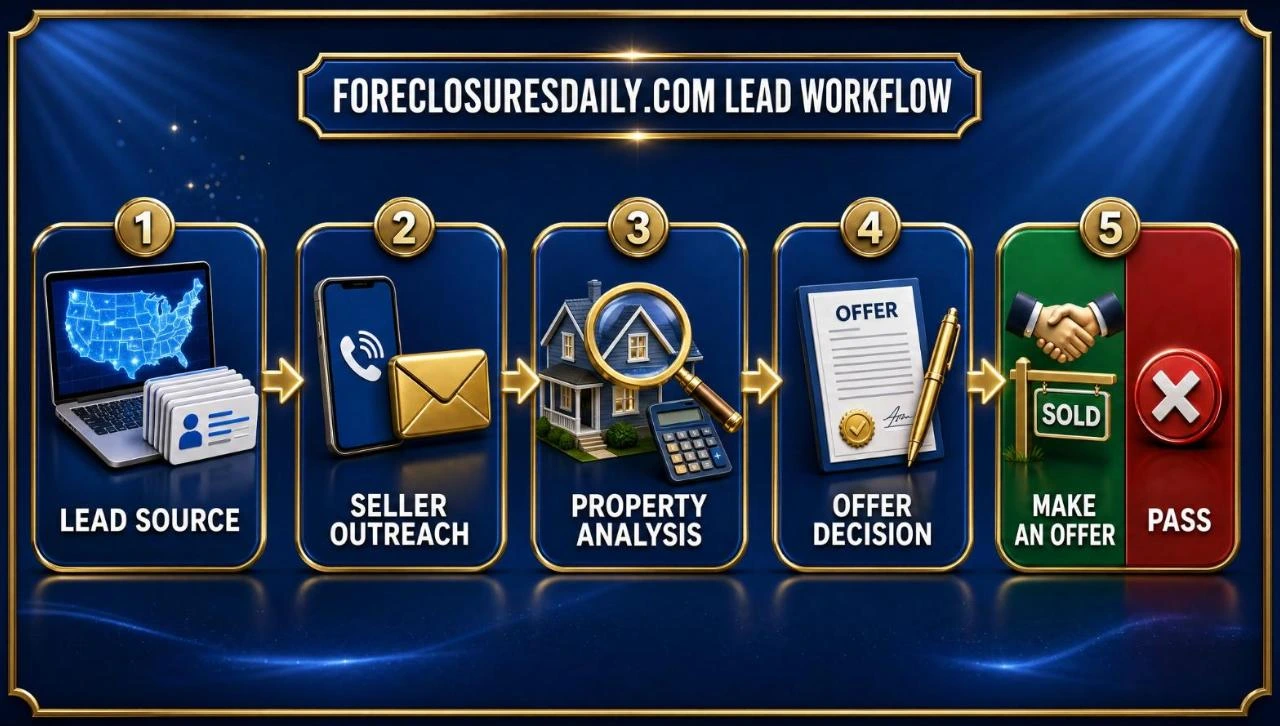
Listings are a good place to learn values, but many investor deals come from off-market sources such as probate, preforeclosure and absentee owners.
Use targeted lead lists
Lists of motivated sellers help you reach owners before they list and compete with fewer buyers.
Follow up consistently

Many sellers take time to decide. Regular, respectful follow-up turns leads into deals.
Before you buy
Explore related guides such as investor rental income and finding private money lenders.
ForeclosuresDaily off-market opportunities before your competition
ForeclosuresDaily.com has been helping investors, wholesalers, flippers, and agents reach motivated sellers first since 2004.
First-time real estate investor FAQ
How much money do I need to start?
It depends on the strategy. House hacking with an owner-occupant loan often requires the least cash, while flips and investment loans require more.
What is a DSCR loan?
A loan that qualifies the property based on its rental income compared with the mortgage payment.
What is the BRRRR method?
Buy, rehab, rent, refinance and repeat, a strategy for recycling capital into new rentals.
What is a good cap rate?
It varies by market and property type. Compare cap rates for similar properties in the same area.
Do I need landlord insurance?
Yes. It covers risks specific to rental properties.
Where do investors find deals?
On listings and off-market through lead lists, agents, wholesalers and networking.
Related guides: Private Money Lenders: 10 Tips to Find Them Fast for Real Estate Deals, Wholesale Real Estate for Beginners: 10 Steps to Your First Deal, Flipping Houses for Profit: A Profit-First Guide to Buying, Renovating and Selling, Investor Rental Income: A Practical Guide to Rental Property Investment.
Start your first real estate investment
A first-time real estate investor succeeds by choosing a strategy that fits their budget, understanding financing, running the numbers carefully, keeping reserves and building a reliable team.