Off-market properties in Indiana
Off-market properties in Indiana let investors reach inherited homes, FSBO sellers, distressed houses and private sales before they hit the open market. ForeclosuresDaily.com’s platform gives you targeted lead generation, verified leads and off-market lists you can work without waiting on crowded public listings.
Whether you run a flipping business, want rental property or are learning to flip as a beginner, the right leads help you move from browsing to making offers.
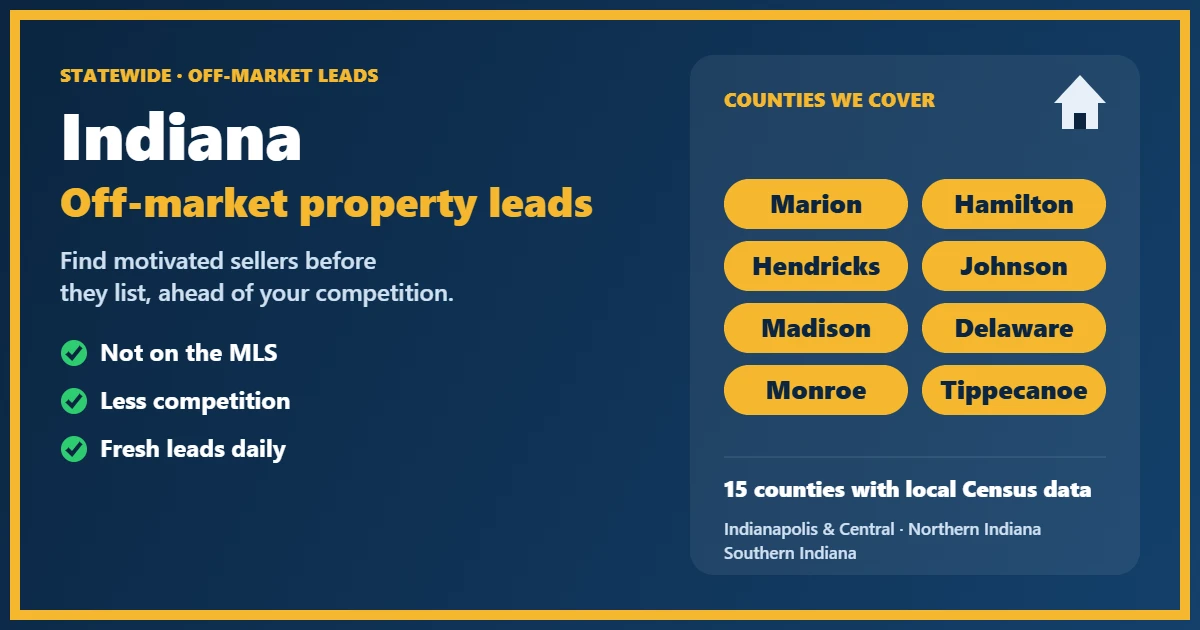
What are Indiana off-market properties?
Off-market properties are homes for sale that are not listed on the Multiple Listing Service (MLS) or publicly advertised, yet the owner may still sell through private outreach or direct negotiation.
Across Indiana, that can mean off-market homes in Indianapolis, Fort Wayne, South Bend, Evansville, New Haven, Gary, Lafayette and Bloomington, as well as in smaller counties where private sales move quietly.
Some owners need flexible terms, some want speed, and some simply do not want a public listing. Inherited property is a common case: heirs often want to sell quickly and value a simple path forward.
- Listed on the MLS
- Advertised to the public
- Every shopper can see it
- Not listed on the MLS
- Not publicly advertised
- Found by buyers who look beyond the portals
These opportunities may include
Indiana lead sources worth working
Not every owner is equally motivated, and not every rundown house is for sale. Good sources help you prioritize, segment and follow up instead of chasing random addresses.
Inheritance and probate
Probate-related properties where heirs may prefer a fast, simple sale.
Inheritance leads →
FSBO owners
Owners selling by themselves have already signaled interest in a sale.
Vacant and absentee-owned
Neglected homes and owners who live elsewhere and may not want the upkeep.
Absentee-owner leads →
Pre-foreclosure research
Foreclosure-related data, used where the law permits and with respectful outreach.
See lead products →
Driving for dollars
Boarded windows, overgrown yards and deferred maintenance you spot in person.
Life events and agent partners
Life-event leads that create a reason to sell, plus referrals from licensed agents you work with.
Verified leads work best with disciplined follow-up. One postcard, call or email rarely builds a pipeline; track each lead as yes, no or follow up.
Benefits of buying off-market properties in Indiana
The biggest benefit is less competition. A cheap house in a strong rental or resale area can draw many buyers within days of listing. Off-market deals give you more room to run numbers, talk with the seller and shape an offer before the property is widely seen.
- Access to FSBO, inheritance, foreclosure and vacant-home opportunities.
- Better sourcing for flips, rentals, wholesaling or below-retail buys.
- Control over outreach by county, property type and seller situation.
- A clearer path to converting motivated sellers than public portals alone.
- Room for creative terms when sellers value speed or certainty.
Property flipping means buying a home, fixing or upgrading it, and reselling it quickly for a profit. Whether it pays off depends on the purchase price, repair budget, ARV, holding costs, financing, resale timeline and exit plan. Lead generation does not replace due diligence; it gives you more deals to analyze. For local pricing context, see our Indianapolis wholesale price guide.

How our Indiana lead platform works
Instead of hours spent combing public records, classifieds, FSBO posts, foreclosure notices and yard signs, you work from lists built around motivated-seller signals.
- Pick your Indiana market: a city, county, ZIP code or niche, such as off-market investment homes in New Haven.
- Review the lead categories that fit your buying strategy.
- Research each property: ownership, condition clues, nearby comps, likely ARV and repair scope.
- Contact the owner professionally and document every conversation.
- Make a written offer only when your numbers and strategy are clear.
- Use proper Indiana contracts, disclosures, inspections, title review and closing support.
A beginner might start with one small target area, compare recent resale values, estimate repairs conservatively and refuse to overbid just because a house looks cheap. The cheapest flip is rarely the lowest price. It is the one where purchase, repairs, financing and resale risk all stay under control.

Indiana disclosure and contract rules to know
Off-market does not mean informal. Private sales still need proper documents, disclosures, title work and closing steps. This is not legal advice; consult an Indiana real estate attorney, licensed broker or title company before you use a contract or buy.
For many one- to four-unit homes, Indiana sellers generally must complete the Seller’s Residential Real Estate Sales Disclosure about the property’s known condition and deliver it before an offer is accepted (Indiana Realtors). The Department of Local Government Finance also requires a sales disclosure form when a deed is filed; the county assessor reviews it before it goes to the county auditor (in.gov).
Never rely on a handshake, a vague text or an online form you do not understand. Deals can move fast, but speed should never replace written terms and professional review.
Your purchase agreement should cover
- Full legal names of buyer and seller.
- Property address and legal description, when available.
- Price, earnest money, financing and closing date.
- Inspection rights, access, appraisal or financing contingencies and title requirements.
- Personal property included or excluded.
- Disclosures, possession date, default remedies and signatures.
- Assignment language if you plan to wholesale or assign.
Indiana counties we cover
These are Indiana’s 15 most populous counties. Compare each with the state medians: $218,200 home value, 71% owner-occupancy, 77% single-unit homes and 8.8% vacancy.
County search counts are modest because most buyers search by city; use them to compare counties, not as a total demand figure.
Marion County (Indianapolis): off-market investor snapshot
Indianapolis and its townships, the state’s largest and most varied housing market.
Local search demand
Resale demand: About 110 monthly searches for Marion County homes (led by “homes for sale marion county in”) point to one of the deepest retail buyer pools on this list, which supports fix-and-flip exits.
Investor note: Median home value is $224,000, 3% above the Indiana median of $218,200; 57% of homes are owner-occupied, 67% are single-unit, and 9.2% sit vacant. Only 57% of homes are owner-occupied, one of the lowest shares on this list, so tired landlords and absentee owners make up a big part of the lead pool. See our Marion County page.
Hamilton County (Carmel, Fishers): off-market investor snapshot
Carmel, Fishers, Noblesville and Westfield north of Indianapolis.
Local search demand
Resale demand: About 90 monthly searches for Hamilton County homes (led by “homes for sale hamilton county in”) point to steady mid-pack buyer interest, so resales should move at a fair price with realistic marketing time.
Investor note: Median home value is $405,500, 86% above the Indiana median of $218,200; 76% of homes are owner-occupied, 80% are single-unit, and 5.2% sit vacant. Values nearly double the state median, and owners have high incomes. Expect relocation and downsizing sellers who want a clean, private sale rather than distressed deals.
Hendricks County (Plainfield, Avon): off-market investor snapshot
Plainfield, Avon, Brownsburg and Danville west of Indianapolis.
Local search demand
Resale demand: About 40 monthly searches for Hendricks County homes (led by “homes for sale hendricks county in”) point to steady mid-pack buyer interest, so resales should move at a fair price with realistic marketing time.
Investor note: Median home value is $307,600, 41% above the Indiana median of $218,200; 78% of homes are owner-occupied, 85% are single-unit, and 3.7% sit vacant. Vacancy is only 3.7% and ownership is high, so off-market deals will be scarce and tied to life events. Relationships and early outreach matter.
Johnson County (Greenwood): off-market investor snapshot
Greenwood, Franklin and Whiteland south of Indianapolis.
Local search demand
Resale demand: About 70 monthly searches for Johnson County homes (led by “houses for sale johnson county in”) point to steady mid-pack buyer interest, so resales should move at a fair price with realistic marketing time.
Investor note: Median home value is $284,600, 30% above the Indiana median of $218,200; 73% of homes are owner-occupied, 82% are single-unit, and 5.1% sit vacant. 82% single-unit housing and low vacancy suit retail flips aimed at families. Look for inherited homes and owners who are relocating.
Madison County (Anderson): off-market investor snapshot
Anderson, Elwood and Pendleton northeast of Indianapolis.
Local search demand
Resale demand: About 30 monthly searches for Madison County homes (led by “homes for sale madison county in”) point to a thinner buyer pool, so a rental or wholesale exit may be safer than a retail flip.
Investor note: Median home value is $161,300, 26% below the Indiana median of $218,200; 70% of homes are owner-occupied, 81% are single-unit, and 9.9% sit vacant. Values run about 26% below the state median with nearly 10% vacancy. That combination often surfaces vacant, tax-delinquent and probate properties.
Delaware County (Muncie): off-market investor snapshot
Muncie and the Ball State University area.
Local search demand
Resale demand: About 60 monthly searches for Delaware County homes (led by “homes for sale delaware county in”) point to steady mid-pack buyer interest, so resales should move at a fair price with realistic marketing time.
Investor note: Median home value is $139,400, 36% below the Indiana median of $218,200; 66% of homes are owner-occupied, 75% are single-unit, and 10.4% sit vacant. The lowest median value on this list and 10.4% vacancy point to low-cost rentals and estate sales. Budget repairs carefully before you offer.
Monroe County (Bloomington): off-market investor snapshot
Bloomington and the Indiana University area.
Local search demand
Resale demand: About 20 monthly searches for Monroe County homes (led by “homes for sale monroe county in”) point to a thinner buyer pool, so a rental or wholesale exit may be safer than a retail flip.
Investor note: Median home value is $285,200, 31% above the Indiana median of $218,200; 54% of homes are owner-occupied, 59% are single-unit, and 9.8% sit vacant. Only 59% of homes are single-unit, and ownership is low, so rental and small multifamily owners dominate the lead pool.
Tippecanoe County (Lafayette): off-market investor snapshot
Lafayette, West Lafayette and the Purdue University area.
Local search demand
Resale demand: Local listing searches are too few to measure, so assume a small buyer pool and price any resale or hold plan conservatively.
Investor note: Median home value is $239,300, 10% above the Indiana median of $218,200; 53% of homes are owner-occupied, 62% are single-unit, and 6% sit vacant. Just 53% of homes are owner-occupied, the lowest share here, reflecting a large student rental market. Small landlords are the natural off-market sellers.
Lake County (Gary, Hammond): off-market investor snapshot
Gary, Hammond, Merrillville, Crown Point and the rest of Northwest Indiana near Chicago.
Local search demand
Resale demand: About 10 monthly searches for Lake County homes (led by “homes for sale lake county in”) point to a thinner buyer pool, so a rental or wholesale exit may be safer than a retail flip.
Investor note: Median home value is $230,600, 6% above the Indiana median of $218,200; 72% of homes are owner-occupied, 79% are single-unit, and 10.3% sit vacant. Vacancy above 10% and an older housing stock point to probate, code-violation and tax-delinquent leads. More on our Lake County page.
Porter County (Valparaiso): off-market investor snapshot
Valparaiso, Portage, Chesterton and the Indiana Dunes area.
Local search demand
Resale demand: About 320 monthly searches for Porter County homes (led by “homes for sale porter county in”) point to one of the deepest retail buyer pools on this list, which supports fix-and-flip exits.
Investor note: Median home value is $281,500, 29% above the Indiana median of $218,200; 78% of homes are owner-occupied, 79% are single-unit, and 5.5% sit vacant. Higher values and 78% ownership make this a market for owner-occupant resale. Estate and downsizing sellers are the likely leads.
Allen County (Fort Wayne, New Haven): off-market investor snapshot
Fort Wayne, New Haven and surrounding Northeast Indiana towns.
Local search demand
Resale demand: About 90 monthly searches for Allen County homes (led by “homes for sale allen county in”) point to one of the deepest retail buyer pools on this list, which supports fix-and-flip exits.
Investor note: Median home value is $214,900, 2% below the Indiana median of $218,200; 69% of homes are owner-occupied, 76% are single-unit, and 5.8% sit vacant. A low 5.8% vacancy rate means few empty houses, so life-event leads such as inheritance and divorce matter more than neglect. Details are on our Allen County page.
St. Joseph County (South Bend): off-market investor snapshot
South Bend, Mishawaka and the Notre Dame area.
Local search demand
Resale demand: About 110 monthly searches for St. Joseph County homes (led by “homes for sale st joseph county in”) point to one of the deepest retail buyer pools on this list, which supports fix-and-flip exits.
Investor note: Median home value is $192,800, 12% below the Indiana median of $218,200; 69% of homes are owner-occupied, 77% are single-unit, and 9.6% sit vacant. Below-state values and 9.6% vacancy create room for rehab buyers. Student and older rental housing can surface tired-landlord leads.
Elkhart County (Elkhart, Goshen): off-market investor snapshot
Elkhart, Goshen and Nappanee, a manufacturing hub east of South Bend.
Local search demand
Resale demand: About 20 monthly searches for Elkhart County homes (led by “homes for sale elkhart county in”) point to a thinner buyer pool, so a rental or wholesale exit may be safer than a retail flip.
Investor note: Median home value is $210,400, 4% below the Indiana median of $218,200; 72% of homes are owner-occupied, 73% are single-unit, and 10.2% sit vacant. Values track the state while vacancy runs above 10%, which suggests absentee-owner and vacant-property lists are worth testing.
Vanderburgh County (Evansville): off-market investor snapshot
Evansville and its neighborhoods along the Ohio River.
Local search demand
Resale demand: About 50 monthly searches for Vanderburgh County homes (led by “homes for sale vanderburgh county in”) point to steady mid-pack buyer interest, so resales should move at a fair price with realistic marketing time.
Investor note: Median home value is $184,000, 16% below the Indiana median of $218,200; 65% of homes are owner-occupied, 73% are single-unit, and 8.3% sit vacant. Values are about 16% below the state median with lower incomes, which favors buy-and-hold rentals and modest rehabs.
Clark County (Jeffersonville): off-market investor snapshot
Jeffersonville, Clarksville and Sellersburg across the river from Louisville.
Local search demand
Resale demand: About 140 monthly searches for Clark County homes (led by “homes for sale clark county in”) point to one of the deepest retail buyer pools on this list, which supports fix-and-flip exits.
Investor note: Median home value is $222,900, 2% above the Indiana median of $218,200; 75% of homes are owner-occupied, 77% are single-unit, and 6.9% sit vacant. Values sit near the state median and vacancy is moderate. Commuter demand from the Louisville area supports both flips and rentals.
U.S. Census Bureau, American Community Survey 2020–2024 5-year estimates. Home values are medians for owner-occupied homes, not current list prices.
Average monthly U.S. Google searches as of October 2026. Home searches combine “homes for sale” and “houses for sale” for each area. Seller searches combine “sell my house fast”, “we buy houses” and “cash home buyers”.
Want to find off-market properties in a specific neighborhood? ZIP-based lead lists make your outreach more relevant and help you work more efficiently.
What our customers say
Real investors share their experience with ForeclosuresDaily.com in short video reviews and press releases.









Turning Indiana leads into closed deals
- 1
Choose counties and seller types
Start with one or two counties and the lead types that match your exit, such as rentals in Evansville or flips in Johnson County.
- 2
Research and reach out
Verify ownership and condition, then contact owners respectfully and log every response.
- 3
Underwrite and contract
Run ARV and repair numbers, then use a written agreement with the required Indiana disclosures.
Your due diligence checklist
- Owner and authority to sell confirmed
- Seller’s residential disclosure received when required
- Sold comps, not asking prices, support ARV
- Repair estimate includes a contingency
- Title search and lien check ordered
- Sales disclosure form ready for closing
Motivation plus poor math is still a bad deal.
Indiana off-market FAQs
Common questions from Indiana buyers.
Have another question? Tell us your target ZIP codes and we will help you choose the right leads.
Are off-market homes only for experienced investors?
No No. Beginners can buy off-market, but they should start with conservative numbers, local comps, inspection support and a clear exit. If you hope to flip with no money of your own, be careful: partnerships, private lenders, hard money and assignments all carry risk and must be structured correctly.
Why can flipping work for some Indiana buyers?
It can work when you buy at the right price, understand repairs and sell into a market that supports your ARV. It is never automatic. The deal must survive real costs, delays, utilities, insurance, taxes, contractor issues and resale uncertainty.
What makes an off-market lead worth pursuing?
The seller has a real reason to sell, the property fits your criteria, and the numbers leave room for repairs, closing costs, holding costs and profit.
Can I use these leads for rentals instead of flips?
Yes Yes. Many buyers use Indiana leads for rentals, BRRRR-style strategies, buy-and-hold portfolios or long-term redevelopment. The right use depends on cash flow, location, condition and financing.
Build a better Indiana deal pipeline
Request Indiana off-market lists, search for motivated sellers in your target counties, and compare FSBO, inheritance, foreclosure-related and driving-for-dollars leads.
Build a repeatable outreach process and review every deal with sound ARV research, repair estimates and Indiana compliance support.