Tips for Success in Miami-Dade Wholesale Market
Wholesale real estate in Miami-Dade County, Florida, is a relationship-driven, numbers-sensitive business where speed matters, but discipline matters more. Investors who win here learn how each neighborhood behaves, build reliable buyer lists, analyze repairs conservatively, and treat sellers with transparency. This guide breaks down practical ways to find, evaluate, and move Miami wholesale properties without relying on guesswork.

Phillip WarrickWatch video →Webinar press release →
What makes wholesaling in Miami-Dade County different?
Wholesaling in Miami-Dade County is different because the county is not one simple market. It includes dense urban neighborhoods, suburban family areas, coastal-adjacent pockets, older housing stock, investor-heavy corridors, and communities where lot size, zoning, insurance, flood risk, and renovation costs can quickly change the deal.
That means a single formula rarely works everywhere. A discount that makes sense for Little River Little Haiti 33150 distressed homes may not make sense for Kendall 33186 high-end flip opportunities. A buyer who loves a North Miami 33161 fix-and-flip may not want a Homestead 33032 starter-home play, even if both deals look profitable on paper.
The most successful wholesalers in Miami-Dade real estate usually do three things well:
- They specialize in understanding local pricing, street by street.
- They build relationships with buyers before they need to assign a contract.
- They protect their reputation by being clear about what they are selling, what they control, and what the buyer should verify.
Local market snapshot: Miami-Dade County
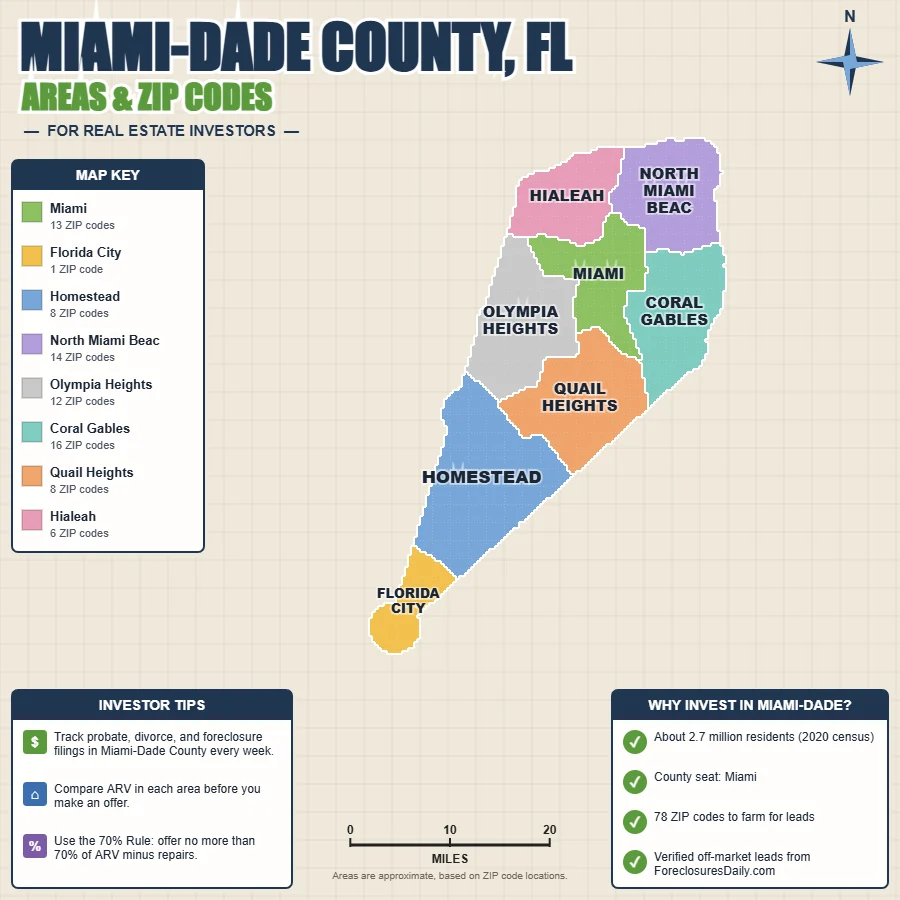
Miami-Dade County is home to about 2.7 million residents as of the 2020 census, and its county seat is Miami. Its ZIP codes span communities such as Hialeah, Opa Locka, Miami Shores, and Key Biscayne, and motivated-seller situations such as inherited homes, tired rentals, and pre-foreclosures show up across all of them.
With a population of this size, Miami-Dade County produces a steady flow of probate filings, divorces, and foreclosure notices every year. Investors who track these records and reach owners early tend to find the best off-market deals.
Miami-Dade wholesaling rewards local precision
Many investors enter real estate Miami searches looking for broad opportunity: distressed homes, foreclosures, private house sale situations, or any cheap house for sale Miami that can be turned into a profitable assignment. That curiosity is useful, but the county quickly punishes vague analysis.
A property can appear discounted relative to countywide averages and still be a weak wholesale property deal. Why? Because the buyer pool may be thin, the renovation scope may be heavier than expected, or the after-repair value may depend on finishes that only work in a very specific micro-market.
Local precision starts with understanding buyer intent. Some buyers want rentals near employment corridors. Others want cosmetic flips with clean titles and short timelines. Others target deeper value-add properties where they can resolve code, layout, or deferred maintenance issues. Your job as a wholesaler is not just to find a low price. Your job is to match the right problem with the right buyer.

Nancy Wallace-LaabWatch video →Read press release →
Neighborhood and ZIP strategy snapshot
Use this section as a quick planning guide, not a substitute for real comps, contractor walks, title review, or buyer feedback. Each pocket of Miami-Dade County has its own investor behavior, so treat these as strategy themes to test and refine.
- Homestead 33032 starter homes: Focus on entry-level affordability, rental demand, and resale potential for family buyers. Watch commute patterns, insurance costs, roof age, and whether the renovation budget still supports a realistic resale price.
- Hialeah 33012 wholesale deals:s Look for older homes with strong local buyer familiarity. Hialeah buyers may care about practical layouts, parking, additions, and potential for multigenerational living, so verify permits and improvement history early.
- Allapattah 33142 value-add: Evaluate properties for repositioning potential, rental upside, and renovation depth. This area can attract investors who understand urban infill, but you still need conservative numbers and clear assumptions about repairs.
- North Miami 33161 fix-and-flip: Focus on cosmetic-to-moderate rehabs where the end buyer can clearly see resale demand. Pay attention to roof condition, electrical updates, flood considerations, and nearby renovated sales.
- Kendall 33186 high-end flip: Treat this as a quality-sensitive strategy. Buyers may expect cleaner finishes, better layouts, and stronger retail presentation, so your maximum allowable offer must reflect higher renovation standards.
- Little River, Little Haiti 33150: distressed homes. Look for distress, deferred maintenance, inherited homes, and properties needing experienced operators. This can be a strong value-add area, but buyers will want clarity on title, occupancy, repairs, and neighborhood-specific comps.

Carolynn CastilloWatch video →Webinar press release →
Lead generation starts with seller motivation
Strong lead generation is less about collecting random addresses and more about identifying owners who may have a real reason to consider a fast, flexible sale. In Miami-Dade County, sellers may be dealing with inherited properties, relocation, deferred repairs, code issues, mortgage pressure, divorce, or the burden of owning a home that no longer fits their life.
The most useful lead sources often include both public-facing and relationship-based channels. You can market directly to owners, network with local professionals, monitor signals for distressed properties, and use a daily off-market platform to consistently review opportunities. The key is to avoid chasing every possible list at once. Pick a few lead channels, track the results, and improve your messaging over time.
Practical lead sources to test
- Inheritance property opportunities: Some owners inherit homes they do not want to renovate, manage, or keep. Approach these sellers with patience. The situation may involve multiple heirs, emotional attachments, title questions, or uncertainty about the next step. Pre-probate leads can be sensitive because the family may be early in the process. Keep outreach respectful, avoid pressure, and focus on being a clear option if selling becomes appropriate.
- Divorce leads: Divorce leads require extra care. A property sale may involve court timelines, multiple decision makers, or strong emotions. Never imply legal expertise, and make sure both parties with authority are handled properly.
- Foreclosures:s Foreclosures can create urgency, but urgency does not excuse aggressive tactics. Sellers need clear information, realistic timelines, and room to compare options. If you cannot help, say so.
- Private house sale conversations:ns A private house sale may come through direct mail, referrals, neighborhood networking, online forms, or local relationships. These sellers may not want showings, agent commissions, repairs, or delays, so your value is convenience and certainty.
- Driving for dollars and local observation:ion Vacant-looking homes, overgrown yards, boarded windows, damaged roofs, and notices can indicate possible distress. Record addresses carefully, research ownership, and avoid trespassing or intrusive behavior.
Gustavo MenchacaWatch video →
Messaging that earns responses
Your outreach should be simple, honest, and specific. Avoid sounding like a mass blast. A good message states who you are, why you are reaching out, what kind of purchase you can make, and that the owner is free to say no.
For example, instead of saying “I have buyers ready to pay top dollar,” use language such as: “I buy houses in Miami-Dade County as-is and can make a cash offer if selling without repairs is something you are considering.” That is direct without overpromising.

Michael KleinWatch video →
How do you analyze wholesale property deals in Miami-Dade?
You analyze wholesale property deals in Miami-Dade by starting with the buyer’s exit strategy, then working backward through after-repair value, repair scope, holding costs, closing costs, risk, and your assignment fee. The goal is not to make the deal look good; it is to find the price at which an actual buyer can purchase it, complete the plan, and still have enough margin to cover the risk.
Begin with comparable sales that match the property type, condition, size, and location as closely as possible. In Miami-Dade County, crossing major roads, canals, school boundaries, or neighborhood edges can weaken a comp. A renovated sale nearby is helpful only if your subject property can realistically reach a similar level of finish and buyer appeal.
Next, estimate repairs in ranges, not wishful single numbers. Older homes may hide electrical, plumbing, roofing, HVAC, window, structural, or permitting issues. If you are not experienced, walk the property with a contractor or experienced buyer before locking in your assumptions.
Kevin SaylesWatch video →
A simple deal analysis checklist
Before you present Miami real estate deals to buyers, review the following:
- Property condition: Note roof age, water intrusion, foundation concerns, HVAC, electrical panel, plumbing, windows, kitchen, baths, flooring, and exterior repairs.
- Comparable sale(s):s Use nearby, recent, similar properties when possible. Avoid cherry-picking the highest renovated sale unless the subject can truly compete with it.
- Buyer exit strategy: Decide whether the deal is likely a fix-and-flip, a wholesale deal, a teardown, or a long-term hold. Different buyers will value the same property differently.
- Title and ownership issues: Ask early about mortgages, liens, heirs, divorce, probate, judgments, open permits, code violations, or unpermitted additions.
- Insurance and hazard considerations: Miami-Dade buyers often think carefully about wind, flood, and roof-related insurance costs. Do not ignore these items in your conversations.
- Access and occupancy: Vacant properties are easier to inspect and close. Occupied properties require careful coordination, tenant awareness, and respect for legal boundaries.
- Assignment spread:d Your fee must leave enough room for the buyer. A large assignment fee on a thin deal can damage trust and kill repeat business.
Jorge OrtizWatch video →
Why conservative numbers build long-term trust
New wholesalers sometimes believe the biggest assignment fee is the best outcome. In reality, a repeat buyer who trusts your numbers is far more valuable than one inflated assignment. If you consistently send deals with realistic ARV, transparent repair notes, and a clear purchase price, buyers will open your messages faster.
Conservative analysis also helps you negotiate with sellers. When you know your repair estimate, resale range, and closing assumptions, you can explain your offer calmly. You do not need to criticize the property or pressure the owner. You can show that your offer reflects the work and risk involved.
Kaylee HarrisWatch video →
Ready to start? Talk to our team about leads in your market →
Motivated Sellers Who Want to Liquidate Fast
Every lead starts with a life event that gives the owner a reason to sell. Click any lead type to see our products.
Probate Leads
Estates in probate, where executors and heirs often need to sell the property to settle the estate.
View lead products →
Foreclosure Leads
Pre-foreclosure filings for homeowners facing a deadline, where a quick sale can protect their equity.
View lead products →
Divorce Leads
Divorce filings where the marital home must be sold or divided, often on a court timeline.
View lead products →
Inheritance Leads
Heirs who have inherited a property, often while living out of state, and would rather sell than manage it.
View lead products →
Life Leads
Owners facing major life changes, such as a move or downsizing, who need a fast sale.
View lead products →
Buyer building is a daily operating system
Finding a motivated seller is only half the business. If you do not have serious buyers ready to purchase Miami investment properties, your contract can become a liability rather than an asset. Buyer building should happen every week, not only after you get a property under contract.
Start by organizing buyers by strategy, geography, price point, and proof of performance. A buyer who says “send me anything in Miami” is less useful than one who says “I want North Miami 33161 fix and flip opportunities under a specific renovation range” or “I buy Homestead rentals if the numbers support long-term cash flow.” Specific buyers help you underwrite better.
Ways to build a stronger buyer list
- Attend local investor meetups and networking events. Ask what buyers purchased recently, where they are active, and what they avoid. Listen more than you pitch.
- Call active cash buyers from recent sales. Research entities that bought distressed or renovated properties. Introduce yourself professionally and ask for their criteria.
- Build relationships with agents who work with investors.s Investor-friendly agents often know who is closing, who is overpaying, and who is reliable.
- Connect with contractors and property manage.rs They often know landlords, flippers, and owners expanding their portfolios.
- Use social proof carefully. If you have closed deals, accurately describe your experience. If you are new, do not pretend otherwise. Lead with hustle, clarity, and good deal analysis.
Joe CreasyWatch video →
Questions to ask every buyer
A real buyer profile should include more than a name and phone number. Ask:
- Which Miami-Dade neighborhoods or ZIP codes do you prefer?
- Are you buying flips, rentals, short-term holds, or redevelopment opportunities?
- What is your maximum purchase price?
- What repair level are you comfortable with?
- How quickly can you inspect and submit earnest money?
- Do you use cash, hard money, private money, or another funding source?
- What deals have you closed recently?
- What makes you pass on a deal immediately?
These questions help you avoid blasting irrelevant properties. They also make your buyers feel understood, which improves response rates when you have a real opportunity.
Off-market deal flow needs consistent follow-up
The best Miami wholesale properties rarely come from a single message. They come from repeated, respectful follow-up with owners who were not ready last month but may be ready now. This is especially true for inherited homes, tired landlords, vacant properties, and owners facing complicated life events.
A daily off-market platform can support this rhythm by helping you review new opportunities, track seller conversations, and avoid relying only on public listings. Still, the tool does not replace judgment. You need a follow-up system, clear notes, and a process for deciding which leads deserve deeper work.
A practical follow-up cadence
Use a cadence that stays present without becoming annoying:
- First contact: Introduce yourself and ask whether the owner would consider selling as-is.
- Second touch: Reference the property and offer a simple next step, such as a quick call or a walkthrough.
- Value-based follow-up: Explain that you can buy without repairs, cleanouts, or traditional showings if that helps the seller.
- Timing check:k Ask whether the owner is thinking now, later, or not at all. Respect the answer.
- Long-term nurture: For owners who are interested but not ready, schedule future check-ins and keep notes on their situation.
Follow-up works best when it is human. A seller who feels like a database record is less likely to trust you with a major financial decision.

Anthony ColettiWatch video →
Seller conversations should be clear, calm, and useful
Wholesaling is often framed as a numbers game, but in Miami-Dade County it is also a communication game. Sellers may be dealing with complex family dynamics, language preferences, relocation stress, liens, repairs, tenants, or uncertainty about property value. Your ability to slow down and ask good questions can separate you from aggressive competitors.
A strong seller call has three goals: to understand motivation, the property, and the decision process. You are not there to force a yes. You are there to determine whether your buying model fits the seller’s needs.
Ask open-ended questions such as:
- What made you consider selling?
- How long have you owned the property?
- Is anyone living in the home now?
- Are there repairs you already know about?
- Are there any mortgages, liens, code issues, or open permits?
- Who else needs to be involved in the decision?
- If you did sell, what timeline would be ideal?
When you make an offer, explain it plainly. If the seller wants full retail value, they may be better served listing with an agent. Saying that honestly can build trust, and sometimes the seller will return later if speed and certainty become more important.

Steven HughesWatch video →
Negotiation works best when value is specific
A low offer with no explanation feels insulting. A lower cash offer tied to specific benefits can feel practical. The difference is how well you connect your price to the seller’s real problem.
For example, an owner with a dated, vacant home may want to avoid repairs, utilities, insurance, cleanout, and months of uncertainty. An heir handling an inheritance property may value a simple closing and fewer family logistics. A seller facing foreclosure may care most about timeline and certainty, while someone with a private house sale may care about privacy.
Your negotiation should clarify trade-offs:
- A retail listing may yield a higher price but usually requires more time and access and carries more uncertainty.
- An investor sale may yield a lower price but can reduce repair costs, showings, and delays.
- A clean contract and reliable closing may be worth more to the seller than a slightly higher offer that never closes.
Do not create fake urgency. Real urgency is enough when the seller has a genuine problem, and your solution fits.

Alex JandickWatch video →
Compliance and ethics protect your business
Wholesaling in Florida should be handled with care because real estate transactions involve contracts, disclosures, money, and consumer protection concerns. Florida Chapter 475 regulates real estate brokers and sales associates, and the Florida Real Estate Commission provides statutes and rules through the Department of Business and Professional Regulation. If you are unsure whether your activity requires a license or specific disclosures, speak with a Florida real estate attorney or qualified compliance professional before marketing deals or collecting fees.
A common wholesaling model involves contracting to buy a property and then assigning your contractual interest to another buyer. However, you should not market a property as if you own it when you only hold a contractual right, and you should ensure the purchase agreement allows assignment. Florida law also addresses the recording of assignments of contracts for real estate, so get legal guidance before recording or attempting to use documents in the public records.

Shannon ThompsonWatch video →
Ethical wholesaling practices
Use these principles as a baseline:
- Disclose your role clearly. Do not let sellers or buyers think you are acting as their agent unless you are properly licensed and operating in that capacity.
- Market the interest you actually have.e If you have an assignable contract, be clear that you are offering your contractual interest, not making unsupported claims of ownership.
- Use written agreements. Avoid handshake deals. Contracts, assignment agreements, inspection rights, deposits, and closing timelines should be documented.
- Avoid predatory pressure. Distressed sellers may be under financial or emotional stress. Give them room to review, ask questions, and seek advice.
- Respect privacy: Divorce leads, pre-probate leads, inheritance situations, and foreclosure matters can be deeply personal. Keep communication professional and confidential.
- Do not exaggerate buyer demand.d Saying you have a buyer when you do not can create mistrust. Build the buyer list before making promises.
- Work with reputable title and closing professionals.ls A good title company or closing attorney can help identify issues early, but they are not a substitute for your own diligence.
Florida also sets duties and disclosure requirements for real estate licensees in brokerage relationships, including duties such as dealing honestly and fairly and accounting for funds. Even if you are not acting as a licensee, those concepts are useful ethical standards for anyone trying to build a serious wholesaling business.
Nico GentileWatch video →
Common mistakes that kill Miami-Dade deals
Many failed wholesale deals do not fail because the property was impossible. They fail because the wholesaler moved too fast, ignored local details, or tried to force numbers that serious buyers would not accept.
Overestimating ARV
This is the classic mistake. A renovated sale two miles away may not support your deal. A waterfront-adjacent comp may not apply to an inland property. A larger home with permitted additions may not compare to a smaller home with questionable improvements.
Underestimating repairs
Miami-Dade properties can carry expensive repair surprises. Roofs, windows, electrical systems, plumbing, HVAC, moisture issues, and unpermitted work can quickly change a budget. If you are new, assume your first repair estimate is incomplete.
Ignoring buyer appetite
A deal is only a wholesale deal if a buyer wants it at your price. Before locking up unusual properties, ask active buyers what they would pay and why. Their feedback is market data.
Failing to solve title issues early
Probate, heirs, divorce, liens, code violations, and old mortgages can delay or stop closings. Ask about these issues early and open title as soon as practical.
Sending messy deal packages
Buyers move faster when the information is organized. Include photos, property details, access instructions, estimated repairs, asking price, assignment terms, and your best comp support. Do not hide obvious problems. Serious buyers will find them anyway.
DJWatch video →
A practical weekly workflow for new wholesalers
Consistency beats random effort. If you are building a wholesale real estate business in Miami-Dade County, create a weekly operating rhythm that covers lead generation, seller follow-up, deal analysis, and buyer outreach.
A sample weekly workflow could look like this:
- Monday: Pipeline review. Review active leads, seller notes, upcoming follow-ups, and contracts in progress. Decide which opportunities deserve immediate attention.
- Tuesday: Lead generation.n Pull targeted lists, review off-market opportunities, drive selected neighborhoods, or contact owners from priority ZIP codes.
- Wednesday: Seller calls and appointments. Focus on live conversations. Ask better questions, book walkthroughs, and gather repair information.
- Thursday: Buyer development. Call cash buyers, update buyer criteria, attend networking events, and ask what deals they are actively seeking.
- Friday: Deal analysis.s Run comps, verify repair assumptions, review title concerns, and decide which offers to make.
- Weekend: Fieldwork and learning. Walk neighborhoods, visit open houses, study renovated listings, and compare online photos with real-world condition.
This workflow keeps you from becoming one-dimensional. A wholesaler who only markets but never builds a buyer base will struggle. A wholesaler who only networks but never talks to sellers will also struggle.
Shannon ThompsonWatch video →
Technology helps, but judgment closes deals
Software can help you find Miami real estate deals, organize follow-up, estimate values, and communicate faster. A daily off-market platform can be especially useful when you need a steady view of potential opportunities across Miami-Dade County. But technology should support your process, not replace it.
The best use of technology is to create consistency. Track which lead sources produce conversations, which neighborhoods produce buyer interest, and which price points move quickly. Over time, your own data becomes a competitive advantage.
Still, never let a dashboard convince you to skip the basics. You need real conversations, property access, photo review, comp discipline, and buyer confirmation. The deal closes because the numbers, title, seller, and buyer all line up.

Amanda YoungWatch video →
The long-term edge is reputation
Wholesaling can look transactional from the outside, but the strongest operators play a long game. Miami-Dade County is large, yet the investor community can feel small. Buyers remember who sent clean deals. Sellers remember who treated them with respect. Title companies remember who came prepared.
If you want to last, build a reputation for accuracy. That means you do not hide bad roofs, inflate ARV, fake urgency, or shop contracts you cannot assign. It also means you keep learning each submarket instead of pretending all Miami investment properties work the same way.
The opportunity in Wholesale Real Estate Miami-Dade County, Florida is real, but it belongs to investors who combine hustle with restraint. Focus on motivated sellers, neighborhood-specific strategy, conservative underwriting, ethical contracts, and buyer relationships that deepen over time. Do that consistently, and the Miami-Dade wholesale market becomes less chaotic and far more workable.
Get Off-Market Leads Before Your Competition
ForeclosuresDaily.com has supplied off-market real estate leads since 2004 on a nationwide platform. Reach motivated sellers before their homes are listed on the MLS.
Get Started →