Wholesale Real Estate Phoenix Arizona
Wholesale real estate in Phoenix rewards investors who reach motivated sellers first. Instead of competing on the MLS, ForeclosuresDaily.com helps you find owners facing probate, foreclosure, or divorce, so you can sign a discounted contract and assign it to a cash buyer.
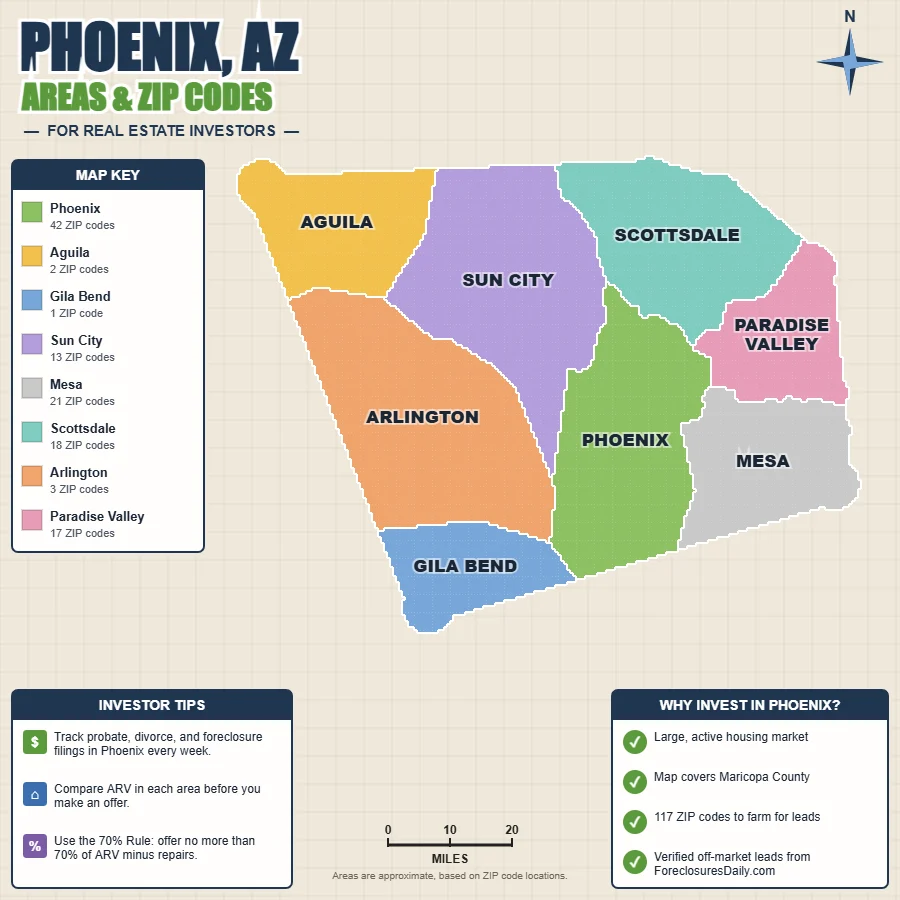
Market data: Realtor.com Maricopa County housing market, October 2026. Zillow Home Value Index for Maricopa County: $456,252 (down 1% from a year earlier), August 2026. View homes on Zillow.

Listed and sold 25 properties and personally bought and sold four fix-and-flip properties, all generated from probate leads.
Carolynn Castillo
Realtor & Broker · eXp Realty
Why wholesale real estate in Phoenix?
Wholesaling needs little capital because you control a property with a contract and an earnest money deposit, not a mortgage. In addition, your buyer handles the repairs, so you never manage contractors, and many assignments close in weeks rather than months.
The ZIP codes with the most homes for sale today are 85016, 85037, and 85041, so that is where most motivated sellers are.

Shannon Thompson
Investor · Joe Homebuyer of Atlanta
Watch Shannon Thompson share their experience using ForeclosuresDaily.com.
How does wholesaling real estate work in Phoenix?
Every wholesale deal follows the same path, from the first lead to the assignment fee:
Find a distressed property
Initially, use targeted lead generation to find owners with a reason to sell, such as heirs, tired landlords, or owners facing foreclosure.
Run the numbers
Next, estimate the after-repair value (ARV) from nearby sales, because your offer depends on it.
Sign a purchase contract
Then agree on a price that leaves room for your buyer’s profit as well as your assignment fee.
Find a cash buyer
After that, match the deal with a flipper, landlord, or other cash buyer from your list.
Assign the contract
In addition, transfer your rights under the contract to the buyer in exchange for your fee.
Collect your fee
Finally, the title company or closing attorney usually pays your assignment fee at closing.

Andrew Litchfield
Webinar host
Andrew Litchfield hosted a ForeclosuresDaily.com monthly webinar for real estate investors.
Motivated sellers who want to liquidate fast
For this reason, ForeclosuresDaily.com’s off-market real estate platform covers every major distress signal in Phoenix, cross-referenced with tax rolls and property appraiser records.

Anthony Coletti
Real estate investor
Watch Anthony Coletti share their experience using ForeclosuresDaily.com.
How do you calculate a wholesale offer in Phoenix?
Every offer starts with the ARV, which is what the home will be worth once it is fixed. For example, the 70% Rule says your buyer should pay no more than 70% of ARV minus repairs. Because your assignment fee comes out of that number, your contract price must be even lower.
For instance, here is the math using the Maricopa County median listing price as the ARV, an 8% repair budget, and a typical assignment fee.
Wholesale offer example

Jeremy Resmer
Webinar host
Jeremy Resmer hosted a ForeclosuresDaily.com monthly webinar for real estate investors.
Phoenix ZIP codes to watch
Start your search in these Phoenix ZIP codes, and then expand as you learn which areas your buyers want. Next, choose a ZIP code from the menu to open its investing data.
Camelback EastZIP 85008$417,500Negotiate
Camelback East (85008) market snapshot
In addition, the Zillow Home Value Index is $373,676 (down 0.7% from a year earlier) as of August 2026.
Investor note: Meanwhile, the median price is down 15.9% from a year earlier, and inventory is up 18.7%. So, price your offer with the 70% Rule before you negotiate.
Also see the full 85008 market report on Realtor.com →Then view 85008 homes on Zillow →
Choose a ZIP code from the menu to see its investing data, then compare markets. Market data: Realtor.com, October 2026, and Zillow Home Value Index, August 2026. Also, gross rent yield is 12 months of median rent divided by the median listing price; the max offer assumes repairs of 8% of the median price.

Antonio Stringfield
Probate investor · Los Angeles
Watch Antonio Stringfield share their experience using ForeclosuresDaily.com.
How do you build your buyers list in Phoenix?
Build your buyers list before you sign your first contract. Your best buyers are cash buyers who can close quickly, such as flippers, landlords, and small builders.
- First of all, attend local real estate investor meetups.
- Also, review recent cash sales in county records to find active buyers.
- Then connect with title companies, hard money lenders, and property managers.
- Finally, ask every buyer for their buy box: areas, price range, and rehab level.
What does assigning contracts mean in Arizona?
Assigning contracts means transferring your rights as the buyer under a purchase agreement to another investor. However, the rules differ by state, so review your contracts with a Arizona real estate attorney before you start.

Nancy Wallace-Laab
Investor · nearly 20 years
Nancy focuses on the best outcome for both the seller and the investor, drawing on nearly 20 years of real estate investing experience.
Wholesale Real Estate Phoenix Arizona
Wholesale real estate in Phoenix, Arizona, is a market where investors seek discounted, distressed, inherited, pre-probate, divorce-related, and off-market properties that can be assigned, renovated, rented, or resold. The opportunity is not uniform across the city: ZIP codes, seller motivation, repair burden, buyer appetite, and exit strategy all influence whether a deal is viable. This guide explains how investors typically evaluate phoenix wholesale properties, focusing on key submarkets such as Maryvale, North Phoenix, Central/East Phoenix, and South Phoenix.
What makes Wholesale Real Estate Phoenix different from other markets?
Wholesale Real Estate Phoenix is shaped by rapid neighborhood variation, diverse housing stock, and a wide range of investor exit strategies. In one part of the city, a buyer may be screening for a Cheap house for sale with heavy repairs and a low acquisition basis; in another, the same buyer may prioritize school access, resale appeal, or long-term rental stability. That means wholesale real estate in Phoenix, Arizona requires more than finding a low price. It requires understanding whether the discount fits the neighborhood, the repairs, and the likely end buyer.
Phoenix also attracts different buyer profiles. Some real estate wholesalers focus on distressed single-family homes that cash buyers can renovate quickly. Others target Phoenix investment properties with rental potential, especially where purchase prices may still support yield. A more sophisticated investor may even consider higher-priced submarkets when the long-term resale potential appears stronger than the immediate spread.
The practical result is simple: the best Arizona real estate deals are rarely defined by price alone. They are defined by context. A wholesale home opportunity in Phoenix that appears inexpensive may still be weak if the repair estimate, title issues, occupancy problems, or buyer demand do not support the assignment price.
Local market snapshot: Phoenix
Its ZIP codes cover neighborhoods across the city, and motivated-seller situations such as inherited homes, tired rentals, and pre-foreclosures show up in every one of them.
Local investors who track probate filings, divorces, and foreclosure notices in Phoenix and reach owners early tend to find the best off-market deals.
Phoenix submarkets tell different investment stories
Submarket analysis is central to Phoenix property investment because the same deal structure can perform very differently across ZIP codes. Phoenix is large, and its investment logic changes between western value corridors, northern rental zones, eastern premium neighborhoods, and southern yield-screening areas.
Maryvale Corridor: motivated seller activity and deep-value screening
The Maryvale corridor, often associated with 85031, 85033, and 85035, is frequently discussed by investors seeking lower-priced, distressed, or value-add homes. Some online investor commentary, including anecdotal Reddit discussions, suggests these ZIP codes may offer deep value and active pools of cash buyers for lower-priced distressed homes. That should not be treated as market proof, but it does reflect why many wholesalers monitor the area closely.
For investors, Maryvale can be appealing because motivated seller situations may be more visible. Properties may involve deferred maintenance, landlord fatigue, Inheritance situations, Pre-probate uncertainty, Divorce, or owners who do not want to complete repairs before selling. However, lower acquisition prices do not automatically create safe spreads. Investors still need disciplined repair estimates, conservative resale assumptions, and awareness of street-by-street variation.
North Phoenix: rental versatility in 85032
North Phoenix, especially 85032, is often evaluated for rental versatility and active off-market deal volume. Platforms and investor marketplaces, including references such as HouseCashin-style tracking and the ForeclosuresDaily off-market Platform concept, are commonly used by buyers to identify possible distress signals, ownership patterns, or wholesale opportunities. The key is not merely finding a lead, but deciding whether the rental or resale exit is coherent.
In 85032, investors may look for homes that can serve several buyer types. A landlord might value steady tenant demand, while a fix-and-flip buyer may focus on cosmetic upside and comparable sales. This versatility can support liquidity but also create competition. Real estate wholesalers working this area should know their buyers before locking up a contract.
Key points for Phoenix investors
The 85014, 85016, and 85018 ZIP codes in the Central and East corridor, including areas associated with Biltmore and Arcadia, tend to skew toward higher price points and long-term resale potential rather than quick, cheap flips. These areas may not match the classic image of wholesale real estate: low-cost distressed inventory, heavy repairs, and a fast cash-buyer assignment. Instead, deals may depend on property condition, lot value, architectural appeal, or a seller’s need for certainty and speed.
In these submarkets, a wholesale buyer must be careful. A small pricing error can erase the assignment spread because acquisition costs are higher. Yet when the numbers work, the buyer pool may include investors with stronger capital, builders, luxury renovators, or owner-occupant-oriented flippers seeking a premium resale path.
South Phoenix: 85041 and yield screening
South Phoenix, especially 85041, is frequently evaluated by investors for yield screening and lower price baselines compared to premier northern or eastern submarkets. This does not mean every property is a bargain. It means investors often analyze whether the acquisition price, rent expectations, repair costs, and neighborhood trajectory can support a buy-and-hold thesis.
For wholesalers, 85041 may be appealing when a property offers enough discount to attract landlords and value-add buyers. Still, the same underwriting discipline applies. Confirm condition, title, access, occupancy, and comparable sales before assuming that a lower price equals a good deal.
Motivated seller situations require careful interpretation
Many wholesale leads begin with life events rather than traditional listings. Inheritance, Pre-probate, and Divorce are common examples, but they require tact, compliance, and patience. A seller in one of these situations may value certainty, privacy, speed, or relief from a burdensome property. That does not mean the investor should pressure the seller or assume distress automatically creates a deal.
Ethical wholesale real estate tips begin with clarity. The seller should understand who is buying, whether the buyer intends to assign the contract, what timeline is proposed, and what obligations remain before closing. Investors should also recognize that probate, title defects, liens, and family disagreements can complicate even a promising lead.
This framework protects both sides. It also improves deal quality because vague information often produces inflated offers, failed assignments, and reputational damage.
How should investors evaluate phoenix wholesale properties?
Investors should evaluate Phoenix wholesale properties by starting with the exit strategy, then working backward into maximum allowable offer, repairs, carrying costs, transaction costs, and buyer demand. A wholesale deal is not viable simply because it is off-market. It is viable when the numbers leave enough margin for the next buyer to accept the risk.
This process is especially important when screening phoenix real estate trends. Broad market narratives can be useful, but they do not replace property-level analysis. Even in a strong market, an overleveraged renovation can fail. Even in a cautious market, a well-bought property in the right ZIP code can attract serious attention.
Off-market platforms and local knowledge work best together
Digital platforms can help investors locate possible leads, including foreclosures, vacant homes, absentee owners, inherited properties, and other indicators of seller motivation. A ForeclosuresDaily off-market Platform or similar tool may support list building, lead organization, and early-stage research. However, software cannot substitute for local judgment.
The strongest operators combine data with field knowledge. They drive neighborhoods, speak with contractors, monitor buyer feedback, and compare active listings with closed sales. They also learn why certain blocks command more interest than others. In Phoenix, that difference can be meaningful even within the same ZIP code.
Each source has limitations. Data may be stale, sellers may be unresponsive, and legal rules around outreach can vary. Professionalism matters because the wholesale model depends heavily on trust.
Ready to start? Talk to our team about leads in your market →
Motivated Sellers Who Want to Liquidate Fast
Every lead starts with a life event that gives the owner a reason to sell. Click any lead type to see our products.
Probate Leads
Estates in probate, where executors and heirs often need to sell the property to settle the estate.
Foreclosure Leads
Pre-foreclosure filings for homeowners facing a deadline, where a quick sale can protect their equity.
Divorce Leads
Divorce filings where the marital home must be sold or divided, often on a court timeline.
Inheritance Leads
Heirs who have inherited a property, often while living out of state, and would rather sell than manage it.
Life Leads
Owners facing major life changes, such as a move or downsizing, who need a fast sale.
Risk management is part of the business model
Wholesale real estate can appear simple from the outside: find a discount, put it under contract, assign it to a buyer. In practice, the risks are more complex. Mispriced repairs, unclear title, unrealistic after-repair value, aggressive marketing claims, and weak buyer qualification can derail a transaction.
Investors should avoid advertising a property as guaranteed profit or presenting uncertain assumptions as facts. They should also understand local contract rules, disclosure obligations, and licensing considerations. Anyone operating at scale should consult qualified Arizona real estate, legal, and tax professionals instead of relying solely on informal investor advice.
These habits may not sound exciting, but they distinguish durable operators from short-term speculators.
A balanced view of opportunity in Phoenix
Wholesale real estate in Phoenix, Arizona, remains a market of contrasts. Maryvale corridor ZIP codes such as 85031, 85033, and 85035 may attract deep-value buyers and distressed-property specialists. North Phoenix 85032 may appeal to investors seeking rental versatility. Central and East Phoenix ZIP codes, such as 85014, 85016, and 85018, may support higher-priced, long-term resale strategies. South Phoenix 85041 may fit yield-focused screening and lower entry-point analysis.
The best approach is not to chase every lead. It is to match each property to the right buyer profile, price risk conservatively, and respect the seller’s circumstances. For investors seeking Arizona real estate deals, Phoenix can offer meaningful opportunities, but only when submarket knowledge, ethical acquisition, and disciplined underwriting work together.
Get Off-Market Leads Before Your Competition
ForeclosuresDaily.com has supplied off-market real estate leads since 2004 on a nationwide platform. Reach motivated sellers before their homes are listed on the MLS.

Phillip Warrick
Full-time investor since 2003
Full-time real estate investor since 2003, with over 20 years of experience.
ForeclosuresDaily off-market opportunities before your competition
In fact, since 2004, ForeclosuresDaily.com has helped investors, wholesalers, flippers, and agents reach motivated sellers first.
More wholesaling guides in Arizona
Compare nearby markets before you choose where to farm. For example, these local guides cover other Arizona cities and counties:
Maricopa County · Wholesale House Prices Mesa · Wholesale House Prices Phoenix · Wholesale House Prices Tucson · Wholesale Real Estate Tucson, Arizona
Also, see Wholesaling Real Estate for Profit for the profit math and guides in every state.
Wholesaling questions for Phoenix
How do you wholesale real estate in Phoenix?
First of all, find a motivated seller through probate, pre-foreclosure, or absentee-owner leads. Then sign a contract at a discount, and finally assign it to a cash buyer for a fee.
Is wholesaling legal in Arizona?
Wholesaling is legal in most states, but the rules vary. For example, some states require disclosures or a license for certain activities, so have a Arizona real estate attorney review your contracts.
How much can you make wholesaling in Phoenix?
Assignment fees vary by deal. For instance, a fee of about 3% on a home priced near the Phoenix median of $499,000 would be roughly $15,000.
Which Phoenix ZIP codes have the lowest entry prices?
Among the ZIP codes in this guide, the lowest median listing prices are in 85051 (North Mountain) at $350,000, 85037 (Maryvale) at $382,500, and 85008 (Camelback East) at $417,500, based on Realtor.com data from October 2026.
Where do Phoenix foreclosures come from?
Most start with missed mortgage payments, so pre-foreclosure filings appear months before an auction. As a result, investors who reach owners early can buy before the home is listed.
Get Phoenix wholesale leads today
Fresh, targeted, off-market data for Camelback East, North Mountain, Deer Valley, and beyond.
Get Started →