California Investors Networking
As a networking platform for real estate investors, realtors, and wholesalers, California Investors Networking focuses on monthly meetings, special seminars, and boot camps. This guide explains how California real estate networking works, how to get the most from your first meetings, and how to turn relationships into deals in one of the country’s most competitive markets.
Market data: Realtor.com U.S. housing market, October 2026.

Listed and sold 25 properties and personally bought and sold four fix-and-flip properties, all generated from probate leads.
Carolynn Castillo
Realtor & Broker · eXp Realty
About California Investors Networking
California Investors Networking is a networking platform for real estate professionals, including investors, realtors, and wholesalers. Its focus is on monthly meetings, special seminars, and boot camps, where members learn from one another’s experiences in a friendly, professional atmosphere.
Networking continues between events, so the relationships you build can lead to partners, lenders, contractors, and buyers. In a state as large and varied as California, those local connections are often the fastest way to learn what works in your market.

Shannon Thompson
Investor · Joe Homebuyer of Atlanta
Watch Shannon Thompson share their experience using ForeclosuresDaily.com.
Why real estate networking matters in California
California is not one market but many. Los Angeles, the Bay Area, San Diego, the Inland Empire, Sacramento, and the Central Valley each have different prices, rents, rules, and buyer pools. A strategy that works in Fresno may fail in San Francisco, and the reverse is also true.
Because prices and costs are high, mistakes are expensive. In addition, networking with experienced California investors helps you understand permits, rent rules, insurance, and financing before you commit your money.

Andrew Litchfield
Webinar host
Andrew Litchfield hosted a ForeclosuresDaily.com monthly webinar for real estate investors.
Motivated sellers who want to liquidate fast
For this reason, ForeclosuresDaily.com’s off-market real estate platform covers every major distress signal across California, cross-referenced with tax rolls and property appraiser records.

Anthony Coletti
Real estate investor
Watch Anthony Coletti share their experience using ForeclosuresDaily.com.
Who you will meet at California investor meetings
California investor groups usually draw a broad mix of professionals:
- Landlords with single-family rentals, small multifamily buildings, and ADUs.
- Flippers and small developers working on renovations and lot splits where allowed.
- Wholesalers who find off-market deals and assign contracts.
- Lenders, escrow and title officers, property managers, and contractors.
- Newer investors looking for mentors, partners, or a first deal, including out-of-state investing.

Jeremy Resmer
Webinar host
Jeremy Resmer hosted a ForeclosuresDaily.com monthly webinar for real estate investors.
Getting the most from your first meetings
Your first few meetings set the pattern for how much you learn and how many useful contacts you make. Arrive with a short introduction that covers what you invest in, where you focus, and what you are trying to learn. Also, listen more than you talk early on, and write down names, follow-up items, and recommendations you want to verify.
After each meeting, send a brief follow-up to two or three people you would like to know better. Also, offer something useful, such as a market article, a contractor name, or a thoughtful question. Consistent follow-up builds trust faster than a large number of quick introductions.

Antonio Stringfield
Probate investor · Los Angeles
Watch Antonio Stringfield share their experience using ForeclosuresDaily.com.
How to get started
Use these steps in your first few months:
Confirm the details
First, check meeting dates, locations, membership options, and guest policies.
Choose a focus
Next, pick one region of California and one strategy to learn about first.
Prepare an introduction
Then write a short introduction you can share in under a minute.
Take notes
After that, track speakers, topics, key numbers, and actions you plan to take.
Follow up
In addition, follow up within a week with the most helpful contacts.
Review monthly
Finally, review your notes each month to see which topics and groups help you most.

Nancy Wallace-Laab
Investor · nearly 20 years
Nancy focuses on the best outcome for both the seller and the investor, drawing on nearly 20 years of real estate investing experience.
California topics worth discussing
Several California issues come up again and again. Rent caps and tenant protections apply to many rentals statewide, and some cities have stricter local rules. Accessory dwelling units, or ADUs, have opened new ways to add value to single-family lots. Moreover, permits, insurance availability, and wildfire risk also affect many deals.
Ask members who own property in your target area how these rules affect their numbers. Their experience can save you from expensive surprises.

Phillip Warrick
Full-time investor since 2003
Full-time real estate investor since 2003, with over 20 years of experience.
Investing outside California
Because California prices are high, many California investors buy rentals in other states. Moreover, networking groups often discuss markets such as Arizona, Texas, the Midwest, and the Southeast, along with property management from a distance.
If you plan to invest out of state, ask members which markets they chose and why, how they found reliable property managers, and what surprised them in the first year.
Using your network and off-market leads together
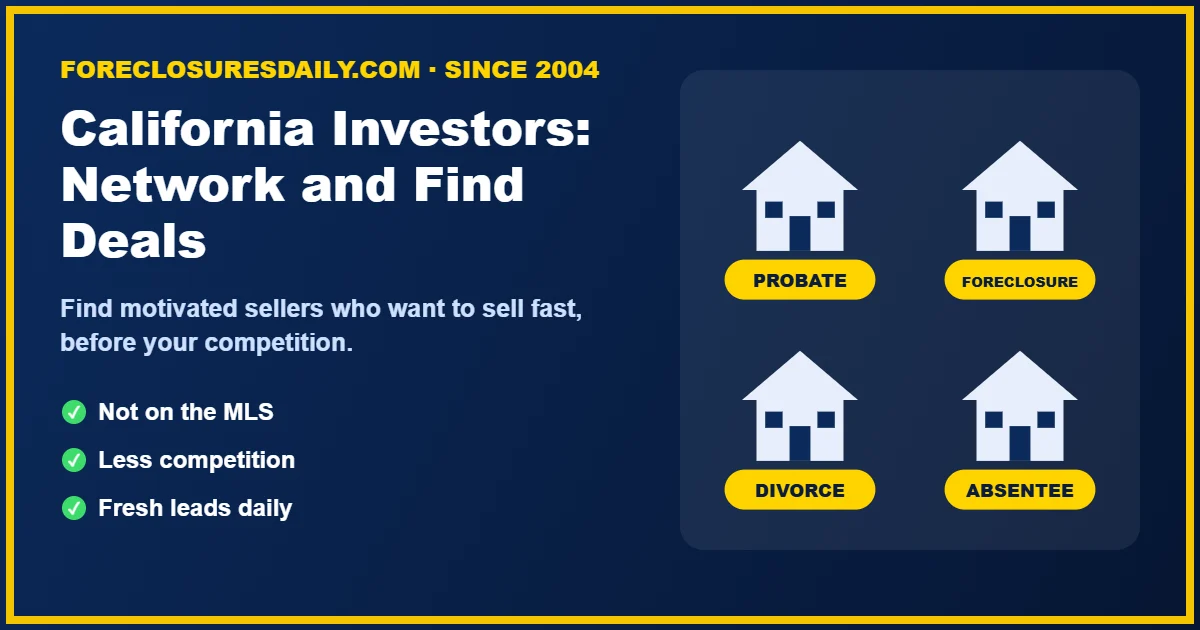
Networking can bring partners, buyers, and occasional deals, but consistent deal flow usually comes from your own lead generation. California investors often target probate estates, inherited homes, pre-foreclosures, divorce cases, and absentee owners.
ForeclosuresDaily.com delivers those leads by county and ZIP code, updated daily. In fact, bring a few to your next meeting and ask experienced members how they would price and approach them.
Strategies California members discuss most
Common strategies include buy-and-hold rentals, value-add renovations, ADU additions, fix-and-flip projects, and wholesaling. In fact, each one carries different risks in California, from long permit timelines to rent rules and high carrying costs.
Listen to members who have completed several deals in your chosen strategy, and ask what they would do differently in today’s market.
How to evaluate a networking group
Before you join, ask how long the group has met, how many members attend regularly, what membership costs, and what it includes. Find out who leads meetings and whether the education fits your goals.
Attend one or two meetings as a guest first. Furthermore, look for practical discussions with real numbers, a respectful atmosphere, and a clear code of conduct for members and vendors.
Finding partners and buyers
Because California deals require significant capital, many investors work with partners. One person finds the deal, another brings funding, and a third manages the work. Furthermore, meeting potential partners repeatedly helps you judge their experience and reliability before you commit.
Wholesalers also use networking events to build cash buyer lists. If you buy with cash, share your buy box, including areas, price range, and rehab level.
Networking across California’s regions
Investors in Southern California often focus on Los Angeles, Orange, San Diego, Riverside, and San Bernardino counties, where buyer demand is deep but prices are high. In Northern California, the Bay Area and Sacramento each have their own dynamics, and the Central Valley offers lower entry prices with different rental demand.
If you invest in more than one region, attend meetings in each one when you can, or ask members who work those areas for introductions. In practice, local contacts help you avoid the mistakes that come from applying one region’s numbers to another.
Meeting vendors and service providers
Networking events are a good place to meet escrow officers, title representatives, insurance agents, inspectors, property managers, and contractors who already work with investors. Similarly, ask other members for honest feedback before you hire anyone, and start with a small job to test the relationship.
In California, a reliable contractor who understands permits and a property manager who knows local tenant rules can make or break your returns, so take time to choose them well.
Common networking mistakes to avoid
New members often pitch too hard in the first conversation, collect business cards without following up, or expect immediate deals after one meeting. Instead, focus on a few genuine relationships, give before you ask, and follow up consistently. Above all, real estate is a long-term business, and the people you meet this year may become your best partners for many years.
Volunteer and contribute
Consider volunteering for a committee or helping with a seminar. In addition, visible contributions build trust faster than attending alone, and they put you in front of the people who organize the group and know its most active members.
Next steps
Confirm the current meeting schedule, attend as a guest, and decide based on what you see. Meanwhile, build your own deal flow, so you always have something real to discuss.
Financing questions to bring to meetings
Ask members how lenders view rentals, ADU projects, and renovations, and how high prices affect down payments and debt coverage. Also, practical answers about hard money, private lending, and refinancing after a renovation are hard to find anywhere else.
Track what you learn
Keep a simple notebook or spreadsheet of each meeting: the speaker, the topic, the key numbers, and any action you plan to take. Reviewing those notes each month shows you which topics help you most and which groups are worth your time.
Keep your expectations realistic
Networking builds relationships over time. In practice, focus on learning, helping others, and showing up consistently, and the opportunities will follow.
More real estate investors associations
For example, these guides cover other investor groups:
Boston REIA · Arizona REIA (AZREIA) · ACRE · Cincinnati REIAGC · Central Indiana REIA · Central Florida (CFRI) · Miami Dade REIA · Montgomery County REIA · Broward REIA (BREIA)
ForeclosuresDaily off-market opportunities before your competition
In fact, since 2004, ForeclosuresDaily.com has helped investors, wholesalers, flippers, and agents reach motivated sellers first.
California investor networking questions
What is California Investors Networking?
It is a networking platform for investors, realtors, and wholesalers focused on monthly meetings, seminars, and boot camps.
Do I need experience to join?
No. Networking groups usually welcome beginners as well as experienced investors.
What topics matter most for California investors?
Rent rules, ADUs, permits, insurance, financing, and out-of-state investing come up often.
Can a networking group give legal advice?
Events are educational. In addition, confirm legal, tax, or financing questions with a licensed professional.
Bring better California deals to your next meeting
Probate, pre-foreclosure, divorce, and absentee owner leads by county and ZIP code, updated daily.
Get Started →