New York Foreclosures and Distressed Properties Statewide
Most investors in New York chase the same bank-owned listings. ForeclosuresDaily.com tracks the earlier signals instead, such as probate filings, missed payments, and tax delinquency, so you can reach motivated sellers before your competition.
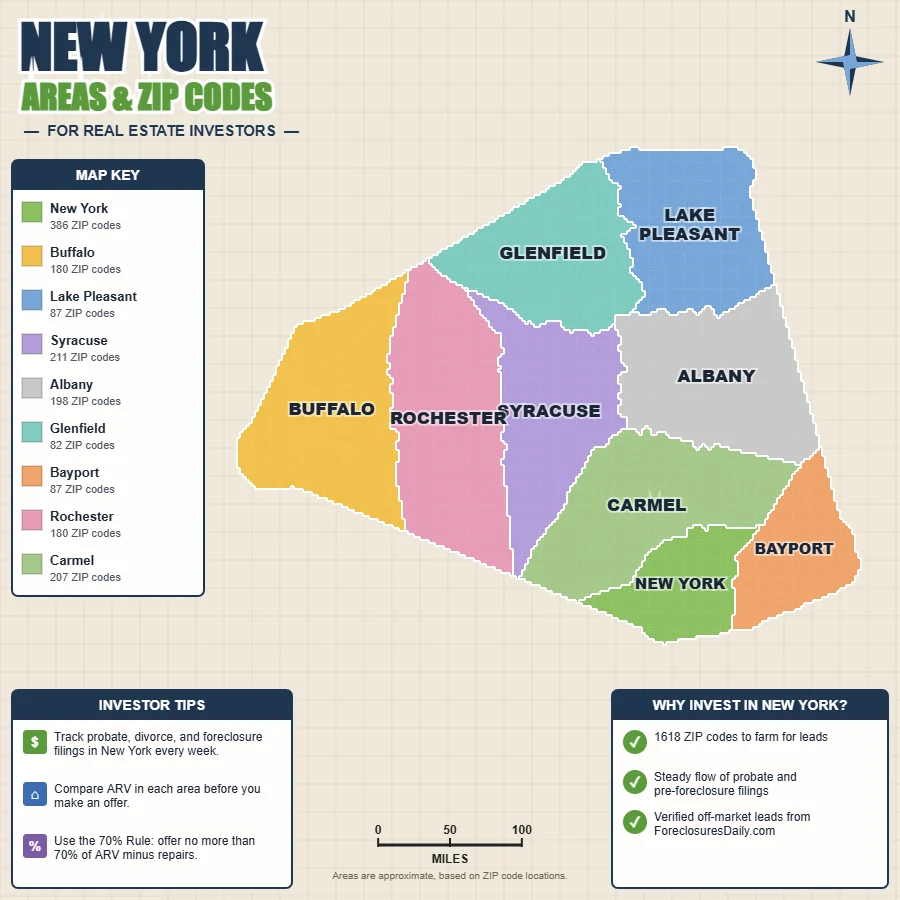
Market data: Realtor.com New York housing market, October 2026. Zillow Home Value Index for New York: $526,714 (up 5.6% from a year earlier), August 2026. View homes on Zillow.

Listed and sold 25 properties and personally bought and sold four fix-and-flip properties, all generated from probate leads.
Carolynn Castillo
Realtor & Broker · eXp Realty
What is a distressed property?
A distressed property is a home whose owner is under pressure to sell. Usually, the cause is a life event, such as a missed mortgage payment, a death in the family, a divorce, unpaid property taxes, or repairs the owner cannot afford.
In New York, these owners matter more than ever. With a median listing price near $615,000, retail deals leave little room for profit. The discount comes from motivated sellers whose property is not publicly advertised for sale, is for sale privately, and is not listed on the Multiple Listing Service (MLS). As a result, there is less competition and room to negotiate wholesale pricing.
In addition, by inventory, its busiest markets right now are Queens County, New York County, and Suffolk County, where more listings mean more owners under pressure.


Shannon Thompson
Investor · Joe Homebuyer of Atlanta
Watch Shannon Thompson share their experience using ForeclosuresDaily.com.
How to find distressed properties in New York
Foreclosure listing sites show homes after the bank or auction is involved. Therefore, to find a deal first, work earlier in the timeline:
Pick your counties
Initially, start with a few New York counties where you know values and have cash buyers ready.
Choose lead types
Next, pick your leads, because probate, pre-foreclosure, divorce, code violation, and tax delinquency leads each signal a different reason to sell.
Use fresh data
Then use ForeclosuresDaily fresh leads, which are updated daily, so that you reach owners before other investors mail them.
Target your marketing
In addition, data targeting your marketing means mail, calls, and texts go only to owners with a real reason to sell.
Run the numbers
After that, estimate the after-repair value (ARV) from nearby sales, and then apply the 70% Rule.
Make a fair offer
Finally, solve the seller’s problem with a quick, as-is cash close, then wholesale or flip the property.

Andrew Litchfield
Webinar host
Andrew Litchfield hosted a ForeclosuresDaily.com monthly webinar for real estate investors.
Motivated sellers who want to liquidate fast
For this reason, ForeclosuresDaily.com’s off-market real estate platform covers every major distress signal in New York, cross-referenced with tax rolls and property appraiser records.

Anthony Coletti
Real estate investor
Watch Anthony Coletti share their experience using ForeclosuresDaily.com.
ARV and the 70% Rule for New York flips
Real estate flippers and wholesalers use the after-repair value (ARV) to set their maximum offer. For example, the 70% Rule says to pay no more than 70% of ARV, minus repairs. As a result, that margin covers holding costs, closing costs, and profit for property flipping, or your assignment fee when you wholesale.
For instance, here is the math using the New York median listing price as the ARV and an 8% repair budget.
70% Rule example

Jeremy Resmer
Webinar host
Jeremy Resmer hosted a ForeclosuresDaily.com monthly webinar for real estate investors.
New York counties to target
These are the 10 New York counties with the most homes for sale. Next, choose a county from the menu to open its investing data, and then match the market to your strategy.
Queens CountyAbove state median$650,000Wholesale
Queens County market snapshot
In addition, the Zillow Home Value Index is $744,565 (up 4.7% from a year earlier) as of August 2026.
Largest inventory on the list, so there are more owners to reach. Meanwhile, the median price is up 0.1% from a year earlier. As a result, prices sit near the area median, so focus on deep discounts from off-market sellers.
Also see the full Queens County market report on Realtor.com →Then view Queens County homes on Zillow →
Choose a county from the menu to see its investing data, then compare markets. Market data: Realtor.com, October 2026, and Zillow Home Value Index, August 2026. Also, gross rent yield is 12 months of median rent divided by the median listing price; the 70% Rule example assumes repairs of 8% of the median price.

Antonio Stringfield
Probate investor · Los Angeles
Watch Antonio Stringfield share their experience using ForeclosuresDaily.com.
ForeclosuresDaily off-market opportunities before your competition
In fact, since 2004, ForeclosuresDaily.com has helped investors, wholesalers, flippers, and agents reach motivated sellers first.

Nancy Wallace-Laab
Investor · nearly 20 years
Nancy focuses on the best outcome for both the seller and the investor, drawing on nearly 20 years of real estate investing experience.

Phillip Warrick
Full-time investor since 2003
Full-time real estate investor since 2003, with over 20 years of experience.
New York foreclosure and distressed property questions
How do I find distressed properties for sale in New York?
Initially, start with public-record signals such as pre-foreclosure, probate, divorce, and tax delinquency. ForeclosuresDaily.com gathers these records daily, so that you can contact New York owners before the home is listed or sent to auction.
Where can I find foreclosed homes in New York?
Bank-owned and auction homes appear on sites like Realtor.com, Zillow, and Auction.com. However, off-market pre-foreclosure leads let you reach owners earlier, while they can still sell on their own terms.
Which counties have the lowest entry prices?
Among the counties in this guide, the lowest median listing prices are in Erie County at $279,900, Monroe County at $289,900, and Onondaga County at $339,000, based on Realtor.com data from October 2026.
Where do homes sell fastest?
Monroe County has the shortest average time on market in this guide, at 29 days. As a result, fast markets reward investors who can reach owners before a home is listed.
How do I find distressed properties for wholesale profit?
First of all, focus on owners with equity and a reason to sell quickly. Then run the 70% Rule, and finally line up cash buyers before you sign a contract you plan to assign.
Get New York distressed property leads today
Fresh, targeted, off-market data for Queens County, New York County, Suffolk County, and beyond.